

Daily Indian Polity quiz – 17 November 2026
Tap an option – the right answer and a short explanation appear at once. Your score is at the bottom. (TNPSC / UPSC Prelims)
The 86th Amendment (2002) inserted Article 21A, substituted Article 45 (early childhood care up to six years) and added Fundamental Duty 51A(k) for parents. Article 21A was given effect by the Right of Children to Free and Compulsory Education Act, 2009, in force from 1 April 2010.
All three are correct. The NHRC was set up on 12 October 1993 – a statutory, not constitutional, body. After the 2019 amendment the Chairperson can be a former Chief Justice of India or a former Supreme Court Judge. The selection committee is headed by the Prime Minister and includes the Lok Sabha Speaker, the Union Home Minister, the Leaders of the Opposition in both Houses and the Deputy Chairman of the Rajya Sabha.
Kesavananda Bharati – Parliament can amend any part of the Constitution but not its basic structure; Maneka Gandhi – 'procedure established by law' under Article 21 must be fair, just and reasonable; Indra Sawhney – upheld 27% OBC reservation, the 50% ceiling and the exclusion of the creamy layer; S.R. Bommai – President's Rule under Article 356 is open to judicial review and the floor of the House is the test of majority; secularism is part of the basic structure.
Both are true and R explains A. Because Article 32 (itself a Fundamental Right) lets a person go straight to the Supreme Court, which can issue writs, the Fundamental Rights in Part III are enforceable – unlike the Directive Principles (Article 37). Dr B.R. Ambedkar called Article 32 the 'heart and soul' of the Constitution. High Courts have a similar, wider power under Article 226.
Article 157: a person must be a citizen of India and have completed 35 years of age to be appointed Governor. The same minimum age (35) applies to the President (Article 58) and the Vice-President (Article 66); for a member of the Rajya Sabha it is 30 and of the Lok Sabha 25.
Article 163 – Council of Ministers to aid and advise the Governor, except where he is required to act in his discretion. Article 154 – executive power of the State vested in the Governor; 164 – appointment of the Chief Minister and other ministers; 167 – duties of the Chief Minister to inform the Governor.
1 and 2 are correct. The Estimates Committee has 30 members, all from the Lok Sabha. The Public Accounts Committee (22 members) examines the CAG's audit reports; a Minister cannot be its member – so 3 is wrong. By convention since 1967 its Chairman is from the Opposition. The Committee on Public Undertakings also has 22 members (15 + 7).
Article 360 – Financial Emergency when the financial stability or credit of India or any part is threatened; it must be approved by both Houses within two months, and the salaries of judges and other officials may be reduced. It has never been proclaimed. Article 352 – National Emergency; 356 – President's Rule; 365 – effect of failure to comply with Union directions.
Under the proviso to Article 368(2), amendments affecting the election of the President (Articles 54, 55), the extent of the executive power of the Union and the States (73, 162), the Supreme Court and the High Courts, the distribution of legislative powers (Part XI, Chapter I and the Lists of the Seventh Schedule), the GST Council (279A), the representation of States in Parliament and Article 368 itself must also be ratified by the Legislatures of at least half of the States. Fundamental Rights and Directive Principles are amended by a special majority of Parliament alone (subject to the basic structure). A new State is formed by an ordinary law under Articles 3 and 4, which is not an amendment under Article 368.
Article 18 – the State shall confer no title other than a military or academic distinction, and no citizen shall accept a title from a foreign State. In Balaji Raghavan (1995) the Supreme Court held that the Bharat Ratna and Padma awards are not 'titles' under Article 18, but should not be used as prefixes or suffixes to names. Article 17 – abolition of untouchability.
Frequently asked questions
What is the daily subject quiz?
Ten questions every day from one subject – Monday History, Tuesday Polity, Wednesday Geography, Thursday Economy, Friday Science & Technology, Saturday Environment, Sunday Tamil Nadu – with instant answers and explanations.
Do I need to sign up?
No. Tap an option to see the answer; your score is shown at the end. A free PDF of the day's questions with answers is also available.
Which exams is it for?
TNPSC Group 1, 2, 2A and 4 Prelims and UPSC Prelims; useful for SSC and bank general awareness too.
Link to this page from your website / blog (HTML code)
Free daily practice
- UPSC Mains answer practice
- Weekly Top 20 current affairs
- Daily subject quiz
- Knowledge nugget
- TNPSC Mains Practice
- All free PDFs
Classroom & online coaching – TNPSC, UPSC – Coimbatore, Madurai.
Courses & fees 99941 46662நடப்பு நிகழ்வுகள் 25 நவம்பர் 2026 | Today Current Affairs in Tamil | TNPSC Group 4 வினா விடை
📚 TNPSC குரூப் 4 / 2 / 2A – பொதுத்தமிழ், பொது அறிவு நூல்கள்
PDF நூல்கள் · ₹149 முதல் · ஒவ்வொன்றுக்கும் 50 பக்க இலவச மாதிரி · UPI-இல் பணம் செலுத்தியதும் உடனே பதிவிறக்கம்
 பொதுத் தமிழ் — முழுமையான கையேடு (TNPSC குரூப் 2 · 2A · 4)
₹199
 TNPSC முழுமையான பாடநூல்கள் – முழுத் தொகுப்பு (9 நூல்கள்)
₹1599
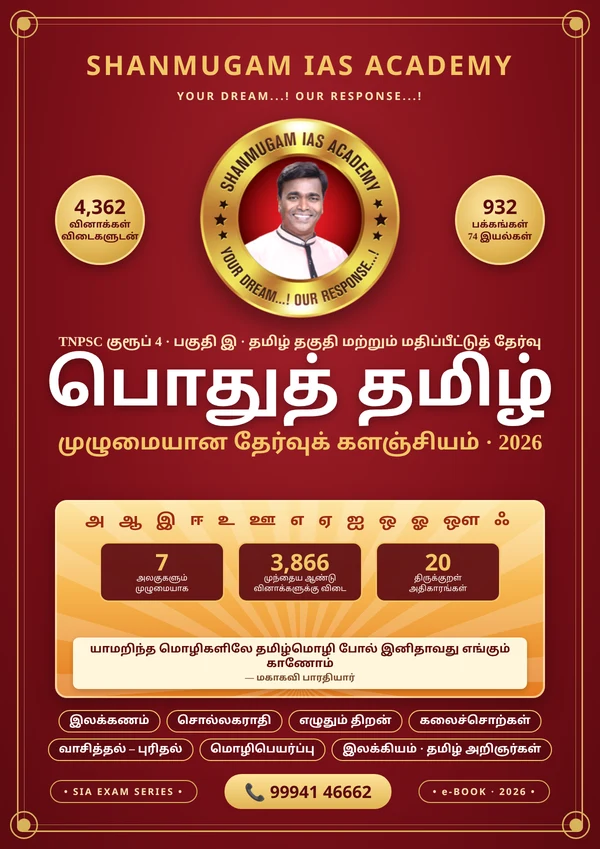 TNPSC குரூப் 4 பொதுத் தமிழ் – முழுமையான தேர்வுக் களஞ்சியம் 2026
₹249
 பொதுத் தமிழ் — முந்தைய ஆண்டு வினா – விடை – விளக்கம் (புதிய பாடத்திட்டம்)
₹199
TNPSC குரூப் 1, 2/2A, 4 – நேரடி வகுப்புகள் · கோவை & மதுரை
2006 முதல் சண்முகம் IAS அகாடமி · Classroom & online coaching in Coimbatore and Madurai
