

Daily Economy quiz – 19 November 2026
Tap an option – the right answer and a short explanation appear at once. Your score is at the bottom. (TNPSC / UPSC Prelims)
A.W. Phillips (1958) found an inverse relation between unemployment and the rate of change of money wages in Britain; it was later restated as a trade-off between inflation and unemployment.
Statements 1 and 3 are correct. Statement 2 is wrong: T-bills are zero-coupon, short-term money-market instruments – they are issued at a discount and redeemed at face value; the difference is the investor's return. State governments do not issue T-bills.
WPI – Office of the Economic Adviser, Department for Promotion of Industry and Internal Trade (Ministry of Commerce and Industry); CPI-IW – Labour Bureau (Ministry of Labour and Employment); PLFS – National Statistics Office, Ministry of Statistics and Programme Implementation; Financial Stability Report – RBI, twice a year.
Both are true and R explains A. On inter-State supplies, IGST is levied and the State share is settled in favour of the consuming State. This is why manufacturing States such as Tamil Nadu sought compensation for possible revenue loss in the early years (GST compensation, 2017–22).
The SHG approach was started in a small way in Dharmapuri district in 1989 with IFAD assistance, and was later scaled up across the State as Mahalir Thittam, implemented by the Tamil Nadu Corporation for Development of Women.
Statements 2 and 3 are correct. Statement 1 is wrong: the CACP is an attached office of the Ministry of Agriculture and Farmers Welfare, set up in 1965 as the Agricultural Prices Commission (renamed in 1985); it is not statutory. The FRP for sugarcane is fixed under the Sugarcane (Control) Order, 1966.
RBI Act, 1934 (the RBI began operations on 1 April 1935); Banking Regulation Act, 1949 (enacted as the Banking Companies Act, renamed in 1966); SARFAESI Act, 2002 – lets banks enforce security interest without going to court; Insolvency and Bankruptcy Code, 2016 – time-bound resolution through the NCLT.
A is true; R is false. Under Section 24 of the Banking Regulation Act, banks keep SLR assets with themselves – cash, gold and unencumbered approved securities such as government bonds. Balances kept with the RBI are the Cash Reserve Ratio (CRR).
The Laffer curve, associated with the economist Arthur Laffer, shows revenue rising with the tax rate up to an optimum and then falling, as very high rates discourage work and encourage evasion. The Lorenz curve shows income distribution; the Engel curve links income and spending on a good.
Statements 1 and 2 are correct. The Gini coefficient is the area between the line of perfect equality and the Lorenz curve, divided by the total area under that line; it ranges from 0 (perfect equality) to 1 (perfect inequality). Statement 3 is wrong – a higher Gini means greater inequality.
Frequently asked questions
What is the daily subject quiz?
Ten questions every day from one subject – Monday History, Tuesday Polity, Wednesday Geography, Thursday Economy, Friday Science & Technology, Saturday Environment, Sunday Tamil Nadu – with instant answers and explanations.
Do I need to sign up?
No. Tap an option to see the answer; your score is shown at the end. A free PDF of the day's questions with answers is also available.
Which exams is it for?
TNPSC Group 1, 2, 2A and 4 Prelims and UPSC Prelims; useful for SSC and bank general awareness too.
Link to this page from your website / blog (HTML code)
Free daily practice
- UPSC Mains answer practice
- Weekly Top 20 current affairs
- Daily subject quiz
- Knowledge nugget
- TNPSC Mains Practice
- All free PDFs
Classroom & online coaching – TNPSC, UPSC – Coimbatore, Madurai.
Courses & fees 99941 46662நடப்பு நிகழ்வுகள் 26 நவம்பர் 2026 | Today Current Affairs in Tamil | TNPSC Group 4 வினா விடை
📚 TNPSC குரூப் 4 / 2 / 2A – பொதுத்தமிழ், பொது அறிவு நூல்கள்
PDF நூல்கள் · ₹149 முதல் · ஒவ்வொன்றுக்கும் 50 பக்க இலவச மாதிரி · UPI-இல் பணம் செலுத்தியதும் உடனே பதிவிறக்கம்
 பொதுத் தமிழ் — முழுமையான கையேடு (TNPSC குரூப் 2 · 2A · 4)
₹199
 TNPSC முழுமையான பாடநூல்கள் – முழுத் தொகுப்பு (9 நூல்கள்)
₹1599
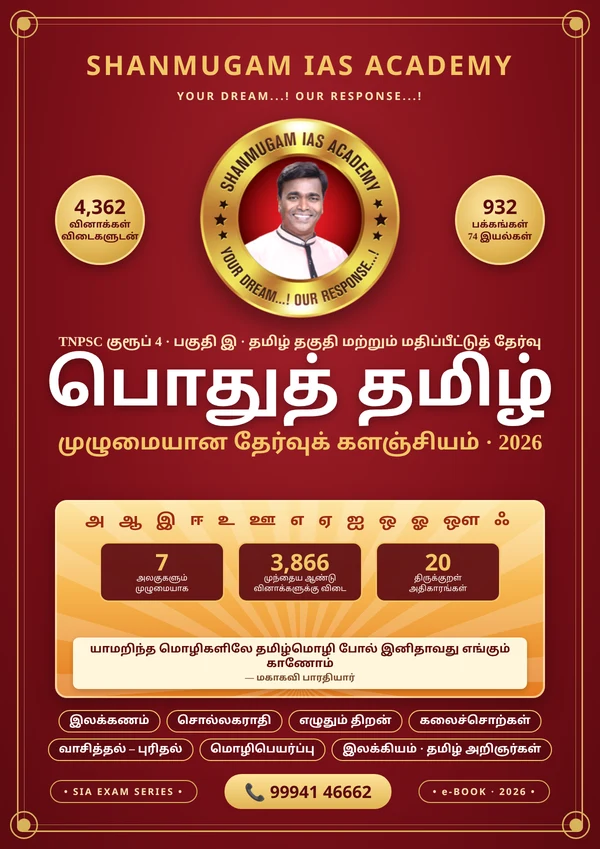 TNPSC குரூப் 4 பொதுத் தமிழ் – முழுமையான தேர்வுக் களஞ்சியம் 2026
₹249
 பொதுத் தமிழ் — முந்தைய ஆண்டு வினா – விடை – விளக்கம் (புதிய பாடத்திட்டம்)
₹199
TNPSC குரூப் 1, 2/2A, 4 – நேரடி வகுப்புகள் · கோவை & மதுரை
2006 முதல் சண்முகம் IAS அகாடமி · Classroom & online coaching in Coimbatore and Madurai
