

Daily Indian Polity quiz – 25 November 2026
Tap an option – the right answer and a short explanation appear at once. Your score is at the bottom. (TNPSC / UPSC Prelims)
Only three Bills have been passed at joint sittings – Dowry Prohibition (1961), Banking Service Commission (Repeal) (1978) and Prevention of Terrorism (2002). A Constitution Amendment Bill must be passed by each House separately by special majority (Article 368); there is no joint sitting for it. The GST Bill was introduced as the 122nd Amendment Bill, 2014 and enacted as the 101st Amendment Act, 2016.
Statement 3 is wrong: impeachment under Article 61 applies to the President. The Vice-President is removed under Article 67(b) – a Rajya Sabha resolution passed by an effective majority, agreed to by the Lok Sabha by a simple majority, after 14 days' notice.
Fifth – Scheduled Areas and Scheduled Tribes (other than the four north-eastern States); Sixth – tribal areas of Assam, Meghalaya, Tripura and Mizoram (autonomous district councils); Eighth – 22 languages; Twelfth – 18 subjects of Municipalities (74th Amendment).
Certiorari is corrective – it quashes an order already passed. Prohibition is preventive – it stops a lower court from proceeding while the case is still pending. Mandamus commands a public authority to do its duty; quo warranto asks by what authority a public office is held.
Statement 3 is wrong: the President can dissolve only the Lok Sabha; the Rajya Sabha is a permanent House, one-third of whose members retire every second year. Quorum – Article 100(3); the six-month rule – Article 85(1).
Statement 1 is wrong: a Panchayat reconstituted after premature dissolution continues only for the remainder of the five-year term. If the remainder is less than six months, an election need not be held for that period.
Statement 3 is wrong: Article 301 is in Part XIII (Articles 301–307), not in Part III – it is a constitutional right, not a Fundamental Right. Part XIII aims at a single economic union across India.
All three are correct – Article 22(4)(a) and 22(6). The detenu must be told the grounds of detention as soon as may be and given the earliest opportunity to make a representation (Article 22(5)). The ordinary safeguards of Article 22(1) and (2) do not apply to preventive detention (Article 22(3)).
Article 168: the Legislature of every State consists of the Governor and one or two Houses. Since the Legislative Council was abolished in 1986, Tamil Nadu has a unicameral Legislature – the Governor and the Legislative Assembly of 234 members.
Pith and substance – the true nature of a law decides legislative competence, even if it incidentally touches another List; eclipse – a pre-Constitution law inconsistent with a Fundamental Right is overshadowed, not void (Bhikaji Narain, 1955); severability – Article 13 strikes down only the offending part; colourable legislation – a legislature cannot transgress its limits in disguise.
Frequently asked questions
What is the daily subject quiz?
Ten questions every day from one subject – Monday History, Tuesday Polity, Wednesday Geography, Thursday Economy, Friday Science & Technology, Saturday Environment, Sunday Tamil Nadu – with instant answers and explanations.
Do I need to sign up?
No. Tap an option to see the answer; your score is shown at the end. A free PDF of the day's questions with answers is also available.
Which exams is it for?
TNPSC Group 1, 2, 2A and 4 Prelims and UPSC Prelims; useful for SSC and bank general awareness too.
Link to this page from your website / blog (HTML code)
Free daily practice
- UPSC Mains answer practice
- Weekly Top 20 current affairs
- Daily subject quiz
- Knowledge nugget
- TNPSC Mains Practice
- All free PDFs
Classroom & online coaching – TNPSC, UPSC – Coimbatore, Madurai.
Courses & fees 99941 46662நடப்பு நிகழ்வுகள் 26 நவம்பர் 2026 | Today Current Affairs in Tamil | TNPSC Group 4 வினா விடை
📚 TNPSC குரூப் 4 / 2 / 2A – பொதுத்தமிழ், பொது அறிவு நூல்கள்
PDF நூல்கள் · ₹149 முதல் · ஒவ்வொன்றுக்கும் 50 பக்க இலவச மாதிரி · UPI-இல் பணம் செலுத்தியதும் உடனே பதிவிறக்கம்
 பொதுத் தமிழ் — முழுமையான கையேடு (TNPSC குரூப் 2 · 2A · 4)
₹199
 TNPSC முழுமையான பாடநூல்கள் – முழுத் தொகுப்பு (9 நூல்கள்)
₹1599
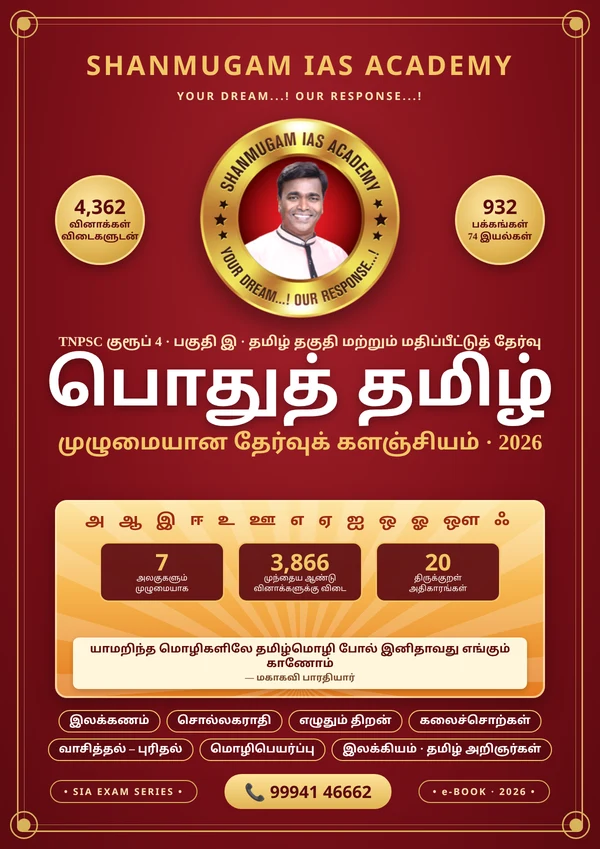 TNPSC குரூப் 4 பொதுத் தமிழ் – முழுமையான தேர்வுக் களஞ்சியம் 2026
₹249
 பொதுத் தமிழ் — முந்தைய ஆண்டு வினா – விடை – விளக்கம் (புதிய பாடத்திட்டம்)
₹199
TNPSC குரூப் 1, 2/2A, 4 – நேரடி வகுப்புகள் · கோவை & மதுரை
2006 முதல் சண்முகம் IAS அகாடமி · Classroom & online coaching in Coimbatore and Madurai
