

IBPS Clerk English – Error Spotting – Level 2 · Exam Level · Prelims Level
IBPS Clerk English – Error Spotting – Level 2 · Exam Level · Prelims Level – 13 questions, subject: English Language. Every question has the correct answer with a two-line explanation; tap "Show Answer". Free practice for IBPS Clerk, IBPS PO, SBI, RRB exams – Shanmugam IAS Academy, Coimbatore.
Link to this page from your website / blog (HTML code)
Correct Answer: B [(B)]
Explanation:
Part (B): “are” → “is”. Rule: A distance taken as one amount takes a singular verb.
Correct Answer: C [(C)]
Explanation:
In "one of the cheques that ...", the relative pronoun "that" refers to the plural noun "cheques", so the verb must be plural: "that were returned". "One" decides only the verb "is" in the main clause.
Correct Answer: B [(B)]
Explanation:
"Object to" is followed by a noun or -ing form because "to" here is a preposition, so part B must be "to paying". Other such phrases are "look forward to", "be used to" and "be accustomed to".
Correct Answer: D [(D)]
Explanation:
In a condition clause beginning with "if" or "only if", the simple present is used for a future idea, so part D should be "are in order". "Will" belongs only in the main clause ("will be sanctioned").
Correct Answer: E [No error]
Explanation:
With "not only ... but also", the verb agrees with the nearer subject; here it is "the manager" (singular), so "was present" is correct. The same proximity rule applies to "either ... or" and "neither ... nor".
Correct Answer: A [(A)]
Explanation:
"Cattle" is a collective noun that is already plural in sense and has no "-s" form, so part A should read "The cattle". It takes a plural verb, which is why "are grazing" is correct.
Correct Answer: C [(C)]
Explanation:
"Prefer" is followed by "to", not "than", when comparing two things, so part C should be "to flood irrigation". "Than" is used with "rather" ("would rather ... than"), not with "prefer".
Correct Answer: E [No error]
Explanation:
"Either of + plural noun" refers to one of two and takes a singular verb, so "Either of the two counters is kept open" is correct. "Neither of" follows the same rule.
Correct Answer: A [(A)]
Explanation:
"Being a rainy day" is a dangling participle, because "the branch" was not a rainy day; part A must have its own subject: "It being a rainy day". This absolute construction gives the phrase a proper subject.
Correct Answer: D [(D)]
Explanation:
When a subject is followed by "together with", the verb agrees with the first subject, "The head cashier" (singular), so part D must be "was checking the vault". "Two clerks" is part of the additive phrase and does not change the verb.
Correct Answer: D [(D)]
Explanation:
A question tag uses the same auxiliary as the main verb; "works" (simple present) uses "does", so the tag must be "doesn't he". "Isn't he" would fit only a sentence with "is", such as "Your brother is a banker".
Correct Answer: E [No error]
Explanation:
"Furniture" is an uncountable noun that takes a singular verb, so "The furniture ... was bought" is correct. It has no plural form; we say "pieces of furniture", not "furnitures".
Correct Answer: B [(B)]
Explanation:
"Lie" (to rest) has forms lie - lay - lain, so ledgers that have stayed somewhere "have lain" in the store room. "Laid" is the past participle of "lay" (to put something), which needs an object.
Today Current Affairs in Tamil | 23 நவம்பர் 2026 | TNPSC Group 4 முக்கிய வினாக்கள்
📚 IBPS Clerk 2026 Books
PDF நூல்கள் · ₹149 முதல் · ஒவ்வொன்றுக்கும் 50 பக்க இலவச மாதிரி · UPI-இல் பணம் செலுத்தியதும் உடனே பதிவிறக்கம்
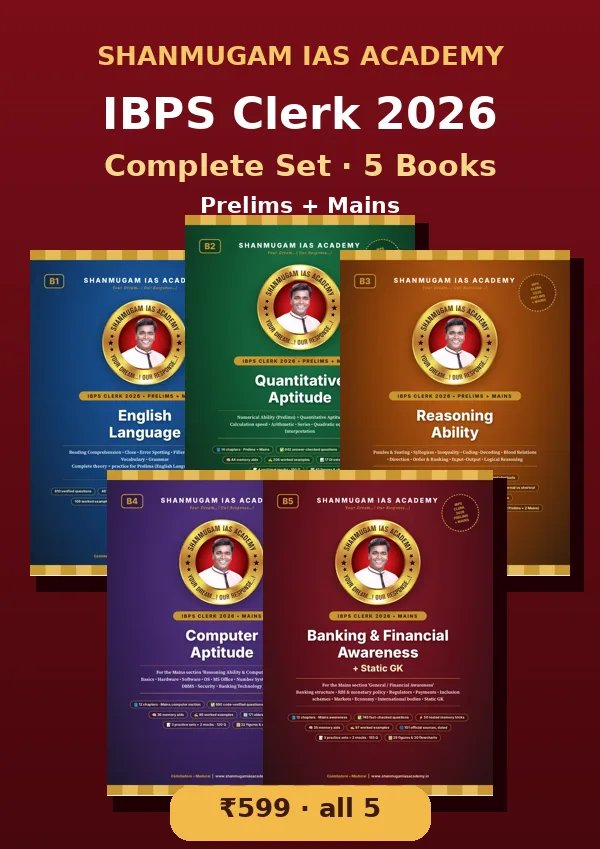 IBPS Clerk 2026 – Complete Set (5 Books, Prelims + Mains)
₹599
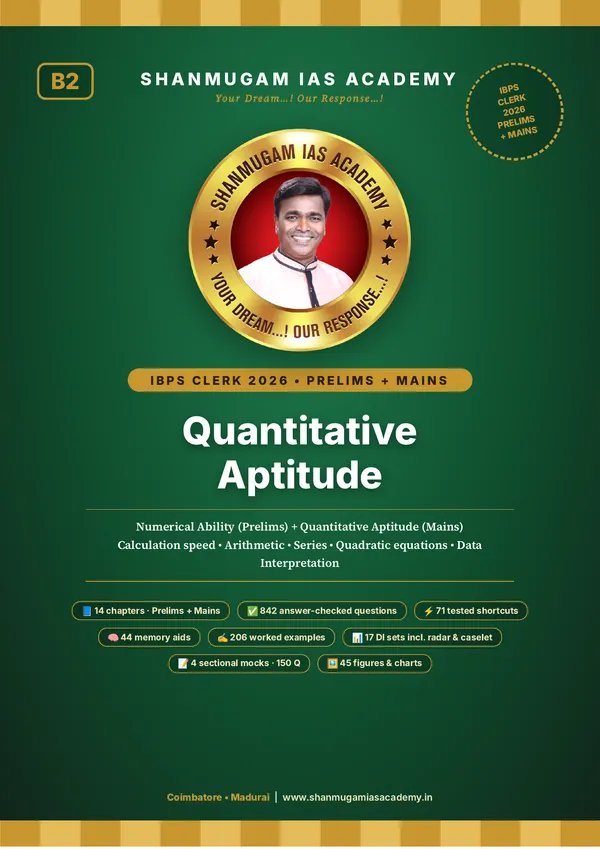 IBPS Clerk 2026 – Quantitative Aptitude (Prelims + Mains)
₹149
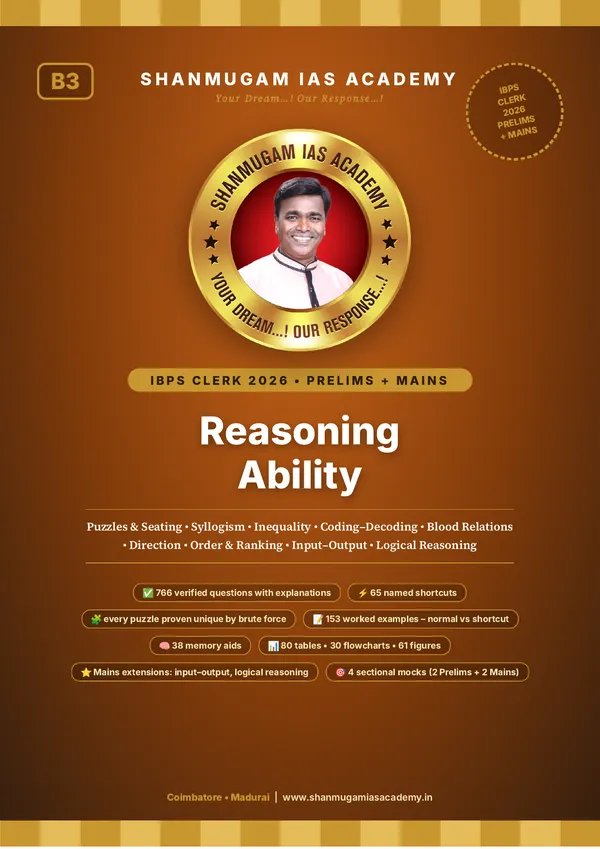 IBPS Clerk 2026 – Reasoning Ability (Prelims + Mains)
₹149
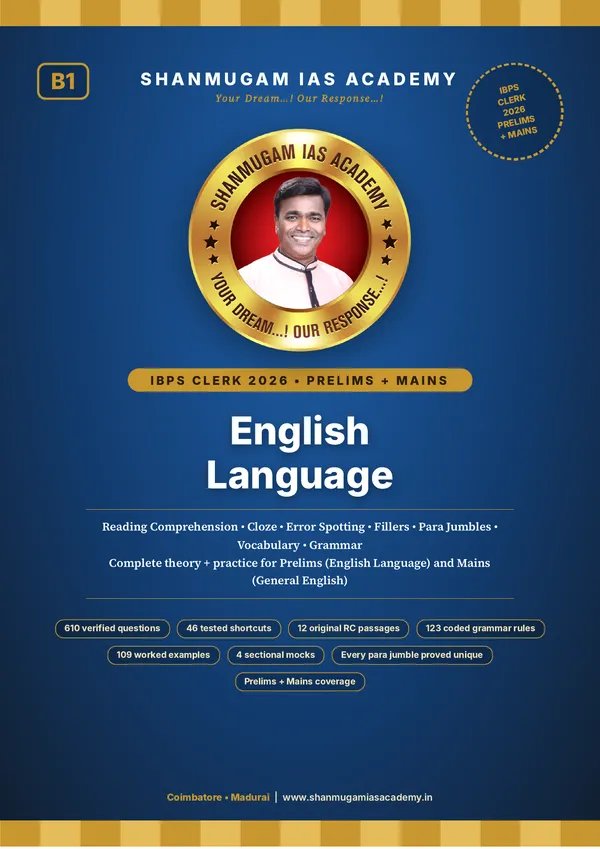 IBPS Clerk 2026 – English Language (Prelims + Mains)
₹149
TNPSC குரூப் 1, 2/2A, 4 – நேரடி வகுப்புகள் · கோவை & மதுரை
2006 முதல் சண்முகம் IAS அகாடமி · Classroom & online coaching in Coimbatore and Madurai
