

IBPS Clerk English – Grammar Quick-Reference – Level 2 · Exam Level · Prelims
IBPS Clerk English – Grammar Quick-Reference – Level 2 · Exam Level · Prelims – 15 questions, subject: English Language. Every question has the correct answer with a two-line explanation; tap "Show Answer". Free practice for IBPS Clerk, IBPS PO, SBI, RRB exams – Shanmugam IAS Academy, Coimbatore.
Link to this page from your website / blog (HTML code)
Correct Answer: C [(C)]
Explanation:
Part (C): were → was. Rule: SV2 – with as well as, along with, together with, with, besides, in addition to , the verb agrees with the FIRST subject.
Correct Answer: B [(B)]
Explanation:
Names of games and sports do not take the article 'the', so part (B) should be just 'cricket': 'He plays cricket every Sunday'. Musical instruments, by contrast, do take 'the' (plays the violin).
Correct Answer: B [(B)]
Explanation:
The verb 'comply' takes the preposition 'with', so part (B) should be 'comply with the new guidelines'. The noun form is used the same way: 'in compliance with'.
Correct Answer: A [(A)]
Explanation:
Part (A): have met → met. Rule: TR2 – the present perfect is not used with a definite past time (yesterday, last year, ago, in 2020).
Correct Answer: C [(C)]
Explanation:
After the preposition 'to', the pronoun must be in the objective case, so part (C) should be 'Ravi and me'. A quick check is to drop 'Ravi': 'handed the keys to me', not 'to I'.
Correct Answer: B [(B)]
Explanation:
'Worse' is already the comparative of 'bad', so adding 'more' creates a double comparative. The correct sentence is 'The traffic today is worse than it was on Monday.'
Correct Answer: B [(B)]
Explanation:
Part (B): remove ‘but’. Rule: CJ2 – though/although + yet or a comma, never but .
Correct Answer: E [No error]
Explanation:
'Each of' takes a singular verb, so 'has been asked' is correct, and 'to submit a report by Friday' is also correct; the sentence has no error. The plural noun 'officers' after 'of' does not change the singular subject 'each'.
Correct Answer: B [(B)]
Explanation:
'Happen' is an intransitive verb and cannot be used in the passive, so part (B) should be 'happened', not 'was happened'. Other such verbs are occur, arrive, die and take place.
Correct Answer: C [(C)]
Explanation:
Part (C): moved → moves. Rule: NA4 – universal truths and habitual facts keep the present tense.
Correct Answer: B [(B)]
Explanation:
'Had better' is followed by the base form of the verb without 'to', so part (B) should be 'consult'. The correct sentence is 'You had better consult a lawyer before signing the agreement'.
Correct Answer: C [(C)]
Explanation:
This is a third conditional about the past ('If he had applied earlier'), so the main clause needs 'would have got'. Part (C) 'would get' is wrong, especially with 'last year' showing past time.
Correct Answer: B [does he]
Explanation:
'Hardly ever' is a negative adverb, so the sentence is negative in meaning and takes a positive tag: 'He hardly ever comes late, does he?'. Words like hardly, scarcely, seldom and never all take positive tags.
Correct Answer: C [(C)]
Explanation:
Part (C): when → than. Rule: CJ3 – no sooner … than ; hardly/scarcely … when .
Correct Answer: B [(B)]
Explanation:
Part (B): have → has. Rule: SV10 – many a + singular noun + singular verb.
Today Current Affairs in Tamil | 23 நவம்பர் 2026 | TNPSC Group 4 முக்கிய வினாக்கள்
📚 IBPS Clerk 2026 Books
PDF நூல்கள் · ₹149 முதல் · ஒவ்வொன்றுக்கும் 50 பக்க இலவச மாதிரி · UPI-இல் பணம் செலுத்தியதும் உடனே பதிவிறக்கம்
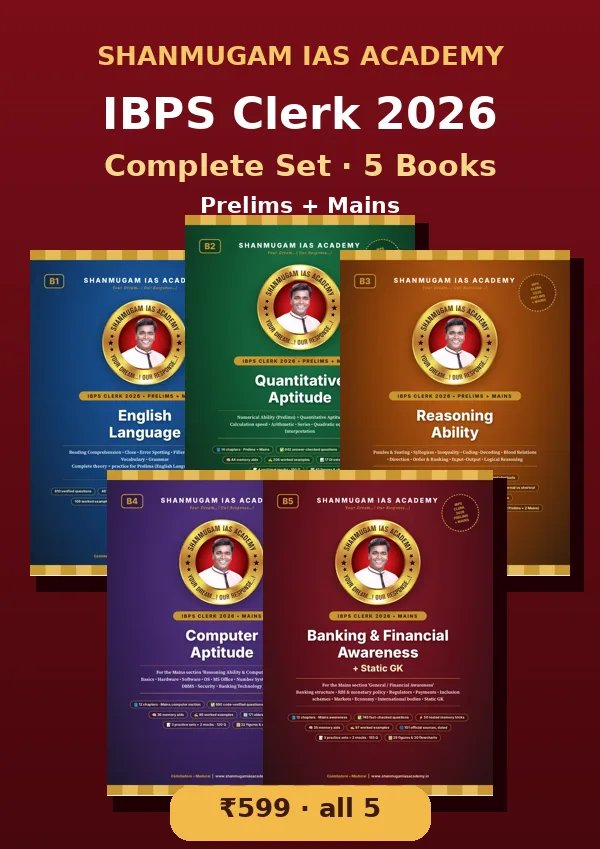 IBPS Clerk 2026 – Complete Set (5 Books, Prelims + Mains)
₹599
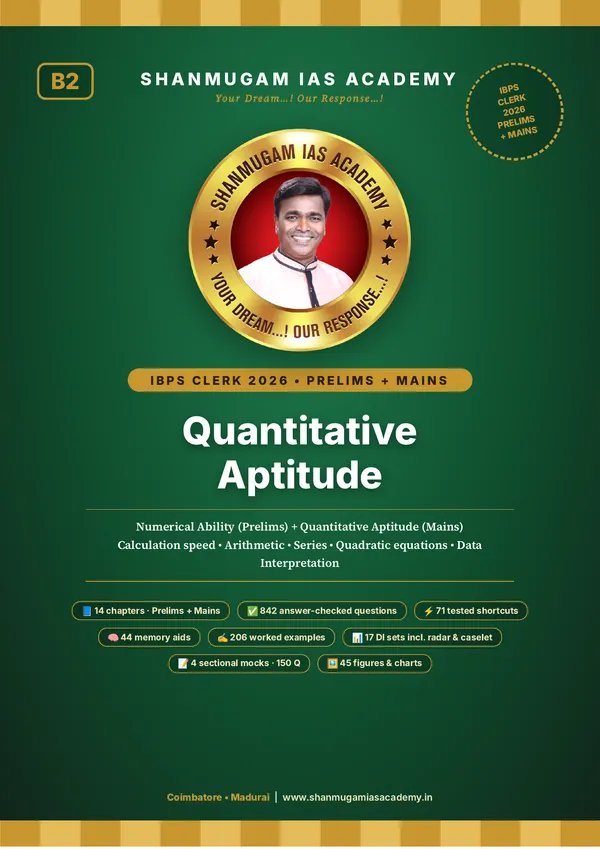 IBPS Clerk 2026 – Quantitative Aptitude (Prelims + Mains)
₹149
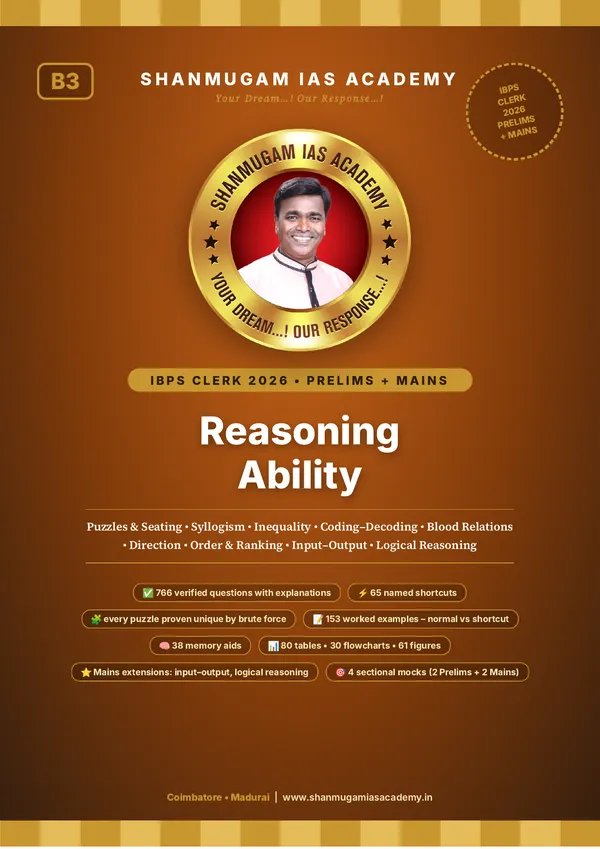 IBPS Clerk 2026 – Reasoning Ability (Prelims + Mains)
₹149
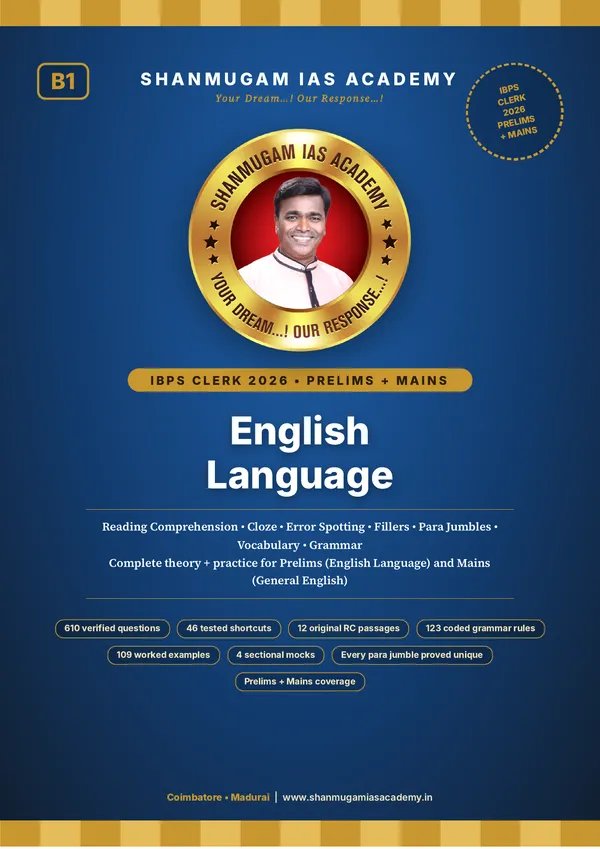 IBPS Clerk 2026 – English Language (Prelims + Mains)
₹149
TNPSC குரூப் 1, 2/2A, 4 – நேரடி வகுப்புகள் · கோவை & மதுரை
2006 முதல் சண்முகம் IAS அகாடமி · Classroom & online coaching in Coimbatore and Madurai
