

IBPS Clerk English – Para Jumbles and Sentence Rearrangement – Mains Practice
IBPS Clerk English – Para Jumbles and Sentence Rearrangement – Mains Practice – 13 questions, subject: English Language. Every question has the correct answer with a two-line explanation; tap "Show Answer". Free practice for IBPS Clerk, IBPS PO, SBI, RRB exams – Shanmugam IAS Academy, Coimbatore.
Link to this page from your website / blog (HTML code)
Directions (Q 34–38): Rearrange the following six sentences (A)–(F) to form a meaningful paragraph and answer the questions.
(A) Once people start using the account, the bank also gets a record of their transactions.
(B) Many new accounts, however, lie idle because their owners see no reason to visit the bank.
(C) The real test is whether the account is used – for saving, receiving payments and borrowing.
(D) This record can later support a small loan without collateral, completing the journey from account to credit.
(E) Opening a bank account for every household was only the first step towards financial inclusion.
(F) Small, regular benefits paid directly into the account give them such a reason.
Correct Answer: D [(E)]
Explanation:
(E). Sequence ECBFAD. ‘The real test’ follows the first step; ‘however’ turns to idle accounts; ‘such a reason’ = the benefits; using the account creates ‘a record’; ‘This record’ supports a loan and closes.
(Financial inclusion) Which sentence comes THIRD after rearrangement?
Correct Answer: B [(B)]
Explanation:
(B). Sequence ECBFAD. ‘The real test’ follows the first step; ‘however’ turns to idle accounts; ‘such a reason’ = the benefits; using the account creates ‘a record’; ‘This record’ supports a loan and closes.
(Financial inclusion) Which sentence comes FOURTH after rearrangement?
Correct Answer: E [(F)]
Explanation:
(F). Sequence ECBFAD. ‘The real test’ follows the first step; ‘however’ turns to idle accounts; ‘such a reason’ = the benefits; using the account creates ‘a record’; ‘This record’ supports a loan and closes.
(Financial inclusion) Which sentence comes SIXTH (LAST) after rearrangement?
Correct Answer: D [(D)]
Explanation:
(D). Sequence ECBFAD. ‘The real test’ follows the first step; ‘however’ turns to idle accounts; ‘such a reason’ = the benefits; using the account creates ‘a record’; ‘This record’ supports a loan and closes.
(A) Cities therefore plan routes and charging depots carefully before buying them.
(B) Many commuters prefer the metro because it avoids traffic jams.
(C) Their batteries, however, are expensive and take hours to charge.
(D) Several cities are replacing diesel buses with electric ones.
(E) Electric buses produce no exhaust smoke on the road, which improves the air in crowded streets.
(F) They are also quieter, a benefit that passengers and shopkeepers notice at once.
Correct Answer: B [(B)]
Explanation:
Sentences D, E, F, C and A all discuss electric buses replacing diesel buses, their benefits, battery problems and planning. Sentence (B) about commuters preferring the metro is off the topic, so it does not belong.
Correct Answer: D [Though the branch is understaffed, it has cleared every pending application this month.]
Explanation:
'Though' introduces a contrast clause and must not be followed by 'but' in the main clause, so 'Though the branch is understaffed, it has cleared...' is correct. Option (c) drops the verb 'is', and (a) wrongly adds 'but' after 'though'.
Correct Answer: D [Despite the flooded road, the bus reached the village on time.]
Explanation:
'Despite' is a preposition and must be followed by a noun or gerund, not a clause, so 'Despite the flooded road' is correct. 'Despite of' is wrong, and 'despite' should not be paired with 'but'.
Correct Answer: A [Not only does the new app show the account balance, but it also blocks a lost card at once.]
Explanation:
When a sentence begins with 'Not only', the auxiliary comes before the subject and the main verb is in base form: 'Not only does the new app show ...', followed by 'but it also'. Option (e) mixes the past 'did' with the present 'blocks'.
Correct Answer: E [Unless you update your address with the bank, its letters will not reach you.]
Explanation:
'Unless' already means 'if not', so 'Unless you update your address with the bank, its letters will not reach you' keeps the original meaning. Adding 'do not' after 'unless' or using 'will' in the unless-clause is wrong.
Correct Answer: C [Consequently]
Explanation:
The second sentence is a result of the first (falling farm incomes led to fewer tractor sales), so 'Consequently' is the correct connector. 'Nevertheless' and 'On the contrary' show contrast, which does not fit here.
Column I: (A) The officer, having checked every document carefully, (B) Unless the form is signed by both joint holders, (C) No sooner had the branch opened its doors
Column II: (D) than a long queue formed at the cash counter. (E) the bank cannot process the request. (F) approved the loan the same afternoon.
Correct Answer: B [A–F, B–E, C–D]
Explanation:
A–F (the officer, having checked documents, approved the loan), B–E (unless signed by both holders, the bank cannot process it) and C–D (No sooner ... than) make correct sentences. 'No sooner' must always pair with 'than', which fixes C–D.
Column I: (A) If a cheque is not presented within its validity period, (B) The customer, who had forgotten his PIN, (C) So heavy was the rush on the last day
Column II: (D) the bank will return it unpaid. (E) that the branch kept its counters open till seven. (F) asked the clerk how to reset it.
Correct Answer: A [A–D, B–F, C–E]
Explanation:
A–D (an unpresented cheque is returned unpaid), B–F (the customer who forgot his PIN asked how to reset it) and C–E ('So heavy ... that') make correct sentences. The 'so ... that' structure confirms C–E.
Column I: (A) Hardly had the meeting begun (B) Although the scheme was launched with great hope, (C) The documents that you submitted yesterday
Column II: (D) when the power failed. (E) it reached very few villages. (F) have been sent to the head office.
Correct Answer: E [A–D, B–E, C–F]
Explanation:
'Hardly had ... when' is a fixed pair, so A joins D; the concessive 'Although ... hope,' needs a contrasting result, so B joins E ('it reached very few villages'). The plural subject 'The documents' takes 'have been sent', so C joins F, giving A–D, B–E, C–F.
Today Current Affairs in Tamil | 23 நவம்பர் 2026 | TNPSC Group 4 முக்கிய வினாக்கள்
📚 IBPS Clerk 2026 Books
PDF நூல்கள் · ₹149 முதல் · ஒவ்வொன்றுக்கும் 50 பக்க இலவச மாதிரி · UPI-இல் பணம் செலுத்தியதும் உடனே பதிவிறக்கம்
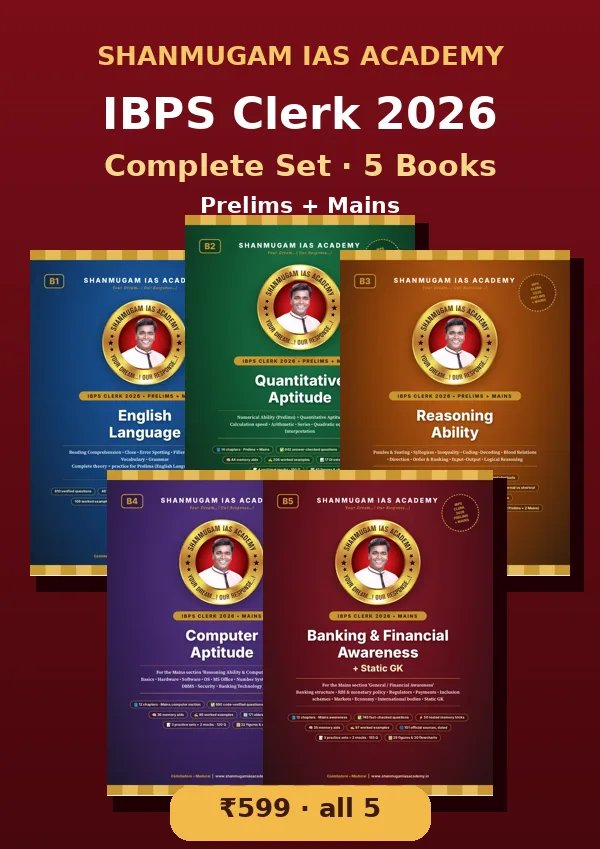 IBPS Clerk 2026 – Complete Set (5 Books, Prelims + Mains)
₹599
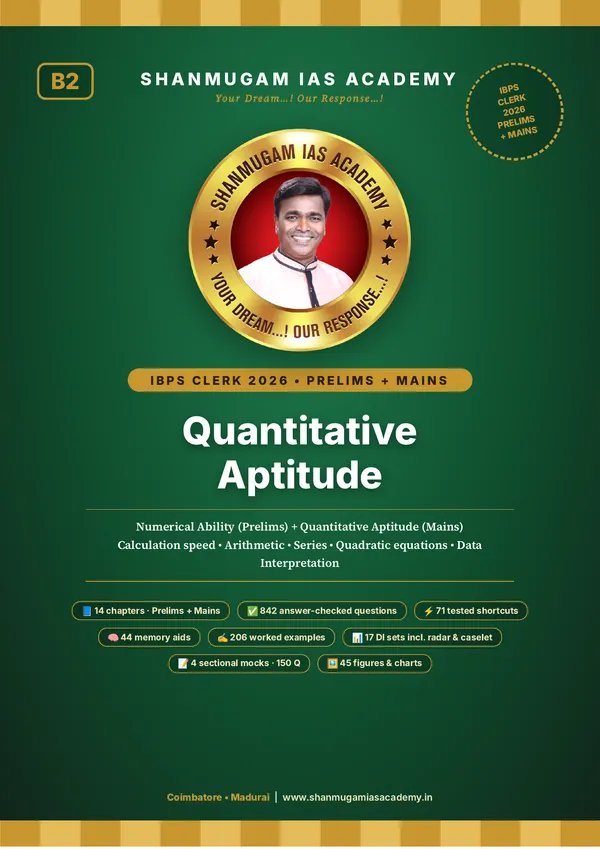 IBPS Clerk 2026 – Quantitative Aptitude (Prelims + Mains)
₹149
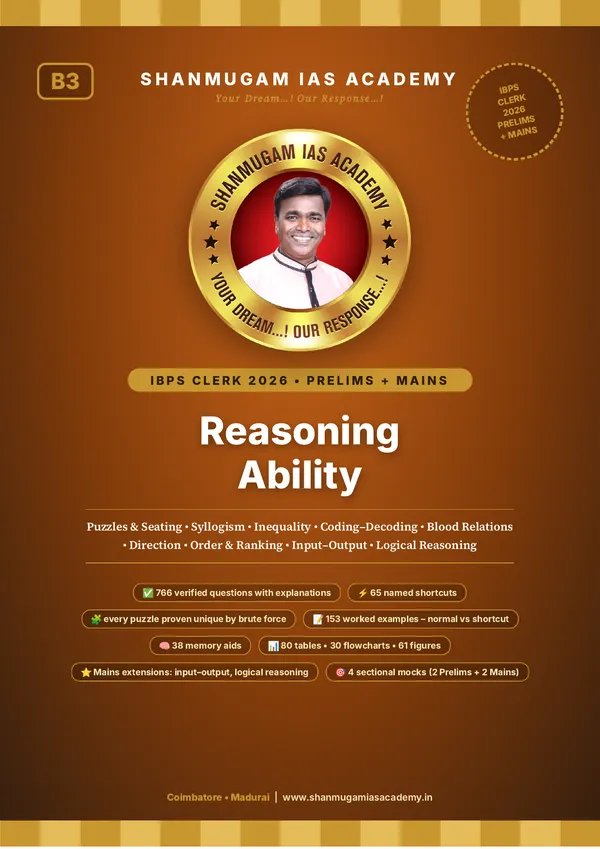 IBPS Clerk 2026 – Reasoning Ability (Prelims + Mains)
₹149
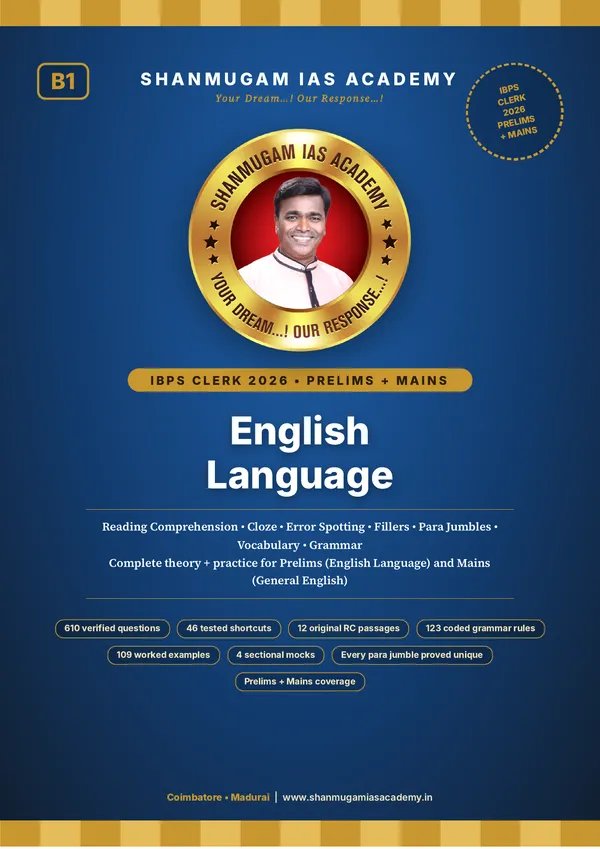 IBPS Clerk 2026 – English Language (Prelims + Mains)
₹149
TNPSC குரூப் 1, 2/2A, 4 – நேரடி வகுப்புகள் · கோவை & மதுரை
2006 முதல் சண்முகம் IAS அகாடமி · Classroom & online coaching in Coimbatore and Madurai
