

IBPS Clerk English – Reading Comprehension – Level 1 · Warm-up · Prelims Level
IBPS Clerk English – Reading Comprehension – Level 1 · Warm-up · Prelims Level – 2 questions, subject: English Language. Every question has the correct answer with a two-line explanation; tap "Show Answer". Free practice for IBPS Clerk, IBPS PO, SBI, RRB exams – Shanmugam IAS Academy, Coimbatore.
Link to this page from your website / blog (HTML code)
Directions (Q 1–6): Read Passage 2A (banking) and answer the questions.
For many families in remote villages, the nearest bank branch is still a bus ride away. A day spent travelling to the branch can mean a day's wages lost, and so small savings are often kept at home, where they are neither safe nor earning anything. To close this gap, banks in India appoint business correspondents – local agents, often shopkeepers or members of self-help groups, who carry out basic banking work on the bank's behalf.
A business correspondent usually works with a hand-held device or a laptop linked to the bank's system. Customers can open simple accounts, deposit small amounts, withdraw cash and check their balance without leaving the village. Because the agent is a familiar face, people who would hesitate to enter a large branch often feel comfortable asking questions. Many first-time savers, especially women, have opened their accounts in this way.
The model is not free of difficulties. The agent earns a commission on each transaction, and in areas where transactions are few, the income may be too small to keep the agent interested. Poor mobile networks can make the device slow or useless for hours. Agents also need to hold enough cash to meet withdrawals, which exposes them to the risk of theft.
Banks have tried several remedies. Some allow agents to offer extra services, such as bill payments, so that they earn more. Others train agents to explain products clearly and to warn customers about fraud. Where networks are weak, a device that could record a transaction and send it once the signal returns would remove a major source of delay.
The business correspondent will not replace the branch. Loans, larger investments and complaints still need the attention of trained officers. But as a first door to the formal banking system, the familiar agent at the village shop has done what grand buildings could not: made the bank feel like a neighbour.
Correct Answer: D [how business correspondents bring basic banking to villages, and the limits of the model]
Explanation:
The passage describes how business correspondents (local agents) bring basic banking to remote villages, and notes that they cannot replace branches for loans and complaints. So option d states the main idea, including the limits of the model.
Directions (Q 7–11): Read Passage 2B (science) and answer the questions.
On a clear afternoon the sky above us is blue, yet the same sky turns orange and red at sunset. Both colours come from the same sunlight, and the explanation lies in what happens when that light meets the air.
Sunlight looks white, but it is a mixture of all the colours of the rainbow. Each colour is a wave of a different length: red light has the longest waves that our eyes can see, and violet has the shortest, with blue close behind. When sunlight enters the atmosphere, it strikes the tiny molecules of gases such as nitrogen and oxygen. These molecules are far smaller than the waves themselves, and they scatter short waves much more strongly than long ones. Blue light is therefore bounced around the sky in every direction, and wherever we look, some of it reaches our eyes.
If violet waves are even shorter, why is the sky not violet? There are two main reasons. Sunlight contains less violet than blue to begin with, and our eyes are much more sensitive to blue than to violet. The result, to us, is a blue sky.
At sunrise and sunset the sun is low, and its light must cross a much thicker layer of air before it reaches us. Along this long path most of the blue is scattered away to the sides. What remains in the direct beam is mainly orange and red, which colour the clouds and the horizon. Dust and smoke in the air can make these colours even deeper.
The same idea helps to explain why the sky on the Moon, which has almost no air, looks black even in daytime: there is nothing to scatter the sunlight. A simple glass of water with a few drops of milk, lit by a torch from one side, shows the effect on a kitchen table. Seen from the side, the liquid looks faintly blue; looking straight through it at the torch, you see an orange glow.
Correct Answer: C [air molecules scatter short (blue) waves much more strongly than long waves]
Explanation:
Air molecules scatter short (blue) wavelengths of sunlight much more strongly than long (red) wavelengths, so blue light reaches our eyes from all parts of the sky. This effect is called Rayleigh scattering, and at sunset light travels a longer path, leaving mainly orange and red.
Today Current Affairs in Tamil | 23 நவம்பர் 2026 | TNPSC Group 4 முக்கிய வினாக்கள்
📚 IBPS Clerk 2026 Books
PDF நூல்கள் · ₹149 முதல் · ஒவ்வொன்றுக்கும் 50 பக்க இலவச மாதிரி · UPI-இல் பணம் செலுத்தியதும் உடனே பதிவிறக்கம்
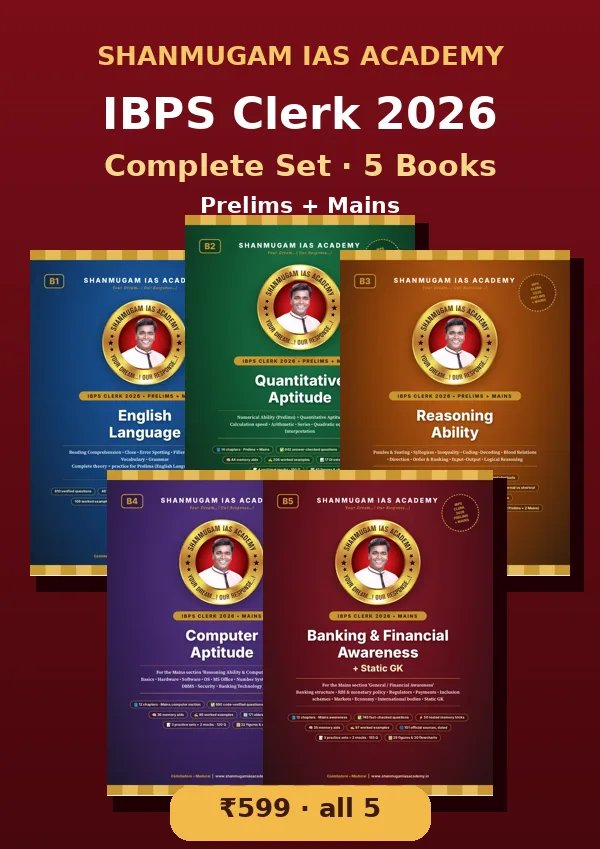 IBPS Clerk 2026 – Complete Set (5 Books, Prelims + Mains)
₹599
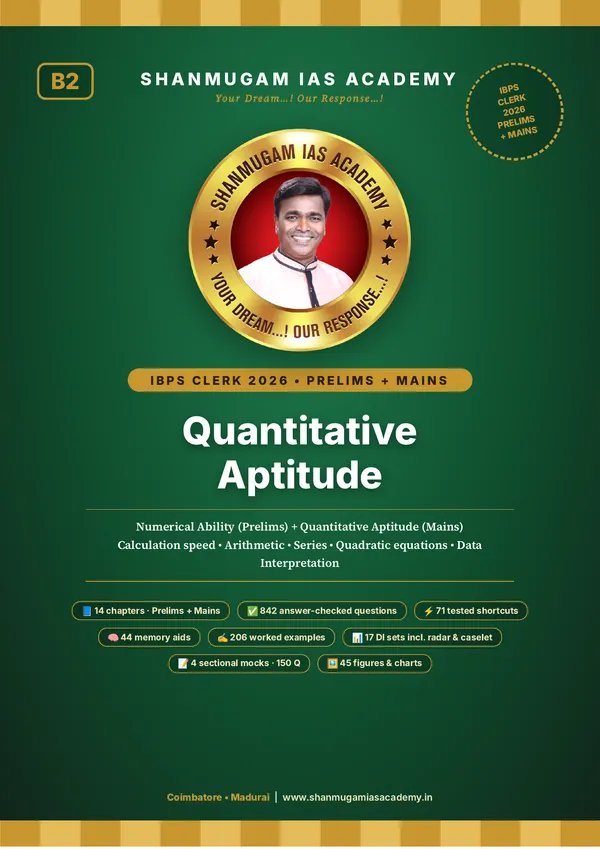 IBPS Clerk 2026 – Quantitative Aptitude (Prelims + Mains)
₹149
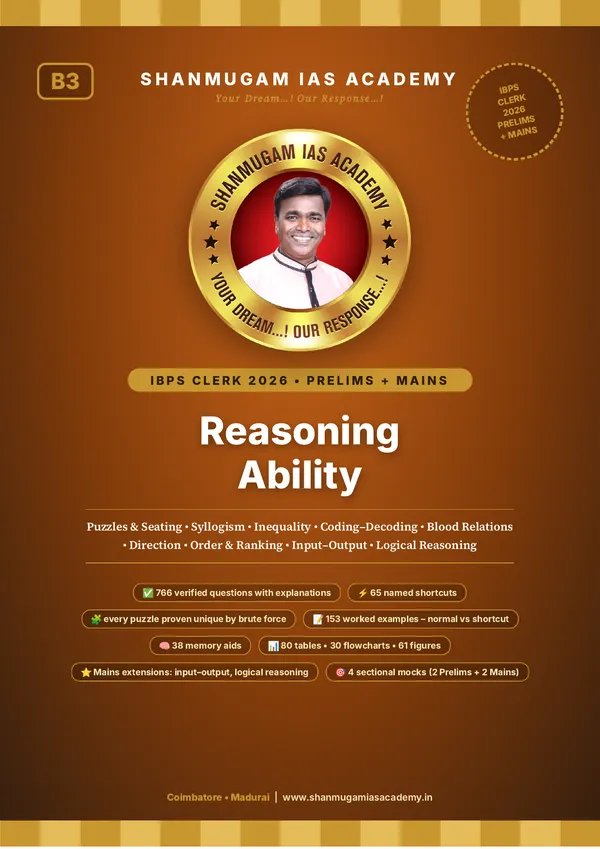 IBPS Clerk 2026 – Reasoning Ability (Prelims + Mains)
₹149
 IBPS Clerk 2026 – English Language (Prelims + Mains)
₹149
TNPSC குரூப் 1, 2/2A, 4 – நேரடி வகுப்புகள் · கோவை & மதுரை
2006 முதல் சண்முகம் IAS அகாடமி · Classroom & online coaching in Coimbatore and Madurai
