

IBPS Clerk English – Reading Comprehension – Level 2 · Exam Level · Prelims Level
IBPS Clerk English – Reading Comprehension – Level 2 · Exam Level · Prelims Level – 4 questions, subject: English Language. Every question has the correct answer with a two-line explanation; tap "Show Answer". Free practice for IBPS Clerk, IBPS PO, SBI, RRB exams – Shanmugam IAS Academy, Coimbatore.
Link to this page from your website / blog (HTML code)
Directions (Q 12–19): Read Passage 2C (economy) and answer the questions.
Few economic words are used as often, or understood as loosely, as inflation. In everyday talk it simply means that things have become costly. Economists use the word more carefully: inflation is a general and sustained rise in the price level, not a jump in the price of onions after a poor harvest. A single item can become dearer while the overall price level hardly moves.
Inflation matters because it changes what money can buy. If prices rise by six per cent in a year, a family whose income stays the same can buy roughly six per cent less than before. The loss is quiet – no one takes money from the purse – but it is real. Pensioners and others who live on fixed incomes feel it most, because their earnings do not rise with prices.
Savers face a similar problem. Suppose a fixed deposit pays seven per cent a year while prices rise by six per cent. The saver's money grows, but its purchasing power rises by only about one per cent. Economists call this the real rate of interest: roughly, the interest rate minus the rate of inflation. If inflation climbs above the deposit rate, the real return turns negative, and the saver becomes poorer in terms of goods even as the passbook shows a larger number.
Borrowers, on the other hand, may gain from unexpected inflation. A farmer who has taken a loan at a fixed rate repays it with money that buys less than it did when he borrowed. This is one reason why lenders try to judge future inflation before they set interest rates.
Not all inflation is harmful. A low and steady rise in prices gives businesses room to adjust wages and prices smoothly, and it is far less damaging than a fall in prices across the economy, which can make people delay purchases and slow down growth. What hurts most is inflation that is high or unpredictable, because it makes planning difficult for households and firms alike.
For this reason, central banks in many countries, including the Reserve Bank of India, are given the task of keeping inflation within a target range. Their main tool is the policy interest rate, which influences the rates that banks charge and pay.
Correct Answer: D [a general and sustained rise in the price level]
Explanation:
Economists define inflation as a general and sustained rise in the price level of goods and services, so option d is correct. A rise in the price of one item, or a one-time jump in food prices after a poor harvest, is not inflation in this strict sense.
A fixed deposit pays 7% a year and prices rise by 6%. According to the passage, the saver's purchasing power rises by about:
Correct Answer: A [one per cent]
Explanation:
The real return is roughly the interest rate minus inflation: 7% - 6% = about 1%, so purchasing power rises by only about one per cent. Adding the two rates (13%) or taking the nominal rate (7%) ignores the effect of rising prices.
If a deposit pays 7% while prices rise by 8%, it can be inferred from the passage that the saver:
Correct Answer: C [becomes poorer in terms of the goods the money can buy]
Explanation:
The real return is roughly the interest rate minus inflation: 7% - 8% = about -1%, so the money buys fewer goods than before and the saver becomes poorer in real terms. The passbook balance still grows in rupees, so the saver does not lose money from the balance itself.
Directions (Q 20–26): Read Passage 2D (society) and answer the questions.
When a bank moves a service online, it usually announces the change as a convenience. For many customers it is one. A salaried worker who once lost half a day standing in a queue can now transfer money from a phone in a minute. Yet the same change can feel like a locked door to a seventy-year-old who has never used a smartphone.
Older customers are not necessarily unwilling to learn. Many of them pick up new skills well when they are taught slowly, with practice, and without being made to feel foolish. The difficulty is that most digital services are designed by young people for young people. Small text, quick time-outs and screens crowded with offers punish anyone whose eyesight or confidence is not perfect.
Fear also plays a part. Older customers hear constantly about frauds in which a caller pretends to be from the bank and asks for a one-time password. Some decide that the safest course is to avoid digital banking altogether. Paradoxically, those who know least about how frauds work are often the easiest targets when they finally do go online, perhaps under pressure from a relative.
Families can help, but help that takes over completely can create new risks. A son who keeps his mother's PIN 'to save her trouble' may mean well, yet the account is no longer under her control. Good help teaches rather than replaces: it sits beside the learner, lets her press the buttons and explains each step until she can do it alone.
Banks, too, have a role beyond building apps. A counter where an older customer can ask questions without being hurried, printed guides in large type, and simple rules repeated often – never share a PIN or password with anyone, not even someone claiming to be from the bank – cost little and build trust. Digital banking succeeds not when the last branch closes, but when the oldest customer can use it without fear.
Correct Answer: A [digital banking should be made usable and safe for older customers, not merely available]
Explanation:
The writer argues that moving services online helps many but leaves older customers afraid, and concludes that digital banking succeeds only when the oldest customer can use it without fear. So the main argument is that it must be usable and safe for older customers, not merely available.
Today Current Affairs in Tamil | 23 நவம்பர் 2026 | TNPSC Group 4 முக்கிய வினாக்கள்
📚 IBPS Clerk 2026 Books
PDF நூல்கள் · ₹149 முதல் · ஒவ்வொன்றுக்கும் 50 பக்க இலவச மாதிரி · UPI-இல் பணம் செலுத்தியதும் உடனே பதிவிறக்கம்
 IBPS Clerk 2026 – Complete Set (5 Books, Prelims + Mains)
₹599
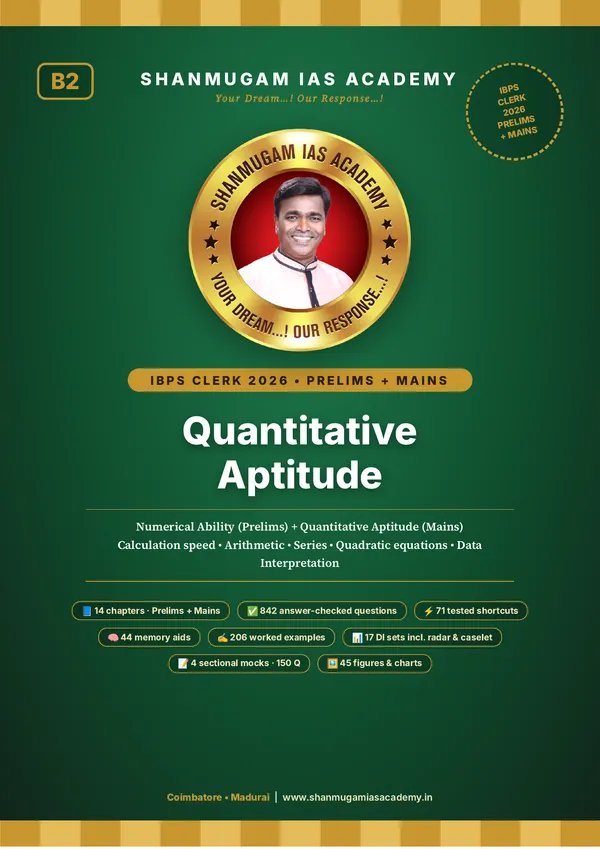 IBPS Clerk 2026 – Quantitative Aptitude (Prelims + Mains)
₹149
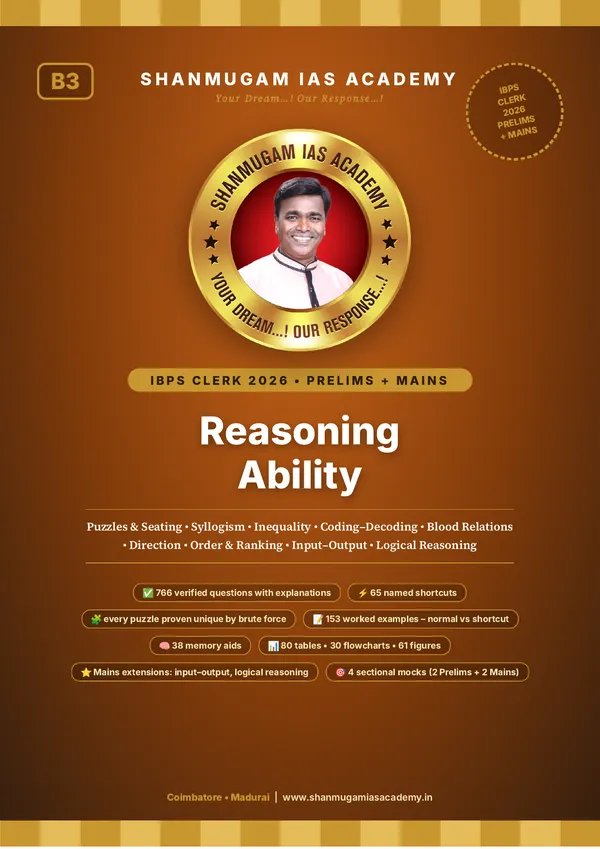 IBPS Clerk 2026 – Reasoning Ability (Prelims + Mains)
₹149
 IBPS Clerk 2026 – English Language (Prelims + Mains)
₹149
TNPSC குரூப் 1, 2/2A, 4 – நேரடி வகுப்புகள் · கோவை & மதுரை
2006 முதல் சண்முகம் IAS அகாடமி · Classroom & online coaching in Coimbatore and Madurai
