

IBPS Clerk English – Sentence Improvement and Phrase Replacement – Mixed Format Drill · Prelims Level
IBPS Clerk English – Sentence Improvement and Phrase Replacement – Mixed Format Drill · Prelims Level – 14 questions, subject: English Language. Every question has the correct answer with a two-line explanation; tap "Show Answer". Free practice for IBPS Clerk, IBPS PO, SBI, RRB exams – Shanmugam IAS Academy, Coimbatore.
Link to this page from your website / blog (HTML code)
Correct Answer: D [have arrested]
Explanation:
'Police' is a collective noun that is always used as plural, so it takes the plural verb 'have': 'The police have arrested the thief.' 'Has arrested' is wrong because 'police' never takes a singular verb.
Correct Answer: D [finished]
Explanation:
A definite past time such as "yesterday" takes the simple past, so "I finished the work yesterday" is correct. The present perfect ("have finished") cannot be used with a finished time expression.
Correct Answer: C [laid]
Explanation:
"Lay" (to put something down) is a transitive verb with forms lay - laid - laid, so "He laid the book on the table" is correct. "Lie" (to rest) has forms lie - lay - lain, and "lied" is the past of "lie" meaning to tell an untruth.
Correct Answer: B [The rich]
Explanation:
"The + adjective" refers to a whole class of people and takes a plural sense, so "The rich should help the poor" is correct. "Rich" alone cannot be the subject, and "Riches" means wealth, not wealthy people.
Correct Answer: A [is]
Explanation:
"News" looks plural but is an uncountable noun that takes a singular verb, so "The news is good" is correct. Other such nouns include "mathematics", "politics" (as a subject) and "economics".
Correct Answer: A [to hearing]
Explanation:
In 'look forward to', the word 'to' is a preposition, so it must be followed by a gerund (-ing form): 'I look forward to hearing from you.' 'To hear' is a common mistake because learners treat 'to' as part of an infinitive.
Correct Answer: B [Seldom does the branch close]
Explanation:
A negative adverb such as "Seldom" at the start needs inversion with "does + subject + base verb": "Seldom does the branch close before five". Option a wrongly keeps "closes" after "does", which already carries the -s ending.
Correct Answer: D [will the results be]
Explanation:
When "Not until ..." begins a sentence, the main clause takes inversion (auxiliary before subject): "Not until Monday will the results be announced". "The results are" or "the results would be" keep normal word order, which is wrong after this negative opening.
Correct Answer: E [No improvement]
Explanation:
"Remember + to + base verb" is used for a duty still to be done, so "remember to sign the form before you submit it" is already correct. "Remember + -ing" refers to recalling a past action, which does not fit an instruction about the future.
Correct Answer: C [made him check]
Explanation:
The causative "make + object + base verb" takes no "to" in the active voice, so "made him check the entries" is correct. "To" appears only in the passive form ("He was made to check"), and "checking" or "checked" cannot follow "made him" here.
Correct Answer: C [has]
Explanation:
"Have" in the sense of possess is a stative verb and is not used in the continuous form, so "He has two accounts" is correct. "Have" does not agree with "He", and "was having" and "is had" are wrong in tense and voice.
Correct Answer: A [agreed to reschedule]
Explanation:
The verb "agree" is followed by "to + base verb" when we agree to do something, so "The bank agreed to reschedule the loan" is correct. "Agree with" is used for a person or an opinion, and "agree" (present) breaks the past tense of the sentence.
Correct Answer: E [No improvement]
Explanation:
The sentence is a second conditional for an unreal present situation: "If + subject + were ..., subject + would + verb", so it is already correct. "If I would be" and "If I will be" wrongly put "would/will" in the if-clause, and "Were I to being" is ungrammatical.
Correct Answer: B [has gone]
Explanation:
The present perfect is "has + past participle", and the past participle of "go" is "gone" (go - went - gone), so "He has gone home" is correct. "Went" is the simple past and cannot follow "has", and "have" does not agree with the singular subject "He".
Today Current Affairs in Tamil | 23 நவம்பர் 2026 | TNPSC Group 4 முக்கிய வினாக்கள்
📚 IBPS Clerk 2026 Books
PDF நூல்கள் · ₹149 முதல் · ஒவ்வொன்றுக்கும் 50 பக்க இலவச மாதிரி · UPI-இல் பணம் செலுத்தியதும் உடனே பதிவிறக்கம்
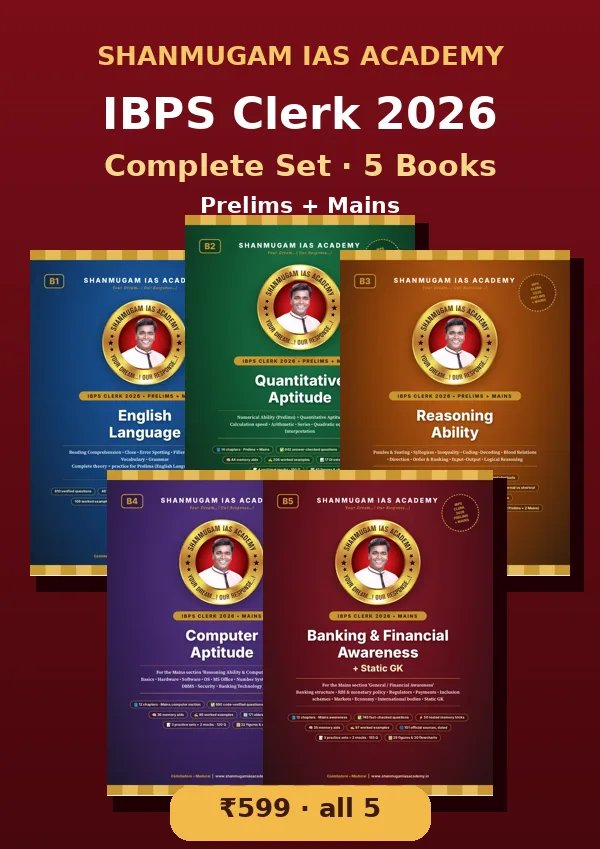 IBPS Clerk 2026 – Complete Set (5 Books, Prelims + Mains)
₹599
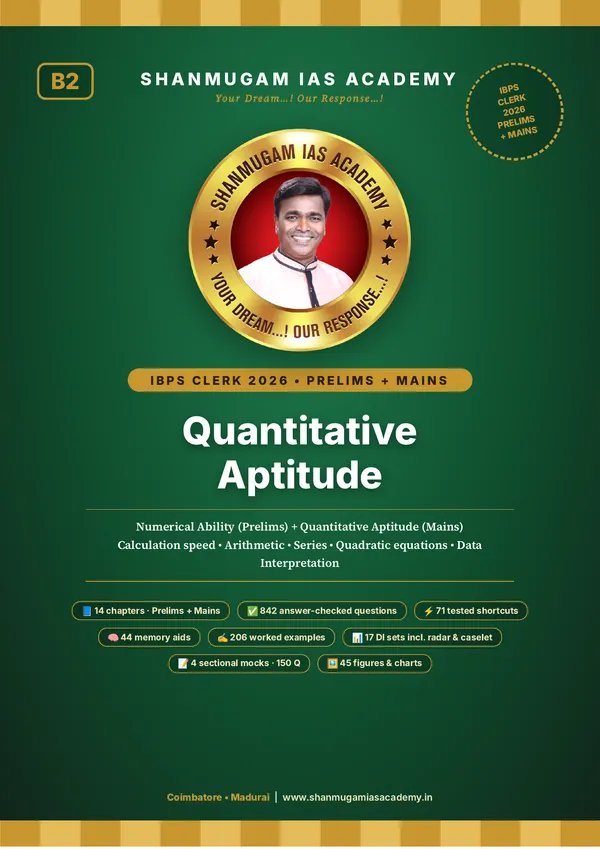 IBPS Clerk 2026 – Quantitative Aptitude (Prelims + Mains)
₹149
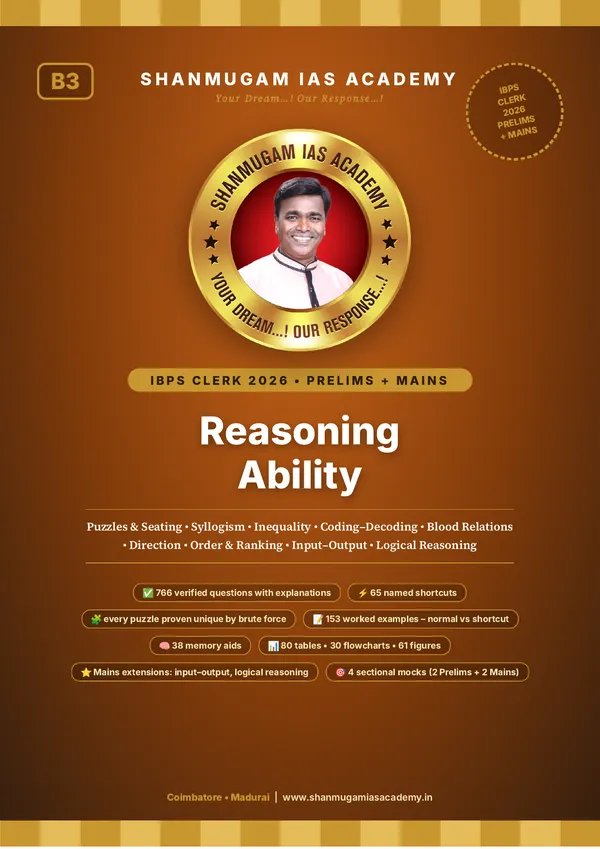 IBPS Clerk 2026 – Reasoning Ability (Prelims + Mains)
₹149
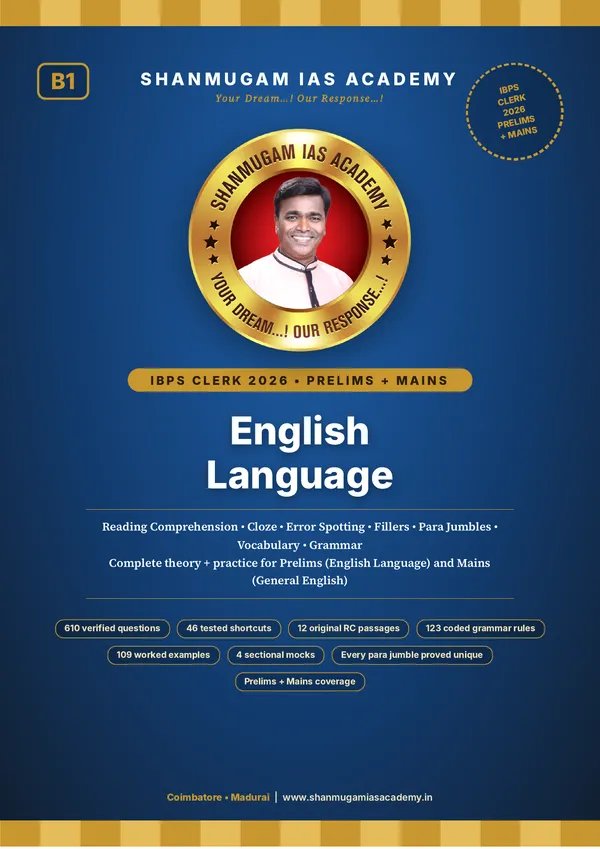 IBPS Clerk 2026 – English Language (Prelims + Mains)
₹149
TNPSC குரூப் 1, 2/2A, 4 – நேரடி வகுப்புகள் · கோவை & மதுரை
2006 முதல் சண்முகம் IAS அகாடமி · Classroom & online coaching in Coimbatore and Madurai
