

Five Great Epics of Tamil – Silappathikaram, Manimekalai, Seevaka Sinthamani, Valayapathi, Kundalakesi and the Five Minor Epics | TNPSC Notes
The Five Great Epics (Aimperumkappiyangal) of Tamil are the Silappathikaram (Ilango Adigal), Manimekalai (Seethalai Sathanar), Seevaka Sinthamani (Thiruthakka Thevar), Valayapathi (author unknown) and Kundalakesi (Nathakuthanar). They were composed between the post-Sangam age and about the 10th century CE. Three – Silappathikaram, Seevaka Sinthamani and Valayapathi – are Jain in outlook (Silappathikaram by general view), while Manimekalai and Kundalakesi are Buddhist epics. The first three survive in full; only 72 verses of Valayapathi and 19 of Kundalakesi survive.
These notes are written for TNPSC Group 1, 2/2A and 4 aspirants. They serve the syllabus topic "Tamil literature from the Sangam age till contemporary times" in the unit on History, Culture, Heritage and Socio-Political Movements of Tamil Nadu, and the work–author–religion matching questions of Group 4 General Tamil. For the earlier literary background see the Sangam literature note.
The Five Great Epics at a Glance
| Epic | Author | Religious outlook | Structure | Status today |
|---|---|---|---|---|
| Silappathikaram | Ilango Adigal | Jain (general view) | 3 kandams, 30 kathais | Complete |
| Manimekalai | Seethalai Sathanar | Buddhist | 30 kathais | Complete |
| Seevaka Sinthamani | Thiruthakka Thevar | Jain | 13 ilambagams, 3,145 verses | Complete |
| Valayapathi | Author unknown | Jain | – | Only 72 verses survive |
| Kundalakesi | Nathakuthanar | Buddhist | – | Only 19 verses survive |
- Definition of a great epic: according to the Thandiyalangaram, a great epic (perumkappiyam) deals with all four aims of life – aram (virtue), porul (wealth), inbam (love) and veedu (liberation); if one or more is missing it is a minor epic (sirukappiyam).
- The phrase "Aimperumkappiyam": first found in Mayilainathar's commentary on the Nannool, which does not name the five works; the list of titles appears only in later works.
- Religious count: Jain 3 (Silappathikaram, Seevaka Sinthamani, Valayapathi) + Buddhist 2 (Manimekalai, Kundalakesi).
- Twin epics: Silappathikaram and Manimekalai – the story continues (Manimekalai is the daughter of Kovalan and Madhavi).
Silappathikaram
- Author: Ilango Adigal. The prologue (pathigam) calls him the younger brother of the Chera king Senguttuvan (a traditional account).
- Name: "the epic of the anklet" (silambu) – the story turns on Kannagi's anklet.
- Characters: Kovalan, Kannagi, Madhavi, Kavunthi Adigal, Mathari, the Pandya king Nedunchezhiyan, Queen Kopperundevi, Cheran Senguttuvan.
- Three truths (prologue): dharma becomes death to rulers who err in governance; the great praise a renowned chaste woman; past deeds (oozh vinai) come back to bear fruit.
- Epithets: Kudimakkal Kappiyam (citizens' epic – its heroes are a merchant family, not kings), Muthamizh Kappiyam (iyal, isai, nadagam – literature, music, drama), Uraiyidaiyitta Pattudai Cheyyul (verse with prose passages), the first Tamil epic.
- All three kingdoms: Puhar (Chola), Madurai (Pandya) and Vanji (Chera) – the three kandams are set in the three capitals.
- Commentators: Arumpadavuraiyasiriyar and Adiyarkunallar (whose commentary is key for music and dance).
- First printed edition: U.Ve. Swaminatha Iyer, 1892.
| Kandam | Kathais | Main events |
|---|---|---|
| Puhar Kandam | 10 | Marriage of Kovalan and Kannagi; Madhavi's debut performance; Kovalan leaves Madhavi |
| Madurai Kandam | 13 | Journey to Madurai with Kavunthi Adigal; Kovalan killed while selling the anklet; Kannagi argues her case; the Pandya king dies; Madurai burns |
| Vanji Kandam | 7 | Cheran Senguttuvan brings a stone from the Himalayas and builds a temple for Kannagi as the Pathini goddess |
- Gajabahu synchronism: the epic says the Sri Lankan king Gajabahu attended the consecration of Kannagi's temple at Vanji. On this basis Senguttuvan is traditionally placed in the 2nd century CE; the date of composition of the epic is still debated by scholars.
- As a historical source: the layout of Puhar, the Indra festival, sea trade, the streets of Madurai, and folk forms such as the Aaychiyar Kuravai, Vettuva Vari and Kundrak Kuravai give a detailed picture of society.
- Art: Madhavi's debut (Arangetru Kathai) gives the measurements of the stage, and the Kadalaadu Kathai describes the eleven dances (pathinoradal) – a primary source on Tamil music and dance.
Manimekalai
- Author: Seethalai Sathanar (the grain merchant Sathanar of Madurai); a Buddhist epic in 30 kathais, also called "Manimekalai Thuravu" (Manimekalai's renunciation).
- Story: Manimekalai, daughter of Kovalan and Madhavi, rejects the love of prince Udayakumaran and becomes a Buddhist nun. The goddess Manimekala takes her to the island of Manipallavam, where she receives the inexhaustible bowl Amudhasurabhi, with which she feeds the hungry.
- Teacher: Aravana Adigal.
- Special feature: the "Samaya Kanakkar Tham Thiram Ketta Kathai" in which Manimekalai hears out the philosophical schools of the time – an early Tamil text of philosophical debate.
- Social message: removal of hunger and turning a prison into a house of charity.
- First printed edition: U.Ve. Swaminatha Iyer, 1898.
Seevaka Sinthamani
- Author: Thiruthakka Thevar (a Jain monk); generally placed in about the 9th–10th century CE.
- Structure: 13 ilambagams, 3,145 verses; a great epic in the viruttam metre – by tradition a model for later epics, including the Kamba Ramayanam.
- Story: the birth and exploits of Prince Seevakan (Jivaka) of Emangatham, his marriage to eight wives, the recovery of his lost kingdom and final renunciation. The eight marriages give it the name "Mana Nool" (book of marriages).
- Commentator: Nachinarkkiniyar. First printed edition: U.Ve. Swaminatha Iyer, 1887 – the first great epic he published.
Valayapathi and Kundalakesi
- Valayapathi: a Jain epic by an unknown author. Only 72 verses, quoted in anthologies such as the Purathirattu and in commentaries, survive; the full story is not known with certainty. The surviving verses are mostly ethical teachings.
- Kundalakesi: a Buddhist epic by Nathakuthanar; only 19 verses survive. It tells of Kundalakesi, a merchant's daughter, who overcomes her husband, a thief, when he tries to kill her, becomes a Buddhist nun and wins religious debates.
- Neelakesi: a Jain work written to refute the Buddhist ideas of Kundalakesi – one of the five minor epics, and evidence of Jain–Buddhist debate in the Tamil country.
Five Minor Epics (in brief)
Epics lacking one or more of the four aims of life are minor epics. All five are Jain works.
| Minor epic | Religion | Note |
|---|---|---|
| Yasodhara Kaviyam | Jain | Stresses the ethic of not killing living beings |
| Choolamani | Jain | Author: Tholamozhi Thevar |
| Udayanakumara Kaviyam | Jain | Story of Udayanan |
| Nagakumara Kaviyam | Jain | Story of Nagakumaran |
| Neelakesi | Jain | A work of debate written to refute the Buddhist Kundalakesi |
Tamil Nadu Angle – the Epic Tradition Today
- Kannagi statue, Marina, Chennai: installed in 1968 in connection with the Second World Tamil Conference held in Chennai.
- Poompuhar: the Tamil Nadu Government has set up the Silappathikaram Art Gallery (Silappathikara Kalaikoodam) with sculpted scenes from the epic.
- Mangaladevi Kannagi temple: on the Tamil Nadu–Keralam border in the hills adjoining Theni district; a festival is held on the Chithirai full-moon day.
- Translations: V.R. Ramachandra Dikshitar translated the Silappathikaram into English (1939); the Central Institute of Classical Tamil carries out translations and research on the epics.
- The Tamil Virtual Academy (tamilvu.org) offers the texts and commentaries free online.
Writing Mains Answers (Group 1 / Group 2)
Silappathikaram as a social document (about 150–250 words)
- Introduction: Ilango Adigal; 3 kandams, 30 kathais; the citizens' epic.
- Polity: capitals of the three kingdoms; "dharma becomes death to rulers who err" – the idea of just rule.
- Economy: Puhar port, merchant families, the markets of Madurai.
- Culture: Indra festival, kuravai dance, music and dance (Madhavi), the Pathini cult.
- Place of women: Kannagi's voice for justice, Madhavi's artistic skill.
- Conclusion: both literature and historical source – a symbol of Tamil identity.
The twin epics compared (about 150 words)
- Silappathikaram – fate, chastity, royal justice; Manimekalai – renunciation, ending hunger, Buddhist ethics.
- Continuity: Manimekalai is the daughter of Kovalan and Madhavi.
- Both are set in Puhar, Madurai and Vanji; both have 30 kathais.
- Significance: the contribution of Jain and Buddhist ethical traditions to Tamil literature.
Practice: Match the Following
| Item | Match |
|---|---|
| Seevaka Sinthamani | Mana Nool – Thiruthakka Thevar |
| Manimekalai | Amudhasurabhi – Seethalai Sathanar |
| Kundalakesi | Nathakuthanar – 19 verses |
| Valayapathi | 72 verses – author unknown |
| Neelakesi | Refutation of Kundalakesi |
| Choolamani | Tholamozhi Thevar |
Common Mistakes to Avoid
- The Kamba Ramayanam, Periya Puranam and Perungathai are not among the Five Great Epics.
- Manimekalai is Buddhist; Seevaka Sinthamani is Jain – do not swap them.
- Kundalakesi is Buddhist; Neelakesi, which refutes it, is Jain – do not confuse the two.
- Valayapathi – 72 verses; Kundalakesi – 19 verses – do not swap the numbers.
- All five minor epics are Jain; none is Buddhist.
- The date of the Silappathikaram is not settled – "2nd century CE" is only a traditional estimate based on the Gajabahu synchronism.
Key Terms – Tamil / English (for the bilingual paper)
| தமிழ் | English |
|---|---|
| ஐம்பெருங்காப்பியங்கள் | Five Great Epics |
| ஐஞ்சிறுகாப்பியங்கள் | Five Minor Epics |
| காதை | Canto (chapter of an epic) |
| இலம்பகம் | Section of the Seevaka Sinthamani |
| உறுதிப்பொருள் (அறம், பொருள், இன்பம், வீடு) | Four aims of life (virtue, wealth, love, liberation) |
| குடிமக்கள் காப்பியம் | Citizens' epic |
| இரட்டைக் காப்பியங்கள் | Twin epics |
| பத்தினி வழிபாடு | Cult of the chaste goddess (Pathini) |
Quick Revision Table
| Year / period | Event |
|---|---|
| Post-Sangam age – c. 10th century CE | Span in which the Five Great Epics were composed (general view) |
| c. 9th–10th century CE | Seevaka Sinthamani (Thiruthakka Thevar) |
| 1887 | U.Ve. Swaminatha Iyer prints the Seevaka Sinthamani |
| 1892 | U.Ve. Swaminatha Iyer prints the Silappathikaram |
| 1898 | U.Ve. Swaminatha Iyer prints the Manimekalai |
| 1939 | V.R. Ramachandra Dikshitar's English translation of the Silappathikaram |
| 1968 | Kannagi statue on the Marina, Chennai (Second World Tamil Conference) |
TNPSC Key Points (PYQ-style facts)
- Five Great Epics: Silappathikaram, Manimekalai, Seevaka Sinthamani, Valayapathi, Kundalakesi.
- Jain 3 – Silappathikaram, Seevaka Sinthamani, Valayapathi; Buddhist 2 – Manimekalai, Kundalakesi.
- Silappathikaram – 3 kandams (Puhar 10, Madurai 13, Vanji 7) – 30 kathais.
- Silappathikaram = citizens' epic, Muthamizh epic, verse with prose passages.
- Manimekalai – 30 kathais – Amudhasurabhi – Manipallavam – Aravana Adigal.
- Seevaka Sinthamani – 13 ilambagams, 3,145 verses – Mana Nool – commentary by Nachinarkkiniyar.
- Valayapathi – 72 verses (Purathirattu); Kundalakesi – Nathakuthanar – 19 verses.
- Neelakesi refutes Kundalakesi; Choolamani – Tholamozhi Thevar.
- Great epic = all four aims of life (Thandiyalangaram).
- The phrase "Aimperumkappiyam" first appears in Mayilainathar's commentary on the Nannool.
Frequently Asked Questions
What are the Five Great Epics and who wrote them?
Silappathikaram – Ilango Adigal; Manimekalai – Seethalai Sathanar; Seevaka Sinthamani – Thiruthakka Thevar; Valayapathi – author unknown; Kundalakesi – Nathakuthanar. Three are Jain in outlook and two are Buddhist epics.
How does a great epic differ from a minor epic?
According to the Thandiyalangaram, a great epic deals with all four aims of life – virtue, wealth, love and liberation; if one or more is missing it is a minor epic. Yasodhara Kaviyam, Choolamani, Udayanakumara Kaviyam, Nagakumara Kaviyam and Neelakesi are the five minor epics.
Why is the Silappathikaram called the "citizens' epic"?
Most epics have kings or gods as heroes; the heroes of the Silappathikaram, Kovalan and Kannagi, belong to a merchant family. Because it sings of ordinary citizens it is the citizens' epic, and because it has literature, music and drama it is the Muthamizh epic.
Which are the twin epics?
The Silappathikaram and the Manimekalai. The heroine of the Manimekalai is the daughter of Kovalan and Madhavi of the Silappathikaram. Both have 30 kathais; the first is Jain in outlook and the second is a Buddhist epic.
Why are Valayapathi and Kundalakesi incomplete?
No complete palm-leaf manuscript of either work has been found. Only verses quoted in anthologies such as the Purathirattu and by commentators survive – 72 of Valayapathi and 19 of Kundalakesi.
Practise this topic with our free Tamil quizzes, follow daily current affairs (English) and Tamil current affairs, and see our TNPSC PYQ books such as the General Tamil PYQ book and the Tamil Nadu Administration PYQ book. For classroom and online TNPSC coaching at Gandhipuram, Coimbatore and Anna Nagar, Madurai, see our TNPSC course page or call 99941 46662 (Coimbatore) / 73059 47122 (Madurai).
Practice questions (20)
Tap an option to see the answer and a one-line explanation.
1. Who composed the Silappathikaram?
(A) Ilango Adigal
Silappathikaram – Ilango Adigal.
2. Which of the Five Great Epics are Buddhist?
(B) Manimekalai, Kundalakesi
Manimekalai and Kundalakesi are Buddhist; the other three are Jain.
3. How many kathais does the Silappathikaram have?
(B) 30
Puhar 10 + Madurai 13 + Vanji 7 = 30.
4. How many kathais are in the Madurai Kandam of the Silappathikaram?
(C) 13
Madurai 13; Puhar 10; Vanji 7.
5. Which work is called the "citizens' epic"?
(A) Silappathikaram
Silappathikaram – its heroes are a merchant family.
6. Which epic is called "Mana Nool"?
(B) Seevaka Sinthamani
Seevaka Sinthamani – Seevakan marries eight wives.
7. How many ilambagams does the Seevaka Sinthamani have?
(C) 13
13 ilambagams, 3,145 verses.
8. What was the inexhaustible bowl received by Manimekalai called?
(D) Amudhasurabhi
Amudhasurabhi; the island was Manipallavam.
9. Who is the author of Kundalakesi?
(A) Nathakuthanar
Kundalakesi – Nathakuthanar (Buddhist).
10. How many verses of Valayapathi survive today?
(C) 72
Valayapathi 72; Kundalakesi 19.
11. Which Jain work was written to refute Kundalakesi?
(C) Neelakesi
Neelakesi – one of the five minor epics.
12. Where is the phrase "Aimperumkappiyam" first found?
(D) Mayilainathar's commentary
In Mayilainathar's commentary on the Nannool.
13. According to the Thandiyalangaram, what must a great epic deal with?
(A) Virtue, wealth, love and liberation
All four aims of life; if one is missing it is a minor epic.
14. Who wrote the Choolamani?
(B) Tholamozhi Thevar
Choolamani – Tholamozhi Thevar (Jain minor epic).
15. Who first printed the Silappathikaram (1892)?
(C) U.Ve. Swaminatha Iyer
U.Ve. Swaminatha Iyer, 1892.
16. Which kandam describes Cheran Senguttuvan building a temple for Kannagi?
(D) Vanji Kandam
Vanji Kandam – the Chera part.
17. Who was Manimekalai's teacher (guru)?
(A) Aravana Adigal
Aravana Adigal; Kavunthi Adigal belongs to the Silappathikaram.
18. Which of these is NOT one of the Five Great Epics?
(B) Perungathai
Perungathai is not among the five.
19. Why is the Silappathikaram called the "Muthamizh epic"?
(C) It has literature, music and drama
Iyal, isai and nadagam – the three Tamils.
20. In which year was the Kannagi statue installed on the Marina, Chennai?
(B) 1968
1968 – in connection with the Second World Tamil Conference.
Link to this page from your website / blog (HTML code)
More TNPSC notes
 Puli Thevar (Pulithevar) of Nerkattumseval – Western Palayakkarar Confederacy, Heron 1755, Kalakadu, Yusuf Khan 1761 & First Resistance to British Rule
 Rani Velu Nachiyar of Sivaganga – Veeramangai, Kalaiyar Kovil 1772, Hyder Ali Alliance, Kuyili & Recovery of Sivaganga (1780)
 Veerapandiya Kattabomman of Panchalankurichi – Palayakkarar Revolt, Jackson & Bannerman, Kayathar 1799, Oomaithurai & the Poligar Wars
 Dheeran Chinnamalai of Kongu – Odanilai Fort, Alliance with Tipu Sultan, Battles of 1801–1804 & Sankagiri 1805
 Vallalar (Ramalinga Swamigal) – Samarasa Suddha Sanmarga Sangam, Sathya Dharma Salai, Sathya Gnana Sabai, Thiruvarutpa & Jeeva Karunyam
 Iyothee Thass Pandithar – Siddha Physician, Tamil Buddhist Revival, Oru Paisa Tamizhan (1907), Dravida Mahajana Sabha & Anti-Caste Reform
 Rettaimalai Srinivasan (Dravida Mani) – Paraiyar Mahajana Sabha, Paraiyan Journal, Madras Legislative Council & Round Table Conferences
 M. Singaravelar (Sinthanai Sirpi) – First May Day in India (1923), Labour Kisan Party, Kanpur Communist Conference, Self-Respect Movement & Labour Rights
 V. O. Chidambaram Pillai (VOC) – Life, Swadeshi Steam Navigation Company & Freedom Struggle
 Maraimalai Adigal – Pure Tamil Movement (1916), Madras Christian College, Gnanasagaram, Sangam Research & Thiruvalluvar Year
 C. Rajagopalachari (Rajaji) – Vedaranyam Salt March, Premier of Madras, C.R. Formula, Governor-General & Swatantra Party
 Periyar E. V. Ramasamy – Self-Respect Movement, Vaikom Satyagraha, Justice Party & Dravidar Kazhagam
 Subramania Bharati (Mahakavi Bharathiyar) – Life, Journalism, Puducherry Exile, Works & Titles
 Thiru. V. Kalyanasundaram (Thiru.Vi.Ka.) – Tamil Scholar, Madras Labour Union 1918, Desabhakthan & Navasakthi, Congress Leader & Writer
 Moovalur Ramamirtham Ammaiyar – Devadasi Abolition, Self-Respect Movement, 1938 Anti-Hindi March, Dasigal Mosavalai & Schemes in Her Name
 Subramania Siva (Veera Thuravi) – Swadeshi with V.O.C., Tirunelveli Uprising 1908, Gnanabanu & Bharatha Matha Temple
 Dr. S. Muthulakshmi Reddy – Pioneer Woman Doctor, First Woman Legislator of British India (1926), Devadasi Abolition, Avvai Home & Adyar Cancer Institute
 Vanchinathan (Vanchi) – Swadeshi Background, Bharatha Matha Association, Ashe Assassination at Maniyachi (1911) & Tinnevelly Conspiracy Case
 Bharathidasan (Puratchi Kavignar) – Puducherry Poet, Self-Respect Movement, Kudumba Vilakku, Pandiyan Parisu & Sahitya Akademi Award
 Thillaiyadi Valliammai – Teenage Satyagrahi of South Africa, 1913 Struggle, Maritzburg Prison, Death in 1914 & Memorials
 K. Kamaraj (Perunthalaivar) – Freedom Struggle, Chief Minister 1954–63, Education, Dams, Kamaraj Plan & Kingmaker
 Tiruppur Kumaran (Kodi Kaatha Kumaran) – Civil Disobedience 1932, Tiruppur Flag Procession, Martyrdom & Memorials
 C. N. Annadurai (Arignar Anna) – Dravidar Kazhagam, Founding of the DMK, Chief Minister 1967–69, Renaming Tamil Nadu & Two-Language Policy
 Justice Party (South Indian Liberal Federation) – Non-Brahmin Manifesto 1916, Dyarchy Ministries 1920–37, Communal G.O.s, HRE Act & Salem 1944
 Pure Tamil Movement (Thanithamizh Iyakkam) – Origin 1916, Maraimalai Adigal, Devaneya Pavanar, Perunchitranar, Karanthai Tamil Sangam & Classical Tamil 2004
 Vaikom Satyagraha (1924–25) – Causes, Leaders, Periyar's Role, Gandhi's Negotiations, Outcome & Centenary
 Self-Respect Movement (1925) – Origin, Chengalpattu Conference 1929, Self-Respect Marriages & Section 7-A, Women's Rights, Rationalism, Justice Party & DK
 Anti-Hindi Agitations of Tamil Nadu – 1937–40 Agitation, 1948–50, 1965 Agitation, Official Languages Acts & Two-Language Policy
 Temple Entry Movement in Tamil Nadu – Vaikom & Travancore Context, Meenakshi Temple Entry 1939, Temple Entry Acts 1939 & 1947, Archakas
 Keeladi (Keezhadi) Excavations – Vaigai Urban Settlement, ASI & State Phases, Tamil-Brahmi Finds, 580 BCE Dating & Keeladi Museum
 Adichanallur – Iron Age Urn Burials, Thamirabarani Valley, Excavations 1876–2022, Gold Diadems, Dating & Site Museum
 Sivakalai (Sivagalai) Excavations – Porunai Valley Urn Burials, 1155 BCE Paddy, Antiquity of Iron Report (3345 BCE) & Porunai Museum
 Kodumanal Excavations – Kodumanam of Pathitrupathu, Noyyal River, Gem Beads & Iron Industry, Tamil-Brahmi, Megaliths & Roman Trade
 Porunai (Thamirabarani) Civilisation and Tamil Nadu Excavation Sites – Porunai Museum, Korkai, Arikamedu, Poompuhar, Mayiladumparai & Yearly Excavations
 Reservation Policy of Tamil Nadu – Communal G.O.s, Champakam Dorairajan & First Amendment, 69% Act 45 of 1994 & Ninth Schedule, Internal Quotas & EWS
 Education Development in Tamil Nadu – Noon Meal to Breakfast Scheme, Higher Education GER, Pudhumai Penn & Tamil Pudhalvan, Naan Mudhalvan, 7.5% Quota
 Tamil Nadu Health Model – PHC Network, TNMSC Drug Model, CMCHIS, Makkalai Thedi Maruthuvam & Maternal-Child Health Outcomes
 Local Governance in Tamil Nadu – Panchayat Acts 1950/1958/1994, 73rd & 74th Amendments, Grama Sabha, 50% Women Quota & Urban Local Bodies
 Tamil Nadu Economy – GSDP & Growth, Per Capita Income, Sectors, Industrial Clusters & MSMEs, Urbanisation, SDG & Poverty Indices, $1 Trillion Target
 Thirukkural – Structure (3 Paals, 133 Chapters, 1330 Couplets), Thiruvalluvar, Commentators, Translations, Valluvar Kottam & Kanniyakumari Statue
 Sangam Literature – Ettuthogai, Pathuppattu, Tolkappiyam, the Thinai Concept, Akam & Puram, the Three-Sangam Tradition and Sangam Society
 Chola Administration – Uthiramerur Inscriptions, Kudavolai System, Ur, Sabha & Nagaram, Variyams, Rajaraja I, Rajendra I, Naval Expeditions & Brihadisvara Temple
 Pallava Art and Architecture – Mahendravarman I's Rock-cut Caves, Mamallapuram (UNESCO 1984), Pancha Rathas, Arjuna's Penance, Shore Temple & Kanchi Kailasanathar
 The Nayak Period – Madurai Nayaks (Viswanatha Nayak, Thirumalai Nayak, Rani Mangammal), the 72 Palayams, Meenakshi Temple Gopurams, Thanjavur & Senji Nayaks
 Marudhu Brothers (Maruthu Pandiyar) of Sivaganga – Velu Nachiyar and 1780, the South Indian Confederacy, Jambudweepa (Tiruchirappalli) Proclamation 1801, Kalaiyarkoil and 24-10-1801
 Ayya Vaikundar (Vaikunda Swamigal) – Ayyavazhi, Swamithoppe, Samathuva Samajam, Muthirikinaru, Akilathirattu Ammanai and Resistance to Caste Oppression in Travancore
 S. Satyamurti (Dheerar Sathyamurthy) – Swaraj Party, Mayor of Madras 1939, Poondi Reservoir (Satyamurti Sagar), Kamaraj's Political Mentor and Patron of the Arts
 P. Jeevanandham (Jeeva) – Boothapandi, Siravayal Ashram, Self-Respect Movement, Bhagat Singh Translation, Communist Movement, Washermanpet 1952, Thamarai and Kalai Ilakkiya Perumandram
 Rukmini Lakshmipathi – Vedaranyam Salt Satyagraha 1930 (First Woman Prisoner in Madras Presidency), Deputy Speaker 1937 and First Woman Minister of Madras Presidency (1946)
 Home Rule Movement in Madras (1916–18) – Annie Besant, New India, Ootacamund Internment 1917, Sir S. Subramania Iyer & the Non-Brahmin Response
 Swadeshi Movement in Tamil Nadu (1905–1911) – Madras and Tuticorin–Tirunelveli Centres, Swadeshi Steam Navigation, 1908 Uprising, Repression & the Ashe Assassination
 Non-Cooperation Movement in Tamil Nadu (1920–22) – Khilafat, Gandhi's Tours, Toddy-Shop Picketing, Buckingham & Carnatic Mills Strike, Madurai 1921 & the Prince of Wales Boycott
 Civil Disobedience Movement in Tamil Nadu (1930–34) – Vedaranyam Salt Satyagraha, Udayavanam Camp in Madras, Rukmini Lakshmipathi, Foreign-Cloth Picketing & Tiruppur 1932
 Quit India Movement in Tamil Nadu (1942) – Kamaraj Underground, Satyamurti, Sulur Airfield, Devakottai–Tiruvadanai, Madurai & Student Protests
 Arikamedu – Indo-Roman Trading Port (Poduke), Mortimer Wheeler 1945, Arretine Ware, Amphorae, Bead Industry, Casal & Begley Excavations
 Korkai – Pandya Pearl Port, Thamirabarani, Caldwell 1876, 1968-69 Excavation (785 BCE), 2021 Excavation, Terracotta Pipes & Offshore Survey 2022-23
 Mayiladumparai – Krishnagiri, 2172 BCE Iron Age AMS Date (2022), Neolithic–Iron Age Transition, Rock Paintings & K. Rajan Excavation
 Poompuhar (Kaveripoompattinam) – Chola Port, Pattinappalai, Silappathikaram, Kilaiyur Wharf, Pallavanesvaram Vihara & Marine Archaeology from 1981 to 2025
 Vembakottai (Vijayakarisalkulam) Excavation – Vaippar River, Virudhunagar, Three Phases (2022–2025), About 12,000 Finds, Glass Beads, Shell Bangles, Gold Objects & Torpedo Jar
 Social Welfare Schemes of Tamil Nadu – Social Security Pensions, Magalir Urimai Thogai, Marriage Assistance, Welfare of Differently Abled Persons & Budget 2026-27
 Women Empowerment and Self-Help Groups in Tamil Nadu – Mahalir Thittam, TNCDW, Dharmapuri IFAD Project, SHG-Bank Linkage, Vazhndhu Kaattuvom, TNSRLM & State Policy for Women
 Agriculture Development in Tamil Nadu – Separate Agriculture Budget (since 2021), Irrigation, Micro-Irrigation, Crop Insurance, Free Farm Power, Uzhavar Sandhai & Cauvery Protected Agricultural Zone
 e-Governance in Tamil Nadu – TNeGA, e-Sevai Centres, e-District, State Data Centre, Nambikkai Inaiyam, Mudhalvarin Mugavari, Makkaludan Mudhalvar & TN AI Mission
 Energy Infrastructure of Tamil Nadu – Wind & Solar Power, TNEB Restructuring 2024 (TNPDCL, TNPGCL, TNGECL), Kudankulam, Pumped Storage & Ports
 Alvars and Nayanmars – the Bhakti Movement in Tamil Nadu, 12 Alvars, 63 Nayanmars, Nalayira Divya Prabandham, Thevaram and the Twelve Thirumurais
 Tamil Siddhars – the Eighteen Siddhars, Thirumoolar's Thirumanthiram, the Reformist Voice of Siddhar Songs, Siddha Medicine and the National Institute of Siddha
 Performing Arts of Tamil Nadu – Bharatanatyam, Tamil Isai, Therukoothu, Karagattam, Silambam, Folk Arts and Cultural Institutions
 Tamil Scripts and Inscriptions – Tamili (Tamil-Brahmi), Vatteluttu, Grantha, Major Inscriptions, Copper Plates, Pulimankombai Hero Stones and Epigraphy in Tamil Nadu
Today Current Affairs in Tamil | 23 நவம்பர் 2026 | TNPSC Group 4 முக்கிய வினாக்கள்
📚 TNPSC குரூப் 4 / 2 / 2A – பொதுத்தமிழ், பொது அறிவு நூல்கள்
PDF நூல்கள் · ₹149 முதல் · ஒவ்வொன்றுக்கும் 50 பக்க இலவச மாதிரி · UPI-இல் பணம் செலுத்தியதும் உடனே பதிவிறக்கம்
 பொதுத் தமிழ் — முழுமையான கையேடு (TNPSC குரூப் 2 · 2A · 4)
₹199
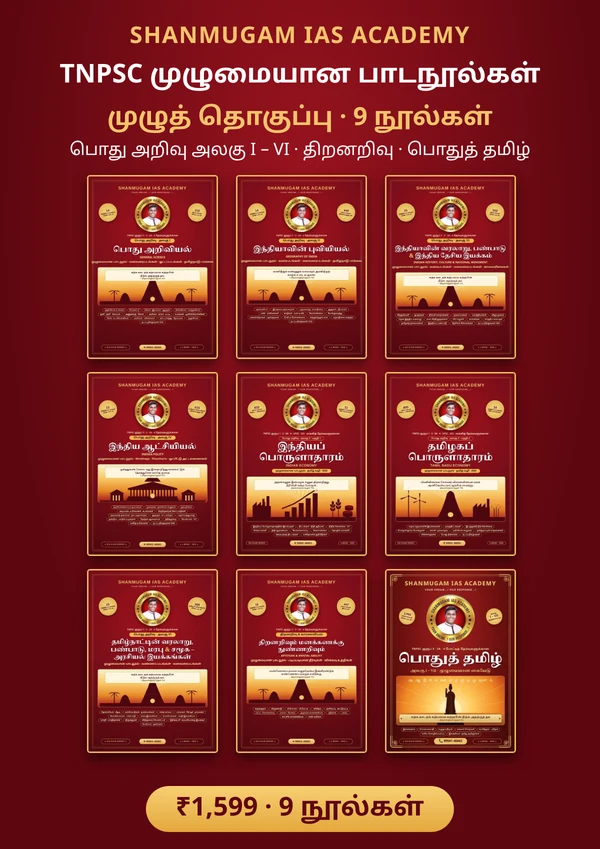 TNPSC முழுமையான பாடநூல்கள் – முழுத் தொகுப்பு (9 நூல்கள்)
₹1599
 பொதுத் தமிழ் — முந்தைய ஆண்டு வினா – விடை – விளக்கம் (புதிய பாடத்திட்டம்)
₹199
 TNPSC திறனறிவும் மனக்கணக்கு நுண்ணறிவும் (Aptitude & Mental Ability) – முழுமையான பாடநூல்
₹199
TNPSC குரூப் 1, 2/2A, 4 – நேரடி வகுப்புகள் · கோவை & மதுரை
2006 முதல் சண்முகம் IAS அகாடமி · Classroom & online coaching in Coimbatore and Madurai
