

Swadeshi Movement in Tamil Nadu (1905–1911) – Madras and Tuticorin–Tirunelveli Centres, Swadeshi Steam Navigation, 1908 Uprising, Repression & the Ashe Assassination | TNPSC Notes
The Swadeshi Movement, which began against the Partition of Bengal (16 October 1905), grew in Tamil Nadu in three forms: constructive work (V. O. Chidambaram Pillai's Swadeshi Steam Navigation Company, 1906), mass struggle (the Coral Mills strike and the Tirunelveli Uprising of 13 March 1908) and revolutionary action (the shooting of Acting Collector Ashe at Maniyachi on 17 June 1911). Madras (Bipin Chandra Pal's 1907 lectures, Bharati's journal "India") and Tuticorin–Tirunelveli were the main centres; after the repression, Pondicherry became a refuge. The Partition was annulled on 12 December 1911.
These notes are written for TNPSC Group 1, 2/2A and 4 aspirants. They give the whole picture of the movement – causes, centres, phases, repression and assessment. Detailed life stories are in our notes on VOC, Subramania Siva, Vanchinathan and Bharathiyar, and are not repeated here.
At a Glance
| Detail | Fact |
|---|---|
| All-India cause | Curzon's Partition of Bengal – in force 16 October 1905; boycott resolution – 7 August 1905, Calcutta |
| Tamil Nadu centres | Madras; Tuticorin–Tirunelveli; (after 1908) Pondicherry |
| Main leaders | V. O. Chidambaranar, Subramania Siva, Subramania Bharati; in Madras V. Chakkarai and Ethiraj Surendranath Arya; on the revolutionary side Neelakanta Brahmachari, V. V. S. Aiyar, Vanchinathan |
| Constructive work | Swadeshi Steam Navigation Company (registered 16 October 1906) – ships Gallia and Lawoe |
| Peak | Coral Mills strike (27 February 1908) → arrest of VOC and Siva (12 March 1908) → Tirunelveli Uprising (13 March 1908) |
| Revolutionary phase | Bharatha Matha Association; Ashe assassination – Maniyachi, 17 June 1911 |
| End | Partition annulled – 12 December 1911 (Delhi Durbar) |
Background: From Bengal to the Tamil Country
- Partition of Bengal (1905): Curzon divided Bengal in the name of administrative convenience; nationalists saw it as "divide and rule".
- Swadeshi and boycott: boycott of foreign goods, use of Indian goods, national education and self-reliance (atma shakti).
- Extremist nationalism: led by Lal–Bal–Pal (Lala Lajpat Rai, Bal Gangadhar Tilak, Bipin Chandra Pal) and Aurobindo; at the Surat split of 1907 the Tamil Extremists, including VOC, backed Tilak's group.
- Tamil setting: a British company's monopoly on the Tuticorin–Colombo sea route and low wages and long hours for mill workers turned economic grievance into a political movement.
Centre 1: Madras – Journals and Lectures
| Event / body | Detail |
|---|---|
| Bipin Chandra Pal's visit (1907) | Lectures on Swadeshi and boycott on the Madras beach; a great impact on students and youth |
| Swadesamitran | Tamil paper started by G. Subramania Iyer; Bharati worked on it from 1904 |
| "India" (1906) | Tamil weekly edited by Bharati – an Extremist voice; moved to Pondicherry in 1908 |
| Madras leaders | V. Chakkarai (Chakkarai Chettiar) and Ethiraj Surendranath Arya – Swadeshi propaganda (as named in the Tamil Nadu textbook) |
Centre 2: Tuticorin–Tirunelveli – From Economic Swadeshi to Mass Uprising
| Phase | What happened | Significance |
|---|---|---|
| Swadeshi Steam Navigation Company (1906) | Registered by VOC at Tuticorin (16 October 1906); ships Gallia and Lawoe; faced fare-cutting by the British BISN company | A rare attempt to make Swadeshi an economic reality |
| Coral Mills strike (1908) | From 27 February 1908 after speeches by VOC and Siva; demands including higher wages were accepted | One of the early links between labour and the national movement |
| Celebration of Bipin Chandra Pal's release (March 1908) | Held in defiance of Collector Wynch | Open challenge to the government |
| Arrests (12 March 1908) | VOC, Subramania Siva and Swadeshi Padmanabha Iyengar | – |
| Tirunelveli Uprising (13 March 1908) | Police station, court and municipal office set on fire; four killed in police firing | One of Tamil Nadu's first big spontaneous nationalist mass outbreaks |
| Sentences (July 1908) | VOC – transportation for life; Siva – ten years (both reduced on appeal); VOC made to pull the oil press in prison | The shipping company declined and was later wound up |
For details see the notes on VOC and Subramania Siva.
Repression and the Pondicherry Refuge (1908–1910)
- Laws: Newspapers (Incitement to Offences) Act, 1908 and the Indian Press Act, 1910 – security deposits and forfeiture for papers.
- Bharati: to avoid arrest he moved in 1908 to Pondicherry, then under French rule; "India" continued from there.
- Pondicherry – refuge of nationalists: Aurobindo and V. V. S. Aiyar (returning from London) also came there in 1910; young men received political training.
- Result: with open mass work crushed, some youths turned to secret revolutionary methods.
Revolutionary Phase: Bharatha Matha Association and the Ashe Assassination (1911)
- Bharatha Matha Association: a secret body organised by Neelakanta Brahmachari; driven by anger at the repression of 1908.
- 17 June 1911: R. W. D'E. Ashe, who as Sub-Collector and Joint Magistrate of Tuticorin in 1908 had acted against the Swadeshi movement and in 1911 was Acting Collector of Tirunelveli, was shot dead at Maniyachi junction by Vanchinathan, who then shot himself.
- Tinnevelly Conspiracy Case (1911): many were tried; this ended the revolutionary phase of Swadeshi in Tamil Nadu. The station is now called Vanchi Maniyachi.
For details see the note on Vanchinathan.
Three Streams Compared
| Stream | Method | Example | Leaders |
|---|---|---|---|
| Constructive / economic Swadeshi | Indian enterprise, Indian goods | Swadeshi Steam Navigation Company (1906) | VOC |
| Mass agitation | Meetings, strikes, boycott | Coral Mills strike; Tirunelveli Uprising (1908) | VOC, Subramania Siva |
| Journalism / cultural nationalism | Songs, journals, speeches | "India", Swadesamitran; Bharati's national songs | Bharati, G. Subramania Iyer |
| Revolutionary | Secret society, arms | Ashe assassination (1911) | Neelakanta Brahmachari, V. V. S. Aiyar, Vanchinathan |
Bengal and Tamil Nadu – Differences
| Aspect | Bengal | Tamil Nadu |
|---|---|---|
| Immediate cause | Partition of its own province – direct impact | National solidarity; local economic grievances |
| Special feature | National educational institutions, Swadeshi mills | Swadeshi shipping company; workers' strike – nationalism joined with labour rights |
| Peak | 1905–08 | 1908 (Tirunelveli) – 1911 (Ashe) |
| Spread | Towns and countryside | Mostly Madras and the southern districts; weaker elsewhere |
Assessment
- Achievements: linked Tamil Nadu with the all-India Extremist current; a rare national model of economic nationalism (the shipping company); brought workers into politics; national literature in Tamil flowered through Bharati's songs.
- Limitations: severe repression; a leadership vacuum as leaders were jailed or exiled; little spread among peasants; revolutionary action did not win mass support.
- Long-term impact: prepared the ground in Tamil Nadu for the Home Rule Movement (1916) and the Gandhian movements; VOC is honoured as "Kappalottiya Thamizhan" (the Tamil who sailed the ship).
Writing Mains Answers (Group 1 / Group 2)
The Swadeshi Movement in Tamil Nadu – nature and significance (about 200–250 words)
- Introduction: Partition of Bengal (16 October 1905); Swadeshi and boycott.
- Madras: Bipin Chandra Pal's lectures (1907); "India", Swadesamitran.
- Tuticorin–Tirunelveli: Swadeshi Steam Navigation Company (1906); Coral Mills strike; 12–13 March 1908.
- Repression: the 1908 and 1910 Acts; Bharati to Pondicherry; harsh sentences on VOC.
- Revolutionary phase: Bharatha Matha Association; Ashe assassination (17 June 1911).
- Conclusion: economic nationalism and the labour link – Tamil Nadu's distinctive contribution.
The Tirunelveli Uprising of 1908 – causes and results (about 150 words)
- Causes: success of the Coral Mills strike; Collector Wynch's hostility; the arrests of 12 March 1908.
- Event: 13 March – government buildings burnt; four killed.
- Results: harsh sentences; decline of the shipping company; a push towards revolutionary methods.
Practice: Match the Following
| Item | Match |
|---|---|
| 16 October 1905 | Partition of Bengal in force |
| 16 October 1906 | Swadeshi Steam Navigation Company registered |
| Gallia, Lawoe | Ships of the Swadeshi company |
| 27 February 1908 | Coral Mills strike begins |
| 13 March 1908 | Tirunelveli Uprising |
| 17 June 1911 | Ashe assassination, Maniyachi |
| 12 December 1911 | Partition annulled |
| "India" (1906) | Bharati's journal |
Common Mistakes to Avoid
- Ashe was killed in 1911 (Maniyachi) – not during the 1908 Tirunelveli Uprising.
- The Collector who opposed VOC in 1908 was Wynch; the official killed in 1911 was Ashe – do not mix them up.
- Arrest on 12 March 1908; uprising on 13 March 1908.
- Ships: Gallia and Lawoe – the company ran on the Tuticorin–Colombo route.
- The Partition was annulled in 1911 (Delhi Durbar) – not by the Morley–Minto Reforms of 1909.
Key Terms – Tamil / English (for the bilingual paper)
| தமிழ் | English |
|---|---|
| சுதேசி | Swadeshi (one's own country's goods) |
| புறக்கணிப்பு | Boycott |
| வங்கப் பிரிவினை | Partition of Bengal |
| தீவிர தேசியவாதிகள் | Extremists |
| சுதேசி நீராவிக் கப்பல் நிறுவனம் | Swadeshi Steam Navigation Company |
| ஆயுள் நாடுகடத்தல் | Transportation for life |
| இராஜத்துரோகம் | Sedition |
| சதி வழக்கு | Conspiracy case |
Quick Revision Table
| Year / date | Event |
|---|---|
| 7 August 1905 | Boycott resolution, Calcutta |
| 16 October 1905 | Partition of Bengal |
| 1906 | "India" (Bharati) |
| 16 October 1906 | Swadeshi Steam Navigation Company |
| 1907 | Bipin Chandra Pal in Madras; Surat split |
| 27 February 1908 | Coral Mills strike |
| 12 March 1908 | Arrest of VOC and Siva |
| 13 March 1908 | Tirunelveli Uprising |
| 1908 | Bharati to Pondicherry; Newspapers Act |
| 1910 | Indian Press Act; Aurobindo and V. V. S. Aiyar at Pondicherry |
| 17 June 1911 | Ashe assassination |
| 12 December 1911 | Partition annulled |
TNPSC Key Points (PYQ-style facts)
- Swadeshi Steam Navigation Company: VOC, Tuticorin, 1906; ships Gallia and Lawoe.
- Coral Mills strike, Tuticorin – 1908.
- Tirunelveli Uprising: 13 March 1908; four killed.
- Bengal leader who lectured in Madras in 1907: Bipin Chandra Pal.
- Bharati's "India": 1906; from Pondicherry after 1908.
- Ashe assassination: 17 June 1911, Maniyachi – Vanchinathan; Bharatha Matha Association – Neelakanta Brahmachari.
- Madras Swadeshi leaders named in the textbook: V. Chakkarai, Ethiraj Surendranath Arya.
Related notes: VOC, Subramania Siva, Vanchinathan, Bharathiyar, Singaravelar.
Frequently Asked Questions
What were the main centres of the Swadeshi Movement in Tamil Nadu?
Madras (Bipin Chandra Pal's 1907 lectures, Bharati's "India", Swadesamitran) and Tuticorin–Tirunelveli (VOC's shipping company, the Coral Mills strike, the 1908 uprising). After 1908, French-ruled Pondicherry became a refuge for nationalists.
Why was the Swadeshi Steam Navigation Company important?
Registered by VOC at Tuticorin on 16 October 1906, it ran the ships Gallia and Lawoe on the Tuticorin–Colombo route against a British company's monopoly. It is a rare example of Swadeshi as Indian enterprise rather than boycott alone.
When and why did the Tirunelveli Uprising take place?
After VOC, Subramania Siva and Swadeshi Padmanabha Iyengar were arrested on 12 March 1908, people rose the next day, 13 March 1908. The police station, court and municipal office were burnt, and four people died in police firing.
How is the Ashe assassination linked to the Swadeshi Movement?
After the repression of 1908 some youths turned to secret revolutionary methods. Vanchinathan, of the Bharatha Matha Association organised by Neelakanta Brahmachari, shot Ashe, Acting Collector of Tirunelveli, at Maniyachi station on 17 June 1911.
How did Swadeshi in Tamil Nadu differ from Swadeshi in Bengal?
Tamil Nadu was not directly affected by the Partition, but local economic grievances (a shipping monopoly, mill wages) strengthened the movement. The Swadeshi shipping company and the joining of a workers' strike with the national movement were its special features.
Practise this topic with our free Tamil quizzes, follow daily current affairs (English) and Tamil current affairs, and see our TNPSC PYQ books such as the General Tamil PYQ book and the Tamil Nadu Administration PYQ book. For classroom and online TNPSC coaching at Gandhipuram, Coimbatore and Anna Nagar, Madurai, see our TNPSC course page or call 99941 46662 (Coimbatore) / 73059 47122 (Madurai).
Practice questions (20)
Tap an option to see the answer and a one-line explanation.
1. On which date did the Partition of Bengal come into force?
(A) 16 October 1905
16 October 1905.
2. Who founded the Swadeshi Steam Navigation Company?
(B) V. O. Chidambaranar
VOC, at Tuticorin, 1906.
3. Which were the ships of the Swadeshi Steam Navigation Company?
(C) Gallia and Lawoe
Gallia and Lawoe.
4. On which sea route did the Swadeshi company's ships run?
(D) Tuticorin–Colombo
Tuticorin–Colombo.
5. Workers of which mill at Tuticorin struck work in 1908?
(A) Coral Mills
Coral Mills – from 27 February 1908.
6. On which date did the Tirunelveli Uprising take place?
(B) 13 March 1908
13 March 1908 – the day after the arrests.
7. How many were killed in police firing in the Tirunelveli Uprising?
(C) Four
Four.
8. Which Bengal leader lectured on Swadeshi on the Madras beach in 1907?
(D) Bipin Chandra Pal
Bipin Chandra Pal.
9. In which year did the journal "India", edited by Bharati, begin?
(B) 1906
1906; from Pondicherry after 1908.
10. Where did Bharati go in 1908 to avoid arrest?
(B) Pondicherry
French-ruled Pondicherry.
11. Where was Ashe shot dead?
(C) Maniyachi
Maniyachi junction – now Vanchi Maniyachi.
12. On which date was Ashe killed?
(D) 17 June 1911
17 June 1911.
13. Who organised the Bharatha Matha Association?
(A) Neelakanta Brahmachari
Neelakanta Brahmachari.
14. Who was the Tirunelveli Collector who opposed VOC and Siva in 1908?
(B) Wynch
Wynch; Ashe was the official killed in 1911.
15. In which year was the Partition of Bengal annulled?
(C) 1911
12 December 1911 – Delhi Durbar.
16. Whom does the Tamil Nadu textbook name as Swadeshi leaders in Madras?
(D) V. Chakkarai and Ethiraj Surendranath Arya
V. Chakkarai and Ethiraj Surendranath Arya.
17. In which year was the Indian Press Act passed?
(C) 1910
1910; the Newspapers (Incitement to Offences) Act was 1908.
18. Who was arrested with VOC and Siva on 12 March 1908?
(B) Swadeshi Padmanabha Iyengar
Swadeshi Padmanabha Iyengar.
19. Who started the Swadesamitran?
(C) G. Subramania Iyer
G. Subramania Iyer; Bharati worked on it from 1904.
20. Which statement on Swadeshi in Tamil Nadu is correct?
(D) A workers' strike was joined with the national movement
The Coral Mills strike was joined with the national movement; the rest are wrong.
Link to this page from your website / blog (HTML code)
More TNPSC notes
 Puli Thevar (Pulithevar) of Nerkattumseval – Western Palayakkarar Confederacy, Heron 1755, Kalakadu, Yusuf Khan 1761 & First Resistance to British Rule
 Rani Velu Nachiyar of Sivaganga – Veeramangai, Kalaiyar Kovil 1772, Hyder Ali Alliance, Kuyili & Recovery of Sivaganga (1780)
 Veerapandiya Kattabomman of Panchalankurichi – Palayakkarar Revolt, Jackson & Bannerman, Kayathar 1799, Oomaithurai & the Poligar Wars
 Dheeran Chinnamalai of Kongu – Odanilai Fort, Alliance with Tipu Sultan, Battles of 1801–1804 & Sankagiri 1805
 Vallalar (Ramalinga Swamigal) – Samarasa Suddha Sanmarga Sangam, Sathya Dharma Salai, Sathya Gnana Sabai, Thiruvarutpa & Jeeva Karunyam
 Iyothee Thass Pandithar – Siddha Physician, Tamil Buddhist Revival, Oru Paisa Tamizhan (1907), Dravida Mahajana Sabha & Anti-Caste Reform
 Rettaimalai Srinivasan (Dravida Mani) – Paraiyar Mahajana Sabha, Paraiyan Journal, Madras Legislative Council & Round Table Conferences
 M. Singaravelar (Sinthanai Sirpi) – First May Day in India (1923), Labour Kisan Party, Kanpur Communist Conference, Self-Respect Movement & Labour Rights
 V. O. Chidambaram Pillai (VOC) – Life, Swadeshi Steam Navigation Company & Freedom Struggle
 Maraimalai Adigal – Pure Tamil Movement (1916), Madras Christian College, Gnanasagaram, Sangam Research & Thiruvalluvar Year
 C. Rajagopalachari (Rajaji) – Vedaranyam Salt March, Premier of Madras, C.R. Formula, Governor-General & Swatantra Party
 Periyar E. V. Ramasamy – Self-Respect Movement, Vaikom Satyagraha, Justice Party & Dravidar Kazhagam
 Subramania Bharati (Mahakavi Bharathiyar) – Life, Journalism, Puducherry Exile, Works & Titles
 Thiru. V. Kalyanasundaram (Thiru.Vi.Ka.) – Tamil Scholar, Madras Labour Union 1918, Desabhakthan & Navasakthi, Congress Leader & Writer
 Moovalur Ramamirtham Ammaiyar – Devadasi Abolition, Self-Respect Movement, 1938 Anti-Hindi March, Dasigal Mosavalai & Schemes in Her Name
 Subramania Siva (Veera Thuravi) – Swadeshi with V.O.C., Tirunelveli Uprising 1908, Gnanabanu & Bharatha Matha Temple
 Dr. S. Muthulakshmi Reddy – Pioneer Woman Doctor, First Woman Legislator of British India (1926), Devadasi Abolition, Avvai Home & Adyar Cancer Institute
 Vanchinathan (Vanchi) – Swadeshi Background, Bharatha Matha Association, Ashe Assassination at Maniyachi (1911) & Tinnevelly Conspiracy Case
 Bharathidasan (Puratchi Kavignar) – Puducherry Poet, Self-Respect Movement, Kudumba Vilakku, Pandiyan Parisu & Sahitya Akademi Award
 Thillaiyadi Valliammai – Teenage Satyagrahi of South Africa, 1913 Struggle, Maritzburg Prison, Death in 1914 & Memorials
 K. Kamaraj (Perunthalaivar) – Freedom Struggle, Chief Minister 1954–63, Education, Dams, Kamaraj Plan & Kingmaker
 Tiruppur Kumaran (Kodi Kaatha Kumaran) – Civil Disobedience 1932, Tiruppur Flag Procession, Martyrdom & Memorials
 C. N. Annadurai (Arignar Anna) – Dravidar Kazhagam, Founding of the DMK, Chief Minister 1967–69, Renaming Tamil Nadu & Two-Language Policy
 Justice Party (South Indian Liberal Federation) – Non-Brahmin Manifesto 1916, Dyarchy Ministries 1920–37, Communal G.O.s, HRE Act & Salem 1944
 Pure Tamil Movement (Thanithamizh Iyakkam) – Origin 1916, Maraimalai Adigal, Devaneya Pavanar, Perunchitranar, Karanthai Tamil Sangam & Classical Tamil 2004
 Vaikom Satyagraha (1924–25) – Causes, Leaders, Periyar's Role, Gandhi's Negotiations, Outcome & Centenary
 Self-Respect Movement (1925) – Origin, Chengalpattu Conference 1929, Self-Respect Marriages & Section 7-A, Women's Rights, Rationalism, Justice Party & DK
 Anti-Hindi Agitations of Tamil Nadu – 1937–40 Agitation, 1948–50, 1965 Agitation, Official Languages Acts & Two-Language Policy
 Temple Entry Movement in Tamil Nadu – Vaikom & Travancore Context, Meenakshi Temple Entry 1939, Temple Entry Acts 1939 & 1947, Archakas
 Keeladi (Keezhadi) Excavations – Vaigai Urban Settlement, ASI & State Phases, Tamil-Brahmi Finds, 580 BCE Dating & Keeladi Museum
 Adichanallur – Iron Age Urn Burials, Thamirabarani Valley, Excavations 1876–2022, Gold Diadems, Dating & Site Museum
 Sivakalai (Sivagalai) Excavations – Porunai Valley Urn Burials, 1155 BCE Paddy, Antiquity of Iron Report (3345 BCE) & Porunai Museum
 Kodumanal Excavations – Kodumanam of Pathitrupathu, Noyyal River, Gem Beads & Iron Industry, Tamil-Brahmi, Megaliths & Roman Trade
 Porunai (Thamirabarani) Civilisation and Tamil Nadu Excavation Sites – Porunai Museum, Korkai, Arikamedu, Poompuhar, Mayiladumparai & Yearly Excavations
 Reservation Policy of Tamil Nadu – Communal G.O.s, Champakam Dorairajan & First Amendment, 69% Act 45 of 1994 & Ninth Schedule, Internal Quotas & EWS
 Education Development in Tamil Nadu – Noon Meal to Breakfast Scheme, Higher Education GER, Pudhumai Penn & Tamil Pudhalvan, Naan Mudhalvan, 7.5% Quota
 Tamil Nadu Health Model – PHC Network, TNMSC Drug Model, CMCHIS, Makkalai Thedi Maruthuvam & Maternal-Child Health Outcomes
 Local Governance in Tamil Nadu – Panchayat Acts 1950/1958/1994, 73rd & 74th Amendments, Grama Sabha, 50% Women Quota & Urban Local Bodies
 Tamil Nadu Economy – GSDP & Growth, Per Capita Income, Sectors, Industrial Clusters & MSMEs, Urbanisation, SDG & Poverty Indices, $1 Trillion Target
 Thirukkural – Structure (3 Paals, 133 Chapters, 1330 Couplets), Thiruvalluvar, Commentators, Translations, Valluvar Kottam & Kanniyakumari Statue
 Sangam Literature – Ettuthogai, Pathuppattu, Tolkappiyam, the Thinai Concept, Akam & Puram, the Three-Sangam Tradition and Sangam Society
 Chola Administration – Uthiramerur Inscriptions, Kudavolai System, Ur, Sabha & Nagaram, Variyams, Rajaraja I, Rajendra I, Naval Expeditions & Brihadisvara Temple
 Pallava Art and Architecture – Mahendravarman I's Rock-cut Caves, Mamallapuram (UNESCO 1984), Pancha Rathas, Arjuna's Penance, Shore Temple & Kanchi Kailasanathar
 The Nayak Period – Madurai Nayaks (Viswanatha Nayak, Thirumalai Nayak, Rani Mangammal), the 72 Palayams, Meenakshi Temple Gopurams, Thanjavur & Senji Nayaks
 Marudhu Brothers (Maruthu Pandiyar) of Sivaganga – Velu Nachiyar and 1780, the South Indian Confederacy, Jambudweepa (Tiruchirappalli) Proclamation 1801, Kalaiyarkoil and 24-10-1801
 Ayya Vaikundar (Vaikunda Swamigal) – Ayyavazhi, Swamithoppe, Samathuva Samajam, Muthirikinaru, Akilathirattu Ammanai and Resistance to Caste Oppression in Travancore
 S. Satyamurti (Dheerar Sathyamurthy) – Swaraj Party, Mayor of Madras 1939, Poondi Reservoir (Satyamurti Sagar), Kamaraj's Political Mentor and Patron of the Arts
 P. Jeevanandham (Jeeva) – Boothapandi, Siravayal Ashram, Self-Respect Movement, Bhagat Singh Translation, Communist Movement, Washermanpet 1952, Thamarai and Kalai Ilakkiya Perumandram
 Rukmini Lakshmipathi – Vedaranyam Salt Satyagraha 1930 (First Woman Prisoner in Madras Presidency), Deputy Speaker 1937 and First Woman Minister of Madras Presidency (1946)
 Home Rule Movement in Madras (1916–18) – Annie Besant, New India, Ootacamund Internment 1917, Sir S. Subramania Iyer & the Non-Brahmin Response
 Non-Cooperation Movement in Tamil Nadu (1920–22) – Khilafat, Gandhi's Tours, Toddy-Shop Picketing, Buckingham & Carnatic Mills Strike, Madurai 1921 & the Prince of Wales Boycott
 Civil Disobedience Movement in Tamil Nadu (1930–34) – Vedaranyam Salt Satyagraha, Udayavanam Camp in Madras, Rukmini Lakshmipathi, Foreign-Cloth Picketing & Tiruppur 1932
 Quit India Movement in Tamil Nadu (1942) – Kamaraj Underground, Satyamurti, Sulur Airfield, Devakottai–Tiruvadanai, Madurai & Student Protests
 Arikamedu – Indo-Roman Trading Port (Poduke), Mortimer Wheeler 1945, Arretine Ware, Amphorae, Bead Industry, Casal & Begley Excavations
 Korkai – Pandya Pearl Port, Thamirabarani, Caldwell 1876, 1968-69 Excavation (785 BCE), 2021 Excavation, Terracotta Pipes & Offshore Survey 2022-23
 Mayiladumparai – Krishnagiri, 2172 BCE Iron Age AMS Date (2022), Neolithic–Iron Age Transition, Rock Paintings & K. Rajan Excavation
 Poompuhar (Kaveripoompattinam) – Chola Port, Pattinappalai, Silappathikaram, Kilaiyur Wharf, Pallavanesvaram Vihara & Marine Archaeology from 1981 to 2025
 Vembakottai (Vijayakarisalkulam) Excavation – Vaippar River, Virudhunagar, Three Phases (2022–2025), About 12,000 Finds, Glass Beads, Shell Bangles, Gold Objects & Torpedo Jar
 Social Welfare Schemes of Tamil Nadu – Social Security Pensions, Magalir Urimai Thogai, Marriage Assistance, Welfare of Differently Abled Persons & Budget 2026-27
 Women Empowerment and Self-Help Groups in Tamil Nadu – Mahalir Thittam, TNCDW, Dharmapuri IFAD Project, SHG-Bank Linkage, Vazhndhu Kaattuvom, TNSRLM & State Policy for Women
 Agriculture Development in Tamil Nadu – Separate Agriculture Budget (since 2021), Irrigation, Micro-Irrigation, Crop Insurance, Free Farm Power, Uzhavar Sandhai & Cauvery Protected Agricultural Zone
 e-Governance in Tamil Nadu – TNeGA, e-Sevai Centres, e-District, State Data Centre, Nambikkai Inaiyam, Mudhalvarin Mugavari, Makkaludan Mudhalvar & TN AI Mission
 Energy Infrastructure of Tamil Nadu – Wind & Solar Power, TNEB Restructuring 2024 (TNPDCL, TNPGCL, TNGECL), Kudankulam, Pumped Storage & Ports
 Five Great Epics of Tamil – Silappathikaram, Manimekalai, Seevaka Sinthamani, Valayapathi, Kundalakesi and the Five Minor Epics
 Alvars and Nayanmars – the Bhakti Movement in Tamil Nadu, 12 Alvars, 63 Nayanmars, Nalayira Divya Prabandham, Thevaram and the Twelve Thirumurais
 Tamil Siddhars – the Eighteen Siddhars, Thirumoolar's Thirumanthiram, the Reformist Voice of Siddhar Songs, Siddha Medicine and the National Institute of Siddha
 Performing Arts of Tamil Nadu – Bharatanatyam, Tamil Isai, Therukoothu, Karagattam, Silambam, Folk Arts and Cultural Institutions
 Tamil Scripts and Inscriptions – Tamili (Tamil-Brahmi), Vatteluttu, Grantha, Major Inscriptions, Copper Plates, Pulimankombai Hero Stones and Epigraphy in Tamil Nadu
Today Current Affairs in Tamil | 23 நவம்பர் 2026 | TNPSC Group 4 முக்கிய வினாக்கள்
📚 TNPSC குரூப் 4 / 2 / 2A – பொதுத்தமிழ், பொது அறிவு நூல்கள்
PDF நூல்கள் · ₹149 முதல் · ஒவ்வொன்றுக்கும் 50 பக்க இலவச மாதிரி · UPI-இல் பணம் செலுத்தியதும் உடனே பதிவிறக்கம்
 பொதுத் தமிழ் — முழுமையான கையேடு (TNPSC குரூப் 2 · 2A · 4)
₹199
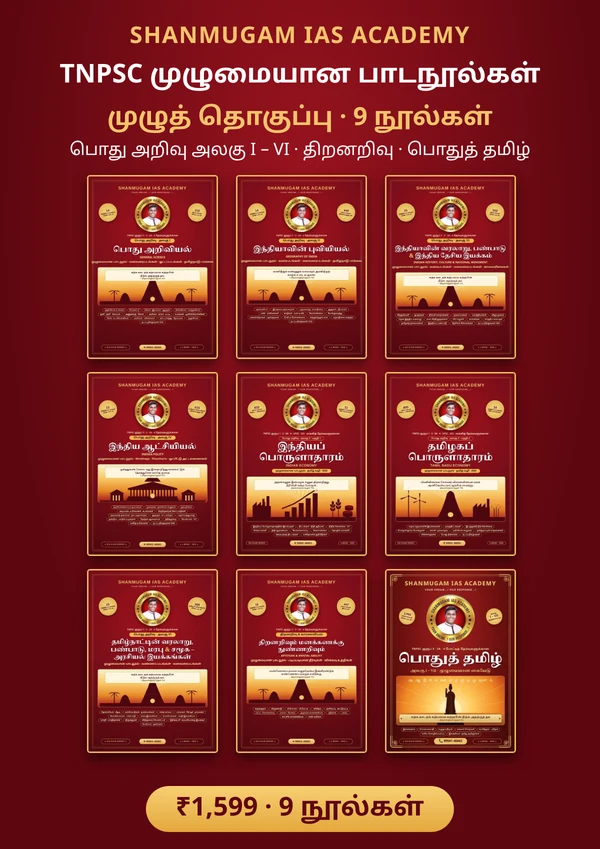 TNPSC முழுமையான பாடநூல்கள் – முழுத் தொகுப்பு (9 நூல்கள்)
₹1599
 பொதுத் தமிழ் — முந்தைய ஆண்டு வினா – விடை – விளக்கம் (புதிய பாடத்திட்டம்)
₹199
 TNPSC திறனறிவும் மனக்கணக்கு நுண்ணறிவும் (Aptitude & Mental Ability) – முழுமையான பாடநூல்
₹199
TNPSC குரூப் 1, 2/2A, 4 – நேரடி வகுப்புகள் · கோவை & மதுரை
2006 முதல் சண்முகம் IAS அகாடமி · Classroom & online coaching in Coimbatore and Madurai
