

TNPSC Group 2, 2A Question Paper 2026 with Answers (TNPSC Tentative Key)
All 200 questions of the TNPSC Group 2 / 2A (CCSE-II) Prelims held on 01-11-2026 – General Studies and Aptitude (Q1–100) and General English (Q101–200) – re-typed in clean text, with the answer from TNPSC's own tentative answer key for every question and a short explanation wherever our faculty has verified it.
Updated: 17-11-2026 · Shanmugam IAS Academy · தமிழில் படிக்க (பொது அறிவு தமிழ் வடிவம் + பொதுத் தமிழ் 101–200) →
Answers as per TNPSC tentative answer key (10-11-2026)
- Every answer on this page is TNPSC's own tentative key (tnpsc.gov.in – Tentative Answer Keys). The final key may change some answers after objections.
- Expert Committee: TNPSC has not given an answer for General Studies Q67 and General English Q157, Q161.
- Our faculty key differs from TNPSC in GS Q5, 19 and 60 (and General Tamil Q102, 118) – reasons on the answer key page.
- Every question also had option (E) "Answer not known"; it is not repeated below.
| Exam | TNPSC Combined Civil Services Examination – II (Group 2 & 2A) – Preliminary |
| Date & time | 01-11-2026 (Sunday), 9.30 am – 12.30 pm |
| Questions & marks | 200 questions, 300 marks (Part A & B: Q1–100, 150 marks; Part C General English / General Tamil: Q101–200, 150 marks) |
| Source of the text | TNPSC specimen booklets CCSE2-2AE/2026 and CCSE2-2AT/2026 published with the tentative key – re-typed by us (no scan, no candidate copy) |
Part A & B – General Studies and Aptitude & Mental Ability (Q1–100)
Questions 1–25
Reason [R] : It is semisolid under normal conditions, it melts when pressure is applied. But soon after coming out of the needle, it becomes a gel again.
- (A) [A] is true but [R] is false
- (B) Both [A] and [R] are true, and [R] is the correct explanation of [A]
- (C) [A] is false, [R] is true
- (D) Both [A] and [R] are true, but [R] is not the correct explanation of [A] is correct
Show answer
Answer: (B) Both [A] and [R] are true, and [R] is the correct explanation of [A] – as per TNPSC tentative key
Explanation: IIT Guwahati with Bose Institute (Jan 2025) developed an injectable supramolecular hydrogel that stays at the breast-tumour site and releases anti-cancer drug locally – [A] is true. The gel is shear-thinning: semi-solid at rest, it flows under injection pressure and re-gels after leaving the needle – [R] is true. This property is exactly what makes injectable, site-specific delivery possible, so [R] explains [A]; hence B, not D.
(i) International Union of Biology and Modern Biology
(ii) International Union of Biochemistry and Molecular Biology
(iii) International Union of Biology and Molecular Biology
(iv) International Union of Biochemistry and Modern Biology
- (A) (i) and (ii) only
- (B) (ii) only
- (C) (ii) and (iii) only
- (D) (iii) and (iv) only
Show answer
Answer: (B) (ii) only – as per TNPSC tentative key
Explanation: IUBMB stands for the International Union of Biochemistry and Molecular Biology. Its Nomenclature Committee gives enzymes EC numbers and divides them into classes (oxidoreductases, transferases, hydrolases, lyases, isomerases, ligases, translocases). The other expansions are made-up variants, so only (ii) is correct.
| Tribes | Area |
| (a) Angamis | 1. Meghalaya |
| (b) Todas | 2. Tamil Nadu |
| (c) Moplahs | 3. Kerala |
| (d) Birhors | 4. Nagaland |
| (e) Khasis | 5. Madhya Pradesh |
- (A) (a) 4 (b) 2 (c) 3 (d) 5 (e) 1
- (B) (a) 5 (b) 4 (c) 3 (d) 2 (e) 1
- (C) (a) 4 (b) 3 (c) 5 (d) 1 (e) 2
- (D) (a) 2 (b) 5 (c) 4 (d) 3 (e) 1
Show answer
Answer: (A) (a) 4 (b) 2 (c) 3 (d) 5 (e) 1 – as per TNPSC tentative key
Explanation: Angamis are a Naga tribe of Nagaland (4); Todas are pastoral people of the Nilgiris, Tamil Nadu (2); Moplahs (Mappilas) are Muslims of the Malabar coast, Kerala (3); Birhors are a forest hunting-gathering tribe of the Chotanagpur-central Indian belt, listed here under Madhya Pradesh (5); Khasis live in the Khasi hills of Meghalaya (1). So a-4, b-2, c-3, d-5, e-1.
| (a) National Environmental Policy | 1. 2014 |
| (b) National Action Plan on Climate Change | 2. 2006 |
| (c) Swachh Bharat Mission Guidelines | 3. 2018 |
| (d) Samagra Shiksha Guidelines | 4. 2008 |
- (A) (a) 3 (b) 1 (c) 4 (d) 2
- (B) (a) 2 (b) 4 (c) 1 (d) 3
- (C) (a) 4 (b) 2 (c) 3 (d) 1
- (D) (a) 1 (b) 2 (c) 3 (d) 4
Show answer
Answer: (B) (a) 2 (b) 4 (c) 1 (d) 3 – as per TNPSC tentative key
Explanation: National Environment Policy was approved in 2006 (a-2). National Action Plan on Climate Change was released on 30 June 2008 (b-4). Swachh Bharat Mission was launched on 2 October 2014 with its guidelines (c-1). Samagra Shiksha, merging SSA, RMSA and Teacher Education, was launched in 2018 (d-3). So 2-4-1-3.
Ministry of Agriculture and Farmers Welfare includes the
(i) Department of Agriculture, Co-operation and Farmers
(ii) Department of Animal Husbandry, Dairying and Fisheries
(iii) Department of Agricultural Research and Education
- (A) (i), (ii) only
- (B) (ii), (iii) only
- (C) (i), (iii) only
- (D) (i), (ii), (iii)
Show answer
Answer: (D) (i), (ii), (iii) – as per TNPSC tentative key
Our faculty key differs here, with evidence – see the reasons on our answer key page. The final TNPSC key will settle it.
(1) Death of Ashoka
(2) Invasion of Alexander
(3) Third Buddhist Council
(4) Founding the Mauryan Empire
- (A) (2), (4), (3), (1)
- (B) (4), (1), (3), (2)
- (C) (2), (1), (4), (3)
- (D) (3), (2), (1), (4)
Show answer
Answer: (A) (2), (4), (3), (1) – as per TNPSC tentative key
Explanation: Alexander invaded north-west India in 326 BCE; Chandragupta Maurya founded the Mauryan Empire about 321 BCE; the Third Buddhist Council was held at Pataliputra under Ashoka about 250 BCE; Ashoka died about 232 BCE. So the order is (2), (4), (3), (1).
(1) Madam Cama - Talwar Journal
(2) A.O. Hume - Commonweal
(3) Annie Besant - Mother of Indian Revolutionary
(4) D.K. Karve - 1st Women University in India.
- (A) (2) and (3) are correct
- (B) (1) and (3) are correct
- (C) (1) and (4) are correct
- (D) (1) and (2) are correct
Show answer
Answer: (C) (1) and (4) are correct – as per TNPSC tentative key
Explanation: Bhikaji (Madam) Cama brought out the revolutionary journals Bande Mataram and Madan's Talwar from Europe, so (1) is correct. Commonweal was Annie Besant's weekly, not Hume's, and the title 'Mother of Indian Revolution' belongs to Madam Cama, not Besant, so (2) and (3) are wrong. D.K. Karve founded the first women's university in India in 1916 (now SNDT Women's University), so (4) is correct.
Assertion [A] : Dr. B.R. Ambedkar announced this on 13th October 1935 at a public meeting at Yeola, in Nasik District, he vowed that
Reason [R] : “I am born a Hindu because I could not help it but I assure you that I will not die a Hindu”
- (A) [A] is true but [R] is false
- (B) Both [A] and [R] are true, and [R] is the correct explanation of [A]
- (C) [A] is false, [R] is true
- (D) Both [A] and [R] are true, but [R] is not the correct explanation of [A] is correct
Show answer
Answer: (D) Both [A] and [R] are true, but [R] is not the correct explanation of [A] is correct – as per TNPSC tentative key
Explanation: [R] is simply the wording of the vow Ambedkar took at Yeola, not the reason for the announcement. Both are true but [R] does not explain [A] – D.
- (A) Star of India
- (B) The Dawn
- (C) Qaum
- (D) Inquilab
Show answer
Answer: (B) The Dawn – as per TNPSC tentative key
Explanation: Dawn was founded by Muhammad Ali Jinnah in Delhi in 1941 (daily from 1942) as the official mouthpiece of the All-India Muslim League. Star of India, Qaum and Inquilab were other papers but not the League's official organ.
(1) Omandur P. Ramasamy - Temple Entry Authorisation and Indemnity Act 1939
(2) Rajaji - Agricultural Debt Relief Act
(3) Perunthalaivar Kamarajar - Madras Land Reforms Act
(4) T.S. Avinashilingam - Self Respect Marriages Legislation Act
- (A) (1) and (3) are correct
- (B) (1) and (4) are correct
- (C) (2) and (3) are correct
- (D) (3) and (4) are correct
Show answer
Answer: (C) (2) and (3) are correct – as per TNPSC tentative key
Explanation: The Temple Entry Authorisation and Indemnity Act 1939 and the Madras Agricultural Debt Relief Act 1938 were both passed under Rajaji's ministry (1937-39), so (1) is wrong and (2) is right; Omandurar's government passed the 1947 Temple Entry Authorisation Act. The Madras Land Reforms (Fixation of Ceiling on Land) Act 1961 came under Kamarajar, so (3) is right. Self-Respect marriages were legalised in 1967-68 under C.N. Annadurai, not T.S. Avinashilingam (Education Minister), so (4) is wrong.
- (A) Social Justice
- (B) Social Welfare
- (C) Social Equality
- (D) Social Security
Show answer
Answer: (C) Social Equality – as per TNPSC tentative key
Explanation: Beyond equality before law (Art 14) and political equality, Fundamental Rights attack social inequality through Arts 15 (non-discrimination), 16 (equal opportunity in public employment), 17 (abolition of untouchability) and 18 (abolition of titles) – i.e., social equality. Social justice, welfare and security are chiefly goals of the Directive Principles (Part IV), so C rather than A.
Assertion [A] : A Minister at the State level continues in office till he enjoys the confidence of the Chief Minister.
Reason [R] : The Chief Minister can ask him to resign or advise the Governor to dismiss him in case of difference of opinion.
- (A) [A] is false but [R] is true
- (B) Both [A] and [R] are true, and [R] is the correct explanation of [A]
- (C) [A] is true but [R] is false
- (D) Both [A] and [R] are true, but [R] is not the correct explanation of [A]
Show answer
Answer: (B) Both [A] and [R] are true, and [R] is the correct explanation of [A] – as per TNPSC tentative key
Explanation: Under Art 164(1) ministers hold office during the Governor's pleasure, but the Governor acts on the CM's advice, so in practice a minister continues only while he enjoys the CM's confidence – [A] true. In case of difference of opinion the CM can ask him to resign or advise the Governor to dismiss him – [R] true, and this is why [A] holds. In this question's option order, B = both true and [R] explains [A].
| Articles | Powers of the President |
| (a) Art. 123 | 1. Proclamation of Emergency Power |
| (b) Art. 72 | 2. Dissolve the House of People |
| (c) Art. 85 | 3. Pardoning Power |
| (d) Art. 352 | 4. Ordinance making Power |
- (A) (a) 2 (b) 3 (c) 4 (d) 1
- (B) (a) 3 (b) 4 (c) 2 (d) 1
- (C) (a) 1 (b) 2 (c) 3 (d) 4
- (D) (a) 4 (b) 3 (c) 2 (d) 1
Show answer
Answer: (D) (a) 4 (b) 3 (c) 2 (d) 1 – as per TNPSC tentative key
Explanation: Article 123 = President's ordinance-making power (4); Article 72 = pardoning power (3); Article 85(2)(b) = power to dissolve the Lok Sabha (House of the People) (2); Article 352 = proclamation of National Emergency (1). So 4-3-2-1.
(i) Article 25
(ii) Article 16
(iii) Article 28
(iv) Article 17
- (A) (i) and (ii)
- (B) (ii) only
- (C) (iii) and (iv)
- (D) (iv) only
Show answer
Answer: (D) (iv) only – as per TNPSC tentative key
Explanation: Art 25 (freedom of religion), Art 16 (no discrimination in public employment on grounds of religion) and Art 28 (no religious instruction in wholly State-funded institutions) all show that the State treats all religions equally - they are standard secular provisions. Art 17 abolishes untouchability; it is a social-equality provision, not about the State's religious neutrality. So only (iv).
(1) The Andhra Pradesh Legislative Council Act - 2005
(2) The Tamil Nadu Legislative Council Act - 2010
(3) The Jammu and Kashmir Reorganization Act - 2021
(4) Madhya Pradesh Legislative Council Act - 2024
- (A) (1) and (2) are correct
- (B) (2) and (3) are correct
- (C) (3) and (4) are correct
- (D) (1) and (3) are correct
Show answer
Answer: (A) (1) and (2) are correct – as per TNPSC tentative key
Explanation: Parliament passed the Andhra Pradesh Legislative Council Act, 2005 (council revived 2007) and the Tamil Nadu Legislative Council Act, 2010 (the Tamil Nadu council was never actually constituted). The Jammu and Kashmir Reorganisation Act was passed in 2019, not 2021, and there is no Madhya Pradesh Legislative Council Act of 2024. So (1) and (2).
- (A) Australia
- (B) India
- (C) Japan
- (D) Russia
Show answer
Answer: (B) India – as per TNPSC tentative key
Explanation: The FIDE World Cup 2025 was held in Goa, India, from 31 October to 27 November 2025 - the first time India hosted the event since 2002. Javokhir Sindarov of Uzbekistan won it.
- (A) This Act provides that the appointment of Election Commissioners should be done by the Prime Minister on the recommendations of the Selection Committee.
- (B) That Selection Committee consisting of the Prime Minister, Leader of opposition in Rajya Sabha, Union Cabinet Minister (nominated by Prime Minister)
- (C) This Act repealed the Election Commission (Conditions of Service of Election Commissioners & Transaction of Business) Act, 1991.
- (D) Under the new legislation, the Chief Justice of Supreme Court of India is part of the Selection Committee.
Show answer
Answer: (C) This Act repealed the Election Commission (Conditions of Service of Election Commissioners & Transaction of Business) Act, 1991. – as per TNPSC tentative key
Explanation: The 2023 Act says the CEC and ECs are appointed by the President (not the PM) on the recommendation of a Selection Committee of the Prime Minister, the Leader of Opposition in the Lok Sabha (not Rajya Sabha) and a Union Cabinet Minister nominated by the PM; the Chief Justice of India is not a member. Section 21 of the Act repeals the Election Commission (Conditions of Service of Election Commissioners and Transaction of Business) Act, 1991. So only C is correct.
The South Indian Liberal Federation
(i) Dr. C. Natesan was the founder.
(ii) Dr. T.M. Nair and Sir. Pitti Theagarayar were the Co-founders.
(iii) Shri Rajarathnam was the first President of the Federation.
(iv) ‘Andhra Prakasika and Muktadhara’ were the magazines of the Federation.
- (A) (i), (ii) and (iv) are correct
- (B) Only (i) is correct
- (C) (i) and (iv) are correct
- (D) (i), (ii) and (iii) are correct
Show answer
Answer: (D) (i), (ii) and (iii) are correct – as per TNPSC tentative key
Explanation: The South Indian Liberal Federation was formed on 20 Nov 1916 in Madras on the initiative of Dr C. Natesa Mudaliar, with Dr T.M. Nair and Sir Pitti Theagaraya Chetty as co-founders; Diwan Bahadur P. Rajarathna Mudaliar was chosen president at that meeting. Its papers were Justice (English), Dravidan (Tamil) and Andhra Prakasika (Telugu); 'Muktadhara' was not one, so (iv) is wrong. Hence (i), (ii), (iii).
Reason [R] : Socio-economic factors and geographical factors play a part in the extent of poverty.
- (A) [A] is true but [R] is false
- (B) Both [A] and [R] are true, and [R] is the correct explanation of [A]
- (C) [A] is false, [R] is true
- (D) Both [A] and [R] are true, but [R] is not the correct explanation of [A] is correct
Show answer
Answer: (B) Both [A] and [R] are true, and [R] is the correct explanation of [A] – as per TNPSC tentative key
Our faculty key differs here, with evidence – see the reasons on our answer key page. The final TNPSC key will settle it.
- (A) To provide free housing to all low-income families
- (B) To offer affordable housing to economically weaker groups
- (C) To promote eco-friendly housings
- (D) To provide housing loan for farmers
Show answer
Answer: (B) To offer affordable housing to economically weaker groups – as per TNPSC tentative key
Explanation: Tamil Nadu's housing schemes for the poor (TN Urban Habitat Development Board, TN Housing Board EWS/LIG schemes, rural housing) aim to give affordable housing to economically weaker sections. 'Free housing to all low-income families' (A) overstates it; eco-friendly housing and farm housing loans are not the goal.
| Tamil Nadu Agro Climate Zone | Soil type |
| (a) Kancheepuram | 1. Red loamy |
| (b) Namakkal | 2. Saline coastal |
| (c) Trichirappalli | 3. Red Sandy loam |
| (d) Kanyakumari | 4. Calcareous black |
- (A) (a) 3 (b) 4 (c) 1 (d) 2
- (B) (a) 1 (b) 2 (c) 3 (d) 4
- (C) (a) 3 (b) 2 (c) 1 (d) 4
- (D) (a) 4 (b) 3 (c) 2 (d) 1
Show answer
Answer: (A) (a) 3 (b) 4 (c) 1 (d) 2 – as per TNPSC tentative key
Explanation: Per TNAU's agro-climatic zones: Kancheepuram is in the North Eastern Zone, dominated by red sandy loam (3); Namakkal is in the North Western Zone with calcareous black soils (4); Tiruchirappalli is in the Cauvery Delta Zone with red loamy soil (1); Kanyakumari is the High Rainfall Zone with saline coastal alluvium (2). So 3-4-1-2.
- (A) M.C. Raja
- (B) R. Veerayan
- (C) Rettamalai Srinivasan
- (D) Ayothidasa Pandithar
Show answer
Answer: (C) Rettamalai Srinivasan – as per TNPSC tentative key
(i) Unmanned aircraft system activities
(ii) Initiative of Digital India
(iii) All drones should be registered with DGCA
- (A) (i) only
- (B) (ii) only
- (C) (i) and (iii) only
- (D) (ii) and (iii) only
Show answer
Answer: (C) (i) and (iii) only – as per TNPSC tentative key
Explanation: Digital Sky is the platform for unmanned aircraft system activities, and under the Drone Rules 2021 no drone may be operated without first registering it on Digital Sky and getting a UIN (unless exempted). So (i) and (iii) – C.
(i) Increase in per capita income
(ii) Increase in employment opportunities
(iii) Progress in industry
(iv) Development of Science and Technology
- (A) (i), (ii) and (iii) only
- (B) (ii), (iii) and (iv) only
- (C) (i), (iii) and (iv) only
- (D) (i), (ii) and (iv) only
Show answer
Answer: (C) (i), (iii) and (iv) only – as per TNPSC tentative key
Explanation: Planning raised national and per capita income, built an industrial base (steel, heavy and capital goods) and developed science and technology (space, atomic energy, research institutions) – these are its achievements. Employment did not keep pace with the labour force; rising unemployment is listed among the failures of planning, so options containing (ii) are out – C.
Reason [R] : Western education introduced ideas of liberty, equality and nationalism.
- (A) [A] is true but [R] is false
- (B) Both [A] and [R] are true, and [R] is the correct explanation of [A]
- (C) [A] is false, [R] is true
- (D) Both [A] and [R] are true, but [R] is not the correct explanation of [A]
Show answer
Answer: (B) Both [A] and [R] are true, and [R] is the correct explanation of [A] – as per TNPSC tentative key
Explanation: Modern (Western) education in the 19th century exposed educated Indians to rational thought and to the ideas of liberty, equality, democracy and nationalism. These ideas made them question social evils like sati, child marriage and caste, which led to reform movements such as the Brahmo Samaj and Prarthana Samaj. So both are true and [R] explains [A].
Questions 26–50
| (a) Integrated Rural Development Programme | 1. 1983 |
| (b) Rural Landless Employment Guarantee Programme | 2. 1980 |
| (c) Antyodaya Anna Yojana | 3. 2014 |
| (d) Deen Dayal Upadhyaya Grameen Kaushalya Yojana | 4. 2000 |
- (A) (a) 2 (b) 1 (c) 4 (d) 3
- (B) (a) 2 (b) 3 (c) 1 (d) 4
- (C) (a) 1 (b) 2 (c) 3 (d) 4
- (D) (a) 3 (b) 1 (c) 4 (d) 2
Show answer
Answer: (A) (a) 2 (b) 1 (c) 4 (d) 3 – as per TNPSC tentative key
Explanation: IRDP was extended to the whole country on 2 October 1980 (2); RLEGP was launched on 15 August 1983 (1); Antyodaya Anna Yojana began in December 2000 (4); DDU-GKY was launched on 25 September 2014 (3). So a-2, b-1, c-4, d-3 = option A.
(i) Self Employment Schemes
(ii) Wage Employment Schemes
(iii) Employment Generation Schemes
- (A) (i) and (ii) only
- (B) (i) and (iii) only
- (C) (ii) and (iii) only
- (D) (iii) only
Show answer
Answer: (A) (i) and (ii) only – as per TNPSC tentative key
Explanation: The Economic Survey 1998-99 grouped the poverty alleviation and employment generation programmes into two broad categories: self-employment programmes (e.g. IRDP, later SGSY) and wage-employment programmes (e.g. JRY, EAS). 'Employment generation' is the overall heading, not a separate category. Hence (i) and (ii) only.
(i) Meat refuser
(ii) Meat eater
(iii) Murderer
(iv) Loving person
- (A) (i) and (iv)
- (B) (ii) and (iii)
- (C) (iii) and (iv)
- (D) (iv) only
Show answer
Answer: (A) (i) and (iv) – as per TNPSC tentative key
Explanation: Kural 260 (Pulal Maruthal): all living beings worship with folded hands the one who neither kills nor eats meat. Such a person is full of arul (love for all life), so (i) meat refuser and (iv) loving person – option A. The meat eater and the killer are exactly the people this chapter condemns.
| (a) Madras Hindu Widow Remarriage Association | 1. 1852 |
| (b) Madras Mahajana Sabha | 2. 1817 |
| (c) Madras Literary Society | 3. 1891 |
| (d) Hindu Progressive Improvement Society | 4. 1884 |
- (A) (a) 2 (b) 3 (c) 1 (d) 4
- (B) (a) 3 (b) 1 (c) 4 (d) 2
- (C) (a) 3 (b) 4 (c) 2 (d) 1
- (D) (a) 1 (b) 2 (c) 3 (d) 4
Show answer
Answer: (C) (a) 3 (b) 4 (c) 2 (d) 1 – as per TNPSC tentative key
Explanation: Madras Mahajana Sabha was founded in 1884 (4) - only option C has b-4. The rest follow: Madras Hindu Widow Remarriage Association 1891 (3), Madras Literary Society 1817 as given in the list (2), and Hindu Progressive Improvement Society 1852, founded by Srinivasa Pillai (1). So a-3, b-4, c-2, d-1.
(i) Temple Entry Movement in India initiated in 1920s, was a social reform movement.
(ii) It aimed to challenge the discriminatory practice of denying temple entry to lower caste members.
(iii) It saw its first major struggle in the Vaikom Satyagraha in 1924.
(iv) Gandhi led the 1924 Vaikom Satyagraha.
- (A) (i) is true
- (B) (i) and (ii) are true
- (C) (i), (ii) and (iii) are true
- (D) All the above are true
Show answer
Answer: (C) (i), (ii) and (iii) are true – as per TNPSC tentative key
Explanation: The temple entry movement of the 1920s was a social reform movement against denying the so-called lower castes entry to temples and temple roads; its first major struggle was the Vaikom Satyagraha (Travancore, March 1924 - November 1925). Statement (iv) is wrong: Vaikom was led by T.K. Madhavan, K.P. Kesava Menon, K. Kelappan and later E.V. Ramasamy (Periyar), who was hailed 'Vaikom Veerar'; Gandhi only visited and negotiated in 1925.
(i) Thirukkural says : Unclaimed wealth, wealth acquired by taxes and wealth got by conquest of foes are the wealth of king.
(ii) The unclaimed wealth means the wealth by conquest of foes.
(iii) The wealth acquired by taxes is called as ulgu porul.
- (A) (i) only correct
- (B) (ii) only correct
- (C) (i) and (iii) only correct
- (D) (i) and (ii) only correct
Show answer
Answer: (C) (i) and (iii) only correct – as per TNPSC tentative key
Explanation: Kural 756: 'Uruporulum ulgu porulumthan onnaar theruporulum vendhan porul' - the king's revenue is (1) uruporul - ownerless/unclaimed wealth, (2) ulgu porul - customs/tax revenue, (3) theruporul - tribute from conquered enemies. So (i) and (iii) are correct; (ii) is wrong because unclaimed wealth (uruporul) is not the wealth from enemies (that is theruporul).
(a) He enacted law for approving self respect marriages.
(b) He named his economic policy as “Scientific Socialism”
(c) He initiated “Veeranam Drinking Water Project” for fulfilling the drinking water need to the people of Chennai.
(d) He was conferred the title “Perarignar” by Thanthai Periyar.
- (A) (a)
- (B) (b)
- (C) (c)
- (D) (d)
Show answer
Answer: (D) (d) – as per TNPSC tentative key
Explanation: Anna's government legalised self-respect marriages in 1967 by inserting Section 7-A into the Hindu Marriage Act (a correct). The paper treats (b) 'Scientific Socialism' and (c) the Veeranam drinking-water project as correct. 'Perarignar' is a popular honorific, not a title conferred by Periyar, so (d) is the incorrect statement.
(i) He founded the Madras Native Association.
(ii) He purchased the News Paper called ‘Native Interpreter’.
(iii) He formed the Hindu progressive improvement society.
(iv) He established Vidyanubavanayandira salai printing press.
- (A) (i) and (ii)
- (B) (ii) and (iii)
- (C) (i) and (iii)
- (D) (ii), (iii) and (iv)
Show answer
Answer: (A) (i) and (ii) – as per TNPSC tentative key
Explanation: Gazulu Lakshmanarasu Chetty founded the Madras Native Association in 1852 (i true). In 1844 he bought the 'Native Interpreter' and ran it as 'The Crescent' (ii true). The Hindu Progressive Improvement Society (1852) was formed by Srinivasa Pillai (iii false), and the Vidyanubalana Yantrasalai press was set up by Arumuga Navalar (iv false). Answer A.
Reason [R] : Annie Besant was the primary cause of Karunagara Menon’s decision.
- (A) [A] is true but [R] is false
- (B) Both [A] and [R] are true, and [R] is the correct explanation of [A]
- (C) [A] is false but [R] is true
- (D) Both [A] and [R] are true, but [R] is not the correct explanation of [A]
Show answer
Answer: (B) Both [A] and [R] are true, and [R] is the correct explanation of [A] – as per TNPSC tentative key
Explanation: In February 1917 the South Indian Liberal Federation planned its English daily 'Justice' and approached C. Karunakara Menon, editor of the 'Indian Patriot', to edit it. He did not take it up, so Dr T.M. Nair became honorary editor ([A] true). The paper was started largely to oppose Annie Besant's Home Rule campaign, and Menon supported the Home Rule movement. The setter treats Besant and Home Rule politics as the reason for his refusal, so [R] explains [A]: option B.
Reason [R] : He has written a book titled “A comparative grammar of the Dravidian or South-Indian family of languages”
- (A) [A] is true but [R] is false
- (B) Both [A] and [R] are true
- (C) [A] is false but [R] is true
- (D) Both [A] and [R] are false
Show answer
Answer: (C) [A] is false but [R] is true – as per TNPSC tentative key
Explanation: Robert Caldwell (1814-1891) was a 19th-century missionary, not a medieval writer; the word 'Dravida' was used much earlier, e.g. by Kumarila Bhatta (7th-8th century) for the language of the south. Caldwell popularised 'Dravidian' as a language-family name in his 1856 book 'A Comparative Grammar of the Dravidian or South-Indian Family of Languages', so R is true and A is false.
Reason [R] : It is highly dangerous one to kill the animals than not to speak untrue words.
- (A) [A] and [R] are true, and [R] is the correct explanation of [A]
- (B) [A] is true, [R] is false
- (C) [A] and [R] are true, and [R] is not the correct explanation of [A]
- (D) [A] is false, [R] is true
Show answer
Answer: (A) [A] and [R] are true, and [R] is the correct explanation of [A] – as per TNPSC tentative key
Explanation: Kural 323 says non-killing is the one supreme virtue, and truthfulness comes after it. So [A] is true. Killing a life is crueller than lying, which is exactly why non-killing ranks above truthfulness, so [R] correctly explains [A]: option A.
Theories of Archaeology.
| (a) Diffusion theory | 1. Lewis & Sally R. Binford |
| (b) Ecological Approach theory | 2. Lewis Binford |
| (c) New Archaeology theory | 3. Robert John Braidwood |
| (d) System Approach theory | 4. Elliot Smith |
- (A) (a) 4 (b) 2 (c) 3 (d) 1
- (B) (a) 4 (b) 3 (c) 2 (d) 1
- (C) (a) 1 (b) 2 (c) 3 (d) 4
- (D) (a) 1 (b) 3 (c) 2 (d) 4
Show answer
Answer: (B) (a) 4 (b) 3 (c) 2 (d) 1 – as per TNPSC tentative key
Explanation: Diffusion theory (hyper-diffusionism) is linked with Grafton Elliot Smith (a-4). Robert J. Braidwood took the ecological approach, studying farming origins at Jarmo (b-3). Lewis Binford led the 1960s New Archaeology (c-2). The systems approach is linked with Lewis and Sally R. Binford's 'New Perspectives in Archaeology' of 1968 (d-1). The code 4-3-2-1 is option B, the only option with a-4 and b-3.
- (A) 6 days
- (B) 7 days
- (C) 8 days
- (D) 9 days
Show answer
Answer: (D) 9 days – as per TNPSC tentative key
Explanation: Let A take x days; then B takes 3x days. 3x - x = 24, so x = 12: A = 12 days, B = 36 days. Together per day = 1/12 + 1/36 = 3/36 + 1/36 = 4/36 = 1/9. So they finish in 9 days.
- (A) 87 days
- (B) 76 days
- (C) 81 days
- (D) 64 days
Show answer
Answer: (C) 81 days – as per TNPSC tentative key
Explanation: Work = 1. One child's 1-day work = 1/(9x360) = 1/3240; one man = 1/(18x72) = 1/1296; one woman = 1/(12x162) = 1/1944. 4 men + 12 women + 10 children = 4/1296 + 12/1944 + 10/3240 = 1/324 + 1/162 + 1/324 = 4/324 = 1/81. So 81 days.
- (A) Rs. 61
- (B) Rs. 122
- (C) Rs. 320
- (D) Rs. 310
Show answer
Answer: (D) Rs. 310 – as per TNPSC tentative key
Explanation: For 3 years, CI - SI = P x r^2 x (300 + r) / 100^3 = 10000 x 100 x 310 / 1000000 = Rs. 310. Check: CI = 10000(1.1^3 - 1) = 3310; SI = 10000 x 10 x 3/100 = 3000; difference = 310.
- (A) Rs. 18,522
- (B) Rs. 17,640
- (C) Rs. 16,800
- (D) Rs. 2,522
Show answer
Answer: (D) Rs. 2,522 – as per TNPSC tentative key
Explanation: Quarterly rate = 20/4 = 5%; 9 months = 3 quarters. Amount = 16000 x (1.05)^3 = 16000 x 1.157625 = Rs. 18,522. Compound interest = 18,522 - 16,000 = Rs. 2,522. (Rs. 18,522 is the amount, not the interest - a trap.)
- (A) Rs. 8,500
- (B) Rs. 1,625
- (C) Rs. 5,156.25
- (D) Rs. 12,000
Show answer
Answer: (A) Rs. 8,500 – as per TNPSC tentative key
Explanation: SI = P x R x T / 100 with R = 50/3 % and T = 9/12 = 3/4 year. SI = 68000 x (50/3) x (3/4) / 100 = 68000 x 12.5 / 100 = Rs. 8,500.
- (A) 31/36 < 17/18 < 43/45 < 59/60
- (B) 17/18 < 31/36 < 43/45 < 59/60
- (C) 31/36 < 17/18 < 59/60 < 43/45
- (D) 43/45 < 17/18 < 59/60 < 31/36
Show answer
Answer: (A) 31/36 < 17/18 < 43/45 < 59/60 – as per TNPSC tentative key
Explanation: Compare how far each is from 1: 1 - 17/18 = 1/18, 1 - 31/36 = 5/36, 1 - 43/45 = 2/45, 1 - 59/60 = 1/60. The bigger the gap, the smaller the fraction: 5/36 (0.139) > 1/18 (0.056) > 2/45 (0.044) > 1/60 (0.017). So 31/36 < 17/18 < 43/45 < 59/60. (Decimals: 0.861, 0.944, 0.956, 0.983.)
- (A) 600
- (B) 500
- (C) 400
- (D) 300
Show answer
Answer: (B) 500 – as per TNPSC tentative key
Explanation: After a 60% decrease, 40% of the number remains. 40% of x = 200, so x = 200 x 100/40 = 500. Check: 500 - 60% of 500 = 500 - 300 = 200.
- (A) 103
- (B) 31
- (C) 27
- (D) 78
Show answer
Answer: (B) 31 – as per TNPSC tentative key
Explanation: Using BODMAS, do multiplication/division left to right first: 2 x 8 = 16, 16 / 2 = 8. Then 24 + 8 - 1 = 31.
- (A) F, G, L, M
- (B) G, H, M, N
- (C) F, G, M, N
- (D) G, H, L, M
Show answer
Answer: (C) F, G, M, N – as per TNPSC tentative key
Explanation: The series pairs each letter with the letter 4 places ahead: AE BF CG DH EI FJ GK HL IM JN ... Written out: A E B F C G D H E I F J G K H L I M J N. J appears twice: between F and G (F J G) and between M and N (M J N). So the letters next to J are F, G, M, N.
Using the above sequence find the number that does not belong to the group 688, 426, 542, 287.
- (A) 542
- (B) 287
- (C) 426
- (D) 688
Show answer
Answer: (B) 287 – as per TNPSC tentative key
Explanation: Take every third digit of the sequence, leaving two digits between picks. 688 comes from positions 1, 4, 7, 542 from 5, 8, 11 and 426 from 8, 11, 14. 287 cannot be formed this way (it appears only by taking every second digit, positions 11, 13, 15). It is also the only odd number of the four. Answer B, 287.
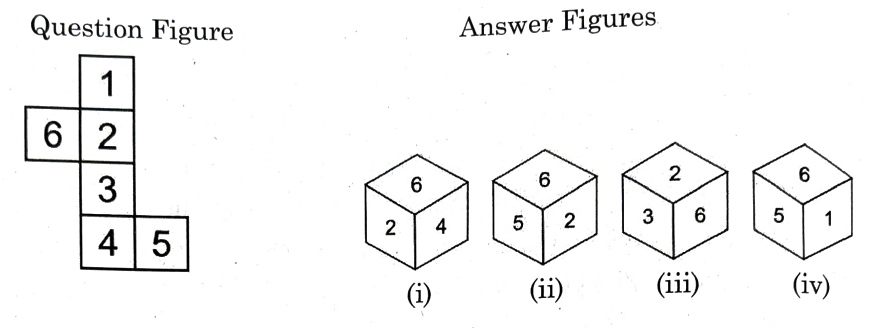
(Figure in words – Question Figure (net): a vertical column 1, 2, 3, 4 from top to bottom; 6 attached to the left of 2; 5 attached to the right of 4. Answer Figures (top / left / right faces): (i) 6 / 2 / 4; (ii) 6 / 5 / 2; (iii) 2 / 3 / 6; (iv) 6 / 5 / 1)
- (A) Only (i)
- (B) Only (ii)
- (C) (i) and (iv)
- (D) Only (iii)
Show answer
Answer: (D) Only (iii) – as per TNPSC tentative key
Explanation: In the straight strip 1-2-3-4, alternate faces are opposite: 1 and 3, 2 and 4. The flaps 6 (left of 2) and 5 (right of 4) fold onto opposite sides, so 5 is opposite 6. Opposite faces can never be seen together. (i) shows 2 and 4, while (ii) and (iv) show 5 and 6, so all three are impossible. Only (iii) (2, 3, 6) has no opposite pair, so the answer is D, Only (iii).
- (A) 25 Years
- (B) 20 Years
- (C) 27 Years
- (D) 22 Years
Show answer
Answer: (D) 22 Years – as per TNPSC tentative key
Explanation: Age order: B > Z > A (B elder than Z and A; Z elder than A). A is elder than Y, and Y is 3rd youngest, so B, Z, A are the three eldest and Z (not eldest) is 2nd oldest = 24 years. C = 20 cannot be the youngest (youngest is below 20), so the order from youngest is X < C(20) < Y < A < Z(24) < B. So A is between 20 and 24, above Y (>20): 22 years fits; 25 and 27 exceed 24 and 20 equals C.
- (A) 108
- (B) 135
- (C) 142
- (D) 159
Show answer
Answer: (D) 159 – as per TNPSC tentative key
Explanation: Letter value = 2n - 1 (n = position). F=11, I=17, L=23, M=25, H=15, I=17, N=27, D=7, I=17. Sum = 11+17+23+25+15+17+27+7+17 = 159. Shortcut: positions add to 84; 2 x 84 - 9 = 159.
Questions 51–75
(1) Science and Technology Policy
(2) Science, Technology and Innovation Policy
(3) Scientific Policy Resolution
(4) Technology Policy Statement
- (A) (2), (3), (1), (4)
- (B) (3), (4), (1), (2)
- (C) (1), (2), (3), (4)
- (D) (3), (1), (4), (2)
Show answer
Answer: (B) (3), (4), (1), (2) – as per TNPSC tentative key
Explanation: Scientific Policy Resolution came in 1958, Technology Policy Statement in 1983, Science and Technology Policy in 2003 and Science, Technology and Innovation Policy in 2013. So the order is (3), (4), (1), (2). Option D wrongly puts the 2003 policy before the 1983 statement.
| (a) Black carbon | 1. Carbon released through biological particles on snow and ice |
| (b) Grey carbon | 2. Carbon released by incomplete combustion of organic matter |
| (c) Brown carbon | 3. Carbon released through industrial emissions |
| (d) Red carbon | 4. Carbon released through fossil fuels |
- (A) (a) 4 (b) 3 (c) 2 (d) 1
- (B) (a) 3 (b) 4 (c) 1 (d) 2
- (C) (a) 3 (b) 1 (c) 4 (d) 2
- (D) (a) 1 (b) 2 (c) 3 (d) 4
Show answer
Answer: (A) (a) 4 (b) 3 (c) 2 (d) 1 – as per TNPSC tentative key
Explanation: Red carbon = biological particles (snow algae) on snow and ice (d-1); brown carbon = incomplete combustion of organic matter/biomass (c-2); grey carbon = industrial emissions (b-3); black carbon = soot from fossil-fuel burning (a-4). Only option A has red carbon = 1, so B, C, D cannot fit.
| (a) Coxsackie virus | 1. Chicken pox |
| (b) Parvovirus B19 | 2. German Measles |
| (c) Rubella virus | 3. Erythema infectiosum |
| (d) Varicella-zoster virus | 4. Hand, foot and mouth disease |
- (A) (a) 4 (b) 3 (c) 2 (d) 1
- (B) (a) 3 (b) 2 (c) 1 (d) 4
- (C) (a) 2 (b) 1 (c) 4 (d) 3
- (D) (a) 1 (b) 4 (c) 3 (d) 2
Show answer
Answer: (A) (a) 4 (b) 3 (c) 2 (d) 1 – as per TNPSC tentative key
Explanation: Coxsackie virus causes hand, foot and mouth disease (4); Parvovirus B19 causes erythema infectiosum or 'fifth disease' (3); Rubella virus causes German measles (2); Varicella-zoster virus causes chicken pox (1). So A: 4, 3, 2, 1.
(i) Expert Committee for water release decisions.
(ii) Establishing Chennai AWS network for rainfall monitoring.
(iii) Sharing of flood management best practices.
(iv) Use of only satellite data for forecasting.
- (A) (i), (ii) and (iii) only
- (B) (ii) and (iii) only
- (C) (i) and (iv) only
- (D) (ii), (iii) and (iv) only
Show answer
Answer: (A) (i), (ii) and (iii) only – as per TNPSC tentative key
Explanation: After the 2015 Chennai floods (sudden release from Chembarambakkam), the lessons included an expert committee for reservoir water-release decisions, a Chennai Automatic Weather Station network for rainfall monitoring, and sharing flood-management best practices. 'Only satellite data' is wrong – forecasting combines ground stations, radar and satellites.
Assertion [A] : The Omega Block over Europe has been conclusively established as the primary cause of India’s delayed monsoon.
Reason [R] : Scientists are still examining whether the Omega Block’s diversion of atmospheric jet stream has influenced the Indian Monsoon.
- (A) Both [A] and [R] are true, and [R] is the correct explanation of [A]
- (B) Both [A] & [R] are true, but [R] is not the correct explanation of [A]
- (C) [A] is true, but [R] is false
- (D) [A] is false, but [R] is true
Show answer
Answer: (D) [A] is false, but [R] is true – as per TNPSC tentative key
Explanation: An Omega Block is a blocking high-pressure pattern shaped like the Greek letter omega that can divert the jet stream. Scientists are only studying whether it influenced the Indian monsoon; it has NOT been 'conclusively established' as the primary cause of delay. The word 'conclusively' makes [A] false, while [R] is true.
(i) Dr. Yellapragada Subbarao mapped ATP and phosphocreatine and created methotrexate.
(ii) He was born in Arunachal Pradesh.
(iii) Denial of MBBS degree at Madras Medical College due to wearing Dhoti.
- (A) (ii) only
- (B) (i) and (ii) only
- (C) (i) and (iii) only
- (D) (i) only
Show answer
Answer: (D) (i) only – as per TNPSC tentative key
Assertion [A] : Shivaji aimed at establishing Maratha rule in Delhi.
Reason [R] : Shivaji took the leadership of the Maratha resistance against the Mughals.
- (A) [A] is false but [R] is true
- (B) Both [A] and [R] are true, and [R] is the correct explanation of [A]
- (C) [A] is true but [R] is false
- (D) Both [A] and [R] are true, but [R] is not a correct explanation of [A]
Show answer
Answer: (A) [A] is false but [R] is true – as per TNPSC tentative key
Explanation: Shivaji's aim was Swarajya – an independent Maratha kingdom in the Deccan – not Maratha rule at Delhi; Maratha influence over Delhi came later under the Peshwas. So [A] is false. He did lead the Maratha resistance against the Mughals – [R] true.
| (a) The East India Association | 1. Sisir Kumar Ghosh |
| (b) The Indian League | 2. Dadabhai Naoroji |
| (c) The Bombay Association | 3. P. Ananda Charlu |
| (d) The Madras Mahajana Sabha | 4. Badruddin Tyabji |
- (A) (a) 3 (b) 1 (c) 4 (d) 2
- (B) (a) 2 (b) 1 (c) 4 (d) 3
- (C) (a) 3 (b) 2 (c) 4 (d) 1
- (D) (a) 4 (b) 1 (c) 3 (d) 2
Show answer
Answer: (B) (a) 2 (b) 1 (c) 4 (d) 3 – as per TNPSC tentative key
Explanation: East India Association (London, 1866) was founded by Dadabhai Naoroji (2); the Indian League (1875) by Sisir Kumar Ghosh (1); the Bombay (Presidency) Association (1885) by Badruddin Tyabji with Pherozeshah Mehta and K.T. Telang (4); the Madras Mahajana Sabha (1884) by P. Ananda Charlu, M. Viraraghavachari and others (3). So B: 2, 1, 4, 3.
(1) Vaikkom Satyagraha - 1924
(2) Self Respect Movement - 1925
(3) Self Respect Marriage Act - 1935
(4) First Communal Government Order - 1929
- (A) (1) and (3)
- (B) (3) and (4)
- (C) (4) and (1)
- (D) (2) and (3)
Show answer
Answer: (B) (3) and (4) – as per TNPSC tentative key
Explanation: Vaikom Satyagraha began in 1924 and Periyar started the Self-Respect Movement in 1925 - both correct. Self-respect marriages were legalised only in 1967 (Hindu Marriage (Madras Amendment) Act, 1967, under Anna), not 1935. The First Communal G.O. was issued by the Justice Party government on 16 September 1921, not 1929. So (3) and (4) are wrongly paired.
Reason [R] : Gandhi participated in the Second Round Table Conference.
- (A) [A] is true but [R] is false
- (B) Both [A] and [R] are true, and [R] is the correct explanation of [A]
- (C) [A] is false, [R] is true
- (D) Both [A] and [R] are true, but [R] is not the correct explanation of [A]
Show answer
Answer: (B) Both [A] and [R] are true, and [R] is the correct explanation of [A] – as per TNPSC tentative key
Our faculty key differs here, with evidence – see the reasons on our answer key page. The final TNPSC key will settle it.
| Part | Subject |
| (a) XI | 1. The Directive Principles of State Policy |
| (b) IX | 2. Elections |
| (c) XV | 3. Panchayats |
| (d) IV | 4. Relations between the Union and the States |
- (A) (a) 2 (b) 1 (c) 4 (d) 3
- (B) (a) 1 (b) 3 (c) 4 (d) 2
- (C) (a) 3 (b) 4 (c) 1 (d) 2
- (D) (a) 4 (b) 3 (c) 2 (d) 1
Show answer
Answer: (D) (a) 4 (b) 3 (c) 2 (d) 1 – as per TNPSC tentative key
Explanation: Part XI deals with Relations between the Union and the States (4); Part IX with Panchayats (3); Part XV with Elections (2); Part IV with Directive Principles of State Policy (1). So D: 4, 3, 2, 1.
(1) Dr. Asom Gana Parishad
(2) Biju Janata Dal
(3) National Peoples Party
(4) Aam Aadmi Party
- (A) (2), (3), (1), (4)
- (B) (1), (2), (4), (3)
- (C) (4), (3), (2), (1)
- (D) (3), (1), (4), (2)
Show answer
Answer: (B) (1), (2), (4), (3) – as per TNPSC tentative key
Explanation: Asom Gana Parishad was formed in October 1985, Biju Janata Dal in December 1997, Aam Aadmi Party on 26 November 2012 and National People's Party (P.A. Sangma) on 6 January 2013. So the order is (1), (2), (4), (3).
Find out the correct statements.
- (A) It’s a complete judicial body
- (B) It was established under the Consumer Protection Act, 1986
- (C) It’s headed by the Union Minister of Consumer Affairs
- (D) It’s Headquarter is Allahabad
Show answer
Answer: (B) It was established under the Consumer Protection Act, 1986 – as per TNPSC tentative key
Explanation: NCDRC is a quasi-judicial body set up in 1988 under the Consumer Protection Act, 1986 (now continued under the 2019 Act). It is headed by a President who is a (retired) Supreme Court judge, not a Minister, and it sits in New Delhi, not Allahabad.
(i) This Committee was set up first in 1921 under the provisions of Government of India Act, 1919
(ii) This Committee consists of 22 members, 15 members from Lok Sabha and 7 members from Rajya Sabha
(iii) A Minister cannot be elected as a Member of the Committee
- (A) (i) only
- (B) (i) and (iii) only
- (C) (i) and (ii) only
- (D) (i), (ii) and (iii)
Show answer
Answer: (D) (i), (ii) and (iii) – as per TNPSC tentative key
Explanation: The PAC was first set up in 1921 under the Government of India Act, 1919 (Montford reforms). It has 22 members - 15 from Lok Sabha and 7 from Rajya Sabha. A Minister cannot be elected a member, and a member who becomes a Minister ceases to be a member. All three are true.
(i) Panchayats have power to implementation of schemes for economic development and Social Justice.
(ii) Panchayats have no power to prepare a plan for Economic Development and Social Justice.
(iii) Panchayat can file a petition against an order of a State Authority.
- (A) (i) only
- (B) (i) and (ii) only
- (C) (i) and (iii) only
- (D) (ii) and (iii) only
Show answer
Answer: (C) (i) and (iii) only – as per TNPSC tentative key
Explanation: Under Art. 243G Panchayats may be empowered both to prepare plans and to implement schemes for economic development and social justice – (i) true, (ii) false. A Panchayat is a body corporate, and the Supreme Court (Village Panchayat Calangute case, 2012) held that a Village Panchayat can file a writ petition against an order of a State authority (Director of Panchayats) – so (iii) is true and 'A: (i) only' is wrong.
| Name of the Leader | Political Vision |
| (a) Jawaharlal Nehru | 1. Liberal Democrat |
| (b) Dr. B.R. Ambedkar | 2. Radical egalitarian |
| (c) Mahatma Gandhi | 3. Non-Modernist |
| (d) K.T. Shah | 4. Social Democrat |
- (A) (a) 1 (b) 2 (c) 3 (d) 4
- (B) (a) 4 (b) 1 (c) 3 (d) 2
- (C) (a) 2 (b) 4 (c) 3 (d) 1
- (D) (a) 3 (b) 2 (c) 1 (d) 4
Show answer
Answer: (B) (a) 4 (b) 1 (c) 3 (d) 2 – as per TNPSC tentative key
Explanation: The visions seen in the Constituent Assembly: Nehru – social democrat (4), Ambedkar – liberal democrat (1), Gandhi – non-modernist (3), K.T. Shah – radical egalitarian (2). So 4-1-3-2 = option B. Option A swaps the labels of Ambedkar and Shah.
(i) Lokpal can suo motu proceed against any public servant.
(ii) Legal assistance to public servants against whom complaint is filed.
(iii) Limitation period of 7 years to file complaints.
- (A) (i) only
- (B) (i) and (ii) only
- (C) (i) and (iii) only
- (D) (ii) and (iii) only
Show answer
Placed before the Expert Committee – TNPSC has not given an answer for this question in its tentative key; the decision will come with the final key.
(1) Art. 353 - Effect of Proclamation of Emergency
(2) Art. 355 - Duty of the Union to protect states against external aggression and internal disturbance
(3) Art. 357 - Suspension of provisions of Article 21 during emergencies.
(4) Art. 358 - Suspension of enforcement of the rights conferred by Part III during emergencies.
- (A) (1) and (3) are correct
- (B) (1) and (2) are correct
- (C) (2) and (3) are correct
- (D) (3) and (4) are correct
Show answer
Answer: (B) (1) and (2) are correct – as per TNPSC tentative key
Explanation: Article 353 deals with the effect of a Proclamation of Emergency and Article 355 with the Union's duty to protect States against external aggression and internal disturbance - both correct. Article 357 is about exercise of legislative powers under a proclamation under Article 356; Article 358 is suspension of Article 19 during emergencies, while suspension of enforcement of Part III rights is Article 359. So only (1) and (2).
| (a) Article 330 | 1. Reservation of seats for SC and ST in the Legislative Assembly of States. |
| (b) Article 331 | 2. Reservation for SC and ST in the House of People. |
| (c) Article 332 | 3. Representation of the Anglo-Indian Community in the Legislative Assembly of the State |
| (d) Article 333 | 4. Representation of the Anglo-Indian Community in the House of People. |
- (A) (a) 3 (b) 1 (c) 2 (d) 4
- (B) (a) 2 (b) 3 (c) 4 (d) 1
- (C) (a) 2 (b) 4 (c) 1 (d) 3
- (D) (a) 4 (b) 3 (c) 2 (d) 1
Show answer
Answer: (C) (a) 2 (b) 4 (c) 1 (d) 3 – as per TNPSC tentative key
Explanation: Art. 330 - reservation of seats for SCs/STs in the Lok Sabha (2); Art. 331 - representation of Anglo-Indians in the Lok Sabha (4); Art. 332 - reservation for SCs/STs in State Legislative Assemblies (1); Art. 333 - representation of Anglo-Indians in State Assemblies (3). (Anglo-Indian nomination ended in 2020 by the 104th Amendment, but the Articles remain.) So C: 2, 4, 1, 3.
- (A) Directorate of Medical Education
- (B) Directorate of Medical and Rural Health Services
- (C) Directorate of Public Health and Preventive Medicine
- (D) Directorate of Family Welfare
Show answer
Answer: (B) Directorate of Medical and Rural Health Services – as per TNPSC tentative key
Explanation: In Tamil Nadu, the Directorate of Medical and Rural Health Services runs the non-teaching district and taluk hospitals that give secondary care, and the Director is the Appropriate Authority for Acts like the PC&PNDT Act and the Clinical Establishments Act. Medical Education handles tertiary/teaching hospitals, Public Health handles primary/preventive care.
Reason [R] : Out of which, around 3% land are under Dense Forest.
- (A) [A] is true but [R] is false
- (B) Both [A] and [R] are true
- (C) [R] is true but [A] is false
- (D) Both [A] and [R] are false
Show answer
Answer: (B) Both [A] and [R] are true – as per TNPSC tentative key
Explanation: Per ISFR 2021, Tamil Nadu's forest cover is 26,419 sq km, 20.31% (one fifth) of its area – [A] true. Very dense forest is 3,593 sq km, about 2.8% (~3%) of the area – [R] true.
Reason [R] : Agricultural incomes have declined due to wide fluctuations in climatic conditions.
- (A) [A] is true but [R] is false
- (B) [A] is false but [R] is true
- (C) Both [A] and [R] are true, and [R] is the correct explanation of [A]
- (D) Both [A] and [R] are true, but [R] is not the correct explanation of [A]
Show answer
Answer: (D) Both [A] and [R] are true, but [R] is not the correct explanation of [A] – as per TNPSC tentative key
Explanation: Rising farm output raises rural incomes and employment, so poverty falls – [A] true. Climatic fluctuations (droughts, floods) have reduced farm incomes – [R] true. But [R] is about falling incomes and does not explain why poverty declines when output rises.
(i) It employs fiscal and monetary tools to promote economic growth
(ii) It employs economic tools to achieve national security objectives
(iii) It reflects rising geopolitical competition.
- (A) (i) and (ii) only
- (B) (ii) and (iii) only
- (C) (iii) only
- (D) (i) and (iii) only
Show answer
Answer: (B) (ii) and (iii) only – as per TNPSC tentative key
Explanation: Economic statecraft means using economic instruments - tariffs, sanctions, export controls, investment screening, aid, supply-chain policy - to achieve foreign-policy and national-security goals, and its growing use reflects rising geopolitical competition (e.g. US-China). Using fiscal and monetary tools to promote growth is ordinary macroeconomic policy, not statecraft. So (ii) and (iii).
| (a) Art 268 | 1. Taxes levied and collected by the union but assigned to the states |
| (b) Art 269 | 2. Grants-in-aid |
| (c) Art 275 | 3. Finance commission |
| (d) Art 280 | 4. Duties levied by the union but collected and appropriated by the states |
- (A) (a) 4 (b) 1 (c) 2 (d) 3
- (B) (a) 1 (b) 2 (c) 3 (d) 4
- (C) (a) 1 (b) 4 (c) 2 (d) 3
- (D) (a) 4 (b) 3 (c) 2 (d) 1
Show answer
Answer: (A) (a) 4 (b) 1 (c) 2 (d) 3 – as per TNPSC tentative key
Explanation: Art. 268 - duties levied by the Union but collected and appropriated by the States (e.g. stamp duties) (4); Art. 269 - taxes levied and collected by the Union but assigned to the States (1); Art. 275 - grants-in-aid from the Union to States (2); Art. 280 - Finance Commission (3). So A: 4, 1, 2, 3.
Reason [R] : Developing economies are characterized by low resource base of the poor who own a very small portion of the total assets.
- (A) [A] is true but [R] is false
- (B) Both [A] and [R] are true, and [R] is the correct explanation of [A]
- (C) [A] is false but [R] is true
- (D) Both [A] and [R] are true, but [R] is not the correct explanation of [A]
Show answer
Answer: (B) Both [A] and [R] are true, and [R] is the correct explanation of [A] – as per TNPSC tentative key
Explanation: Mass poverty is the central problem of developing economies – [A] true. The poor have a very low resource base, owning only a tiny share of total assets, so their incomes stay low – this causes mass poverty, so [R] explains [A].
Questions 76–100
(i) Protect the farmers from exploitative practices of private traders.
(ii) All the people living below poverty line in rural areas are eligible for solar powered green houses.
(iii) No land acquisition is envisaged under this scheme. Only people with patta for their sites are eligible under this scheme.
- (A) (i) only
- (B) (ii) only
- (C) (iii) only
- (D) (ii) and (iii) only
Show answer
Answer: (D) (ii) and (iii) only – as per TNPSC tentative key
Explanation: The TN Rural Development Department's CMSPGHS page lists under Features (2.1), word for word: 'All the people living below poverty line in rural areas are eligible for Solar Powered Green Houses' and 'No land acquisition is envisaged under this scheme. Only people with patta for their sites are eligible' – so (ii) and (iii) are true. (i) is the aim of Uzhavar Sandhai/regulated markets, not a housing scheme. Extra conditions in the separate eligibility section (BPL wait list, 300 sq ft site) do not make the official feature (ii) false, so C is wrong.
(i) This system was introduced by Cornwallis in 1973.
(ii) This system was prevalent in West Bengal, Bihar, Orissa, Uttar Pradesh, Andhra Pradesh and Madhya Pradesh.
(iii) The demand was fixed at 9/11 of the rental, the rest 2/11 being the Zamindar’s remuneration.
(iv) The Zamindari settlement made them owner of the land. Thereby creating a permanent interest in land.
- (A) (i), (iii) and (iv) only
- (B) (ii) and (iii) only
- (C) (i), (ii) and (iv) only
- (D) (i) and (iv) only
Show answer
Answer: (C) (i), (ii) and (iv) only – as per TNPSC tentative key
Explanation: The Zamindari (Permanent Settlement) system was introduced by Cornwallis in 1793 (the paper prints 1973 – misprint). It prevailed in Bengal, Bihar, Orissa, UP, Andhra and MP, and made zamindars owners of land with a permanent interest – (i), (ii), (iv) true. (iii) is false: the state demand was 10/11 of the rental and the zamindar kept 1/11, not 9/11 and 2/11.
| (a) Indian Money Market | 1. New York |
| (b) England Money Market | 2. Mumbai |
| (c) USA Money Market | 3. London |
| (d) Japan Money Market | 4. Tokyo |
- (A) (a) 2 (b) 3 (c) 1 (d) 4
- (B) (a) 3 (b) 2 (c) 4 (d) 1
- (C) (a) 4 (b) 3 (c) 1 (d) 2
- (D) (a) 1 (b) 2 (c) 4 (d) 3
Show answer
Answer: (A) (a) 2 (b) 3 (c) 1 (d) 4 – as per TNPSC tentative key
Explanation: The main money-market centres: India - Mumbai (2), England - London (3), USA - New York (1), Japan - Tokyo (4). So (a)-2, (b)-3, (c)-1, (d)-4, which is option A.
(1) Viralkavar Periyazh Paanar - Kurunthogai
(2) Meen Seevum Pancheri Yodu - Madurai Kanchi
(3) Mullai Nalyazh Paanar - Ayngurunooru
(4) Paanar Padumalai Panniya Yelaalin - Pathitrupaththu
- (A) (1) and (4)
- (B) (1) and (2)
- (C) (2) and (3)
- (D) (3) and (4)
Show answer
Answer: (A) (1) and (4) – as per TNPSC tentative key
Explanation: 'Viral kavar periyazh' is from Pathitrupathu, not Kurunthogai – (1) wrong. 'Paanar padumalai panniya ezhaalin' is Kurunthogai 323 (Pathadi Vaikalar), not Pathitrupathu – (4) wrong; the two sources are swapped. 'Meen seevum paancheriyodu' (Maduraikanchi) and 'Mullai nalyazh paana' (Ainkurunuru) are correct.
(1) Glimpses of world history - Gandhiji
(2) India wins freedom - Abul Kalam Azad
(3) The Indian Struggle - Subash Chandra Bose
(4) The Story of My Experiment with Truth - Jawaharlal Nehru
- (A) (1) and (3) are correct
- (B) (1) and (2) are correct
- (C) (2) and (3) are correct
- (D) (3) and (4) are correct
Show answer
Answer: (C) (2) and (3) are correct – as per TNPSC tentative key
Explanation: 'India Wins Freedom' is by Maulana Abul Kalam Azad and 'The Indian Struggle' is by Subhas Chandra Bose - both correct. 'Glimpses of World History' was written by Jawaharlal Nehru and 'The Story of My Experiments with Truth' by Gandhiji, so (1) and (4) are swapped and wrong.
- (A) who are without material wealth
- (B) who are without spiritual wealth
- (C) who are without love
- (D) who are without knowledge
Show answer
Answer: (A) who are without material wealth – as per TNPSC tentative key
Explanation: The line is from Kural 752 (chapter Porul Seyalvagai): 'Illaarai ellaarum elluvar; selvarai ellaarum seyvar sirappu' - everyone despises those who have nothing and everyone honours the rich. Since the chapter is about earning wealth and 'illaar' is contrasted with 'selvar' (the rich), it means those without material wealth.
Assertion [A] : In 1925 Thanthai Periyar left the Congress Party.
Reason [R] : In 1925 Thanthai Periyar started the Self-Respect Movement.
Code :
- (A) [A] is true but [R] is false
- (B) [A] is false but [R] is true
- (C) Both [A] and [R] are true, and [R] is the correct explanation of [A]
- (D) Both [A] and [R] are true, but [R] is not the correct explanation of [A]
Show answer
Answer: (D) Both [A] and [R] are true, but [R] is not the correct explanation of [A] – as per TNPSC tentative key
Explanation: Periyar left the Congress in 1925 after his communal-representation resolution was rejected at the Kanchipuram conference, and he started the Self-Respect Movement the same year – both true. But starting the movement was the result, not the cause, of leaving Congress, so [R] does not explain [A].
- (A) Kurunthokai
- (B) Natrinai
- (C) Pattinapalai
- (D) Pathitrupathu
Show answer
Answer: (D) Pathitrupathu – as per TNPSC tentative key
Explanation: Kodumanal (Erode district, on the Noyyal) was an ancient industrial and trade centre. Pathitrupathu (on the Chera kings) mentions it as 'Kodumanam', famous for its ornaments. Excavations there found beads, iron-working and Tamil-Brahmi pottery inscriptions.
The person who received “Kaisar i Hind” medal from the British for the medical service on the ship ‘SS Madras’ during the first world war.
- (A) Natesanar
- (B) T.A. Ramalingam
- (C) Sir. Pitti Thiyagarayar
- (D) T.M. Nair
Show answer
Answer: (D) T.M. Nair – as per TNPSC tentative key
Explanation: Dr. T.M. Nair, a co-founder of the Justice Party, served as one of the surgeons on the hospital ship SS Madras during the First World War and was awarded the Kaiser-i-Hind medal at the end of the war. Natesanar was also a doctor, but the SS Madras service and the medal belong to T.M. Nair.
(I) To promote rationale thinking, self-respect and self confidence.
(II) To protect the rights of the Brahmins.
(III) To eradicate the social evils like injustice towards women.
(IV) To abolish superstitious beliefs.
- (A) (I), (II) and (IV)
- (B) (I), (III) and (IV)
- (C) (II), (III) and (IV)
- (D) (I), (II), (III) and (IV)
Show answer
Answer: (B) (I), (III) and (IV) – as per TNPSC tentative key
Explanation: The Self-Respect Movement (1925) aimed at rational thinking and self-respect, removal of social evils such as caste discrimination and injustice to women, and abolition of superstitions. It opposed Brahminical dominance, so 'protecting the rights of the Brahmins' (II) is wrong. Hence (I), (III) and (IV).
| (a) Food mixed by little fingers of children’s hands | 1. Speaking sweet words |
| (b) One’s hand is to make to choice of unripe to ripe fruit | 2. The wealth of self control |
| (c) It is not good to forget the good done | 3. Gratitude |
| (d) The tongue’s caustic reproach will never heal | 4. The Begetting of children |
- (A) (a) 4 (b) 1 (c) 3 (d) 2
- (B) (a) 3 (b) 2 (c) 1 (d) 4
- (C) (a) 1 (b) 2 (c) 3 (d) 4
- (D) (a) 4 (b) 3 (c) 2 (d) 1
Show answer
Answer: (A) (a) 4 (b) 1 (c) 3 (d) 2 – as per TNPSC tentative key
Explanation: 'Sirukai alaaviya koozh' - Kural 64, chapter Makkatperu (Begetting of children) = 4. 'Kaniyiruppak kaai kavarnthatru' - Kural 100, Iniyavai Kooral (Speaking sweet words) = 1. 'Nandri marappathu nandrandru' - Kural 108, Seynandri Arithal (Gratitude) = 3. 'Aaraathe naavinaal sutta vadu' - Kural 129, Adakkamudaimai (Self control) = 2. Code 4, 1, 3, 2 = A.
(Like the swan that leaving the water drinks the milk)
- (A) Leaving the water drink the milk
- (B) Learning the books likes the qualities of milk and water
- (C) Learning good books by removing bad ones
- (D) Learning in the way of things learned from good books
Show answer
Answer: (C) Learning good books by removing bad ones – as per TNPSC tentative key
Explanation: This is from Naladiyar song 135 (chapter Kalvi): learning is endless, life is short and full of troubles, so one should carefully choose and learn only the good, worthy books, leaving out the useless ones - just as the swan (annam) drinks only the milk leaving the water. So the message is to learn good books by removing bad ones. Option A is only the literal picture; D (living by what is learnt) is not this line's point.
(1) South Indian Liberal Federation - 1950
(2) Trade Union (or) Labour Union - 1918
(3) Communal Reservation Law - 1921
(4) Charity Law - 1930
- (A) (1) and (4) are correct
- (B) (2) and (4) are correct
- (C) (1) and (3) are correct
- (D) (2) and (3) are correct
Show answer
Answer: (D) (2) and (3) are correct – as per TNPSC tentative key
Explanation: The Madras Labour Union, India's first trade union, was formed in 1918 (B.P. Wadia) - correct. The first Communal G.O. on reservation was issued by the Justice Party government in 1921 - correct. The South Indian Liberal Federation (Justice Party) was founded in 1916, not 1950, and the Hindu Religious Endowments (charity) Act came in 1926, not 1930.
- (A) 1548.8 cm²
- (B) 1558.8 cm²
- (C) 1538.8 cm²
- (D) 1528.8 cm²
Show answer
Answer: (B) 1558.8 cm² – as per TNPSC tentative key
Explanation: Side = 180 / 3 = 60 cm. Area = (√3 / 4) × side² = (1.732 / 4) × 3600 = 1.732 × 900 = 1558.8 cm².
- (A) 1612 sq.feet
- (B) 1522 sq.feet
- (C) 1512 sq.feet
- (D) 1622 sq.feet
Show answer
Answer: (C) 1512 sq.feet – as per TNPSC tentative key
Explanation: Each rope = 84 / 2 = 42 ft. Each cow grazes a quarter circle; four quarters = one full circle = (22/7) x 42 x 42 = 5544 sq ft. Square area = 84 x 84 = 7056 sq ft. Ungrazed = 7056 - 5544 = 1512 sq ft.
- (A) Rs. 14,000
- (B) Rs. 11,400
- (C) Rs. 12,000
- (D) Rs. 12,200
Show answer
Answer: (C) Rs. 12,000 – as per TNPSC tentative key
Explanation: Simple interest: total rate = 6 x 2 + 9 x 3 + 14 x 4 = 12 + 27 + 56 = 95%. So 95% of P = 11,400, P = 11,400 x 100 / 95 = Rs. 12,000.
- (A) 81
- (B) 84
- (C) 83
- (D) 48
Show answer
Answer: (D) 48 – as per TNPSC tentative key
Explanation: Milk = 72 x 5/8 = 45 L, water = 27 L. For milk : water = 3 : 5 with milk 45 L, water must be 45 x 5/3 = 75 L. Water to add = 75 - 27 = 48 L.
- (A) Rs. 1,300
- (B) Rs. 1,000
- (C) Rs. 640
- (D) Rs. 780
Show answer
Answer: (C) Rs. 640 – as per TNPSC tentative key
Explanation: A : B = 2 : 3, B : C = 2 : 3, C : D = 2 : 3, so A : B : C : D = 8 : 12 : 18 : 27 (total 65 parts). One part = 5200 / 65 = 80, so A = 8 x 80 = Rs. 640 (B 960, C 1440, D 2160).
- (A) 21
- (B) 48
- (C) 14
- (D) 22
Show answer
Answer: (C) 14 – as per TNPSC tentative key
Explanation: For the least number of equal stacks, take the HCF: HCF(336, 240, 96) = 48 books per stack. Stacks = 336/48 + 240/48 + 96/48 = 7 + 5 + 2 = 14.
- (A) 768
- (B) 652
- (C) 1024
- (D) 512
Show answer
Answer: (A) 768 – as per TNPSC tentative key
Explanation: 90% - 72% = 18% of the number = 256. 54% is 3 times 18%, so 54% = 3 x 256 = 768.
1, 3, 11, 31, 69, .
- (A) 125
- (B) 130
- (C) 131
- (D) 132
Show answer
Answer: (C) 131 – as per TNPSC tentative key
Explanation: Differences: 2, 8, 20, 38; second differences: 6, 12, 18 (increase by 6). Next second difference 24, next difference 38 + 24 = 62, next term 69 + 62 = 131.
- (A) 32761
- (B) 81225
- (C) 42438
- (D) 20164
Show answer
Answer: (C) 42438 – as per TNPSC tentative key
Explanation: A perfect square never ends in 2, 3, 7 or 8. 42438 ends in 8, so it cannot be a square. Check: 32761 = 181^2, 81225 = 285^2, 20164 = 142^2.

(Figure in words – three views of the same cube (top / left / right faces): (i) F / A / D; (ii) E / C / F; (iii) D / A / B)
- (A) A
- (B) D
- (C) E
- (D) F
Show answer
Answer: (D) F – as per TNPSC tentative key
Explanation: F is seen next to A and D (cube 1) and next to E and C (cube 2). So F touches A, C, D and E; the only letter left is B, so F is opposite B. With B on top, F is at the bottom.
- (A) Sunday
- (B) Saturday
- (C) Monday
- (D) Wednesday
Show answer
Answer: (D) Wednesday – as per TNPSC tentative key
Explanation: 75 days = 10 weeks + 5 days. Going 5 days back from Monday: Sunday, Saturday, Friday, Thursday, Wednesday. So her birthday was on Wednesday.
P O L I C M A N T
1 2 3 4 5 6 7 8 9
- (A) 2, 5, 6, 7, 1, 4, 8, 3, 9
- (B) 5, 2, 7, 1, 6, 4, 3, 8, 9
- (C) 5, 2, 6, 1, 3, 4, 7, 8, 9
- (D) 2, 5, 1, 6, 7, 3, 8, 4, 9
Show answer
Answer: (C) 5, 2, 6, 1, 3, 4, 7, 8, 9 – as per TNPSC tentative key
Explanation: Decode option C: 5-C, 2-O, 6-M, 1-P, 3-L, 4-I, 7-A, 8-N, 9-T = COMPLIANT, a meaningful word. The others give OCMAPINLT, COAPMILNT and OCPMALNIT, which are not words.
Part C – General English (Q101–200)
Questions 101–125
- (A) Mohan is one of the best students in the college
- (B) Mohan is a best student of our college
- (C) Mohan is the best student in our college
- (D) None of the above
Show answer
Answer: (C) Mohan is the best student in our college – as per TNPSC tentative key
His words filled them with terror.
- (A) SVOC
- (B) SVOA
- (C) SVCA
- (D) SVIODO
Show answer
Answer: (A) SVOC – as per TNPSC tentative key
A fox once met a lion. The fox had never seen a lion before. is
- (A) A fox who had never seen a lion before met him
- (B) A fox who have never seen a lion before met him
- (C) A fox had never seen a lion before
- (D) A fox had never met a lion before
Show answer
Answer: (A) A fox who had never seen a lion before met him – as per TNPSC tentative key
| Column A | Column B |
| (a) I am a hardworking person | 1. can’t she? |
| (b) Her sister can teach English | 2. didn’t she? |
| (c) She came to college | 3. do we? |
| (d) We don’t watch movies | 4. aren’t I? |
- (A) (a) 4 (b) 1 (c) 2 (d) 3
- (B) (a) 3 (b) 2 (c) 4 (d) 1
- (C) (a) 3 (b) 4 (c) 2 (d) 1
- (D) (a) 1 (b) 4 (c) 3 (d) 2
Show answer
Answer: (A) (a) 4 (b) 1 (c) 2 (d) 3 – as per TNPSC tentative key
- (A) Go
- (B) Talk
- (C) Eat
- (D) Sing
Show answer
Answer: (B) Talk – as per TNPSC tentative key
I have had dinner.
- (A) have
- (B) had
- (C) have had
- (D) had have
Show answer
Answer: (B) had – as per TNPSC tentative key
“Work faster”
- (A) Do work faster, Don’t waste time.
- (B) Please work faster.
- (C) Wonderful initiative in picking up the pace.
- (D) You should work fast to achieve more.
Show answer
Answer: (C) Wonderful initiative in picking up the pace. – as per TNPSC tentative key
“Please help me”.
- (A) Can you help me?
- (B) You help me?
- (C) Will help me?
- (D) Did you help me?
Show answer
Answer: (A) Can you help me? – as per TNPSC tentative key
(a) You were detained!
(b) How wonderful she!
(c) What a surprise that was!
(d) Can you believe you were detained?
- (A) (a)
- (B) (b)
- (C) (c)
- (D) (d)
Show answer
Answer: (C) (c) – as per TNPSC tentative key
- (A) No one will remember.
- (B) Well done! You got selected.
- (C) Read the instructions carefully.
- (D) No pain No gain.
Show answer
Answer: (C) Read the instructions carefully. – as per TNPSC tentative key
They for five years.
- (A) are married
- (B) have married
- (C) were married
- (D) have been married
Show answer
Answer: (D) have been married – as per TNPSC tentative key
Did he give you a call?
- (A) Was he given a call by you?
- (B) Were you given a call by him?
- (C) Did the call given by you?
- (D) Was you given a call by him?
Show answer
Answer: (B) Were you given a call by him? – as per TNPSC tentative key
“She has many mouths to feed ”.
- (A) Epithet
- (B) Synecdoche
- (C) Hyperbole
- (D) Euphemism
Show answer
Answer: (B) Synecdoche – as per TNPSC tentative key
- (A) Cook, Stove
- (B) Flame, Matches
- (C) Man, Fire
- (D) Stick, Fire
Show answer
Answer: (C) Man, Fire – as per TNPSC tentative key
- (A) Flyover
- (B) Gatepass
- (C) Bypass
- (D) Crossroads
Show answer
Answer: (A) Flyover – as per TNPSC tentative key
“He identifies himself as a supporter of the (right) policies.”
- (A) ing
- (B) ness
- (C) ist
- (D) ful
Show answer
Answer: (C) ist – as per TNPSC tentative key
“One who can use both hands with equal care”
- (A) Costemonger
- (B) Novice
- (C) Ambidextrous
- (D) Sophist
Show answer
Answer: (C) Ambidextrous – as per TNPSC tentative key
Though Indian Farmers earn a good yield, they cannot save much as they have several (1)s to support. They are (2) on the rains even now in the age of scientific agriculture. (3) Agriculturist, Dr. M.S. Swaminathan has given many suggestions to improve fertility of the soil still an outbreak of flood seems (4) in some areas which affects the yield.
(a) Eminent
(b) Imminent
(c) Dependant
(d) Dependent
- (A) (1)-(d), (2)-(c), (3)-(b), (4)-(a)
- (B) (1)-(c), (2)-(d), (3)-(a), (4)-(b)
- (C) (1)-(d), (2)-(c), (3)-(a), (4)-(b)
- (D) (1)-(a), (2)-(b), (3)-(d), (4)-(c)
Show answer
Answer: (B) (1)-(c), (2)-(d), (3)-(a), (4)-(b) – as per TNPSC tentative key
Government has at last agreed to excise duty on cloth.
- (A) wave
- (B) way
- (C) waive
- (D) waif
Show answer
Answer: (C) waive – as per TNPSC tentative key
The economic success of tech entrepreneurs serves as a paradigm for other startups in the industry.
- (A) Prototype
- (B) Pattern
- (C) Model
- (D) Anomaly
Show answer
Answer: (D) Anomaly – as per TNPSC tentative key
(a) absolute
(b) hard
(c) impeccable
(d) steadfast
- (A) Only (a)
- (B) Only (b)
- (C) Only (c)
- (D) Only (d)
Show answer
Answer: (D) Only (d) – as per TNPSC tentative key
Statement : We don’t retrieve information or images or words from memory registers. Computers do all of these things but we do not.
Inference :
(I) We are not as advanced as computers.
(II) We are different from computers.
- (A) Only inference (I) follows
- (B) Only inference (II) follows
- (C) Both inferences follow
- (D) None of the inference follows
Show answer
Answer: (B) Only inference (II) follows – as per TNPSC tentative key
Type of Query
(a) Book Availability and Hold Inquiry
(b) Library Service Request
(c) Resource Information
(d) Borrowing Inquiry
- (A) Only (a)
- (B) Only (c)
- (C) Only (b)
- (D) (a), (b), (d)
Show answer
Answer: (A) Only (a) – as per TNPSC tentative key
- (A) Yours faithfully
- (B) Yours truly
- (C) Yours lovingly
- (D) Yours sincerely
Show answer
Answer: (C) Yours lovingly – as per TNPSC tentative key
Which type of letter consists the sentence?
- (A) Complaint letter
- (B) Business letter
- (C) Order letter
- (D) Informal letter
Show answer
Answer: (B) Business letter – as per TNPSC tentative key
Questions 126–150
- (A) I’m afraid there isn’t much we can do about it.
- (B) I cannot tell you how sorry I am.
- (C) I wish it had never happened.
- (D) Would you mind...?
Show answer
Answer: (A) I’m afraid there isn’t much we can do about it. – as per TNPSC tentative key
- (A) presuppose
- (B) pretend
- (C) idea taken as true
- (D) assumption
Show answer
Answer: (C) idea taken as true – as per TNPSC tentative key
(1) Connoisseur – A person who has a very deep knowledge in a specific field
(2) Condominium – An error to be corrected especially in a printed text
(3) Corrigendum – A territory ruled by two or more countries
(4) Congenital – A condition of anomaly from the time of birth
- (A) (2) and (3)
- (B) (1) and (4)
- (C) (1) and (2)
- (D) (3) and (4)
Show answer
Answer: (B) (1) and (4) – as per TNPSC tentative key
- (A) Increased competition between providers
- (B) Enhanced collaboration and patient care
- (C) Reduced communication between parties
- (D) Limited access to services
Show answer
Answer: (B) Enhanced collaboration and patient care – as per TNPSC tentative key
- (A) Administratrix
- (B) Administress
- (C) Adminishetor
- (D) Admin
Show answer
Answer: (A) Administratrix – as per TNPSC tentative key
- (A) An armed force for a special operation
- (B) An individual with specialized knowledge
- (C) A temporary team within the organization
- (D) A group of volunteers with no specific skills
Show answer
Answer: (A) An armed force for a special operation – as per TNPSC tentative key
Organic agriculture is a production system that sustains the health of the soil and people. It relies on ecological processes and cycles adapted to local conditions, rather than the use of inputs with adverse effects. It promotes fair relationships and a good quality of life.
(1) Organic farming is a continuous system.
(2) It neither guarantees fair relationship and a good quality of life.
(3) It does not rely on the use of inputs.
(4) It promises less adverse effects.
- (A) (1) and (2)
- (B) (1) and (4)
- (C) (2) and (3)
- (D) (3) and (4)
Show answer
Answer: (C) (2) and (3) – as per TNPSC tentative key
- (A) To sell science related merchandise
- (B) To recruit new students
- (C) To raise funds to school
- (D) To showcase student projects and innovations
Show answer
Answer: (D) To showcase student projects and innovations – as per TNPSC tentative key
- (A) dawn, predictability
- (B) emergence, application
- (C) creation, welcoming
- (D) tradition, modernization
Show answer
Answer: (B) emergence, application – as per TNPSC tentative key
1. Glossolalia – Abusive Criticism
2. Fastidious – Hard to please
3. Vituperate – Non meaningful speech
4. Expurgate – Remove all objectionable matter
- (A) 1 and 2
- (B) 1 and 3
- (C) 2 and 3
- (D) 3 and 4
Show answer
Answer: (B) 1 and 3 – as per TNPSC tentative key
What does the above passage talk about?
- (A) Aesculapius
- (B) Hippocrates the Father of Medicine
- (C) Four elements and their influence on human behaviour
- (D) Popular medical beliefs during Hippocrates’ time
Show answer
Answer: (D) Popular medical beliefs during Hippocrates’ time – as per TNPSC tentative key
Find out the meaning of the word ‘Adverse’ .
- (A) favourable
- (B) pleasant
- (C) hostile
- (D) positive
Show answer
Answer: (C) hostile – as per TNPSC tentative key
Which question is applicable to the given passage?
- (A) How deep is the lake?
- (B) How can we avoid water pollution?
- (C) What is the history of the lake?
- (D) What is the time of the day that is described in the passage?
Show answer
Answer: (D) What is the time of the day that is described in the passage? – as per TNPSC tentative key
Jal Shakti Abhiyan
National Water Mission, Ministry of Jal Shakti launched a campaign, “catch the rain, where it falls, when it falls” on 22nd March 2021 on World Water Day to urge the states and all stakeholders to create Rain Water Harvesting Structures (RWHS), suitable to their climatic conditions and sub-soil strata, with people’s active participation.
1. The centre encourages the states to act according to their climatic conditions.
2. Involvement of the State Government only can improve RWHS.
3. RWHS implies only for government structures.
4. RWHS requires peoples’ participation.
- (A) 1 and 2
- (B) 3 and 4
- (C) 2 and 3
- (D) 1 and 4
Show answer
Answer: (D) 1 and 4 – as per TNPSC tentative key
சூரியன் மறைவதற்குள் தோட்டக்காரர் செடிகளுக்குத் தண்ணீர் ஊற்றியிருப்பார்.
- (A) The plants would have been watered by the gardener before sunset
- (B) The plants will be watered by the gardener before sunset
- (C) The plants are being watered by the gardener before sunset
- (D) The plants had been watered by the gardener before sunset
Show answer
Answer: (A) The plants would have been watered by the gardener before sunset – as per TNPSC tentative key
Question : Which of the following Tamil sentences best conveys the meaning of the given sentence?
(a) நான் என் வேலையை முடித்தேன்.
(b) நான் என் வேலையை முடித்துவிட்டேன்.
(c) நான் என் வேலையை முடித்துக் கொண்டிருக்கிறேன்.
(d) நான் என் வேலையை முடிப்பேன்.
- (A) Only (c)
- (B) Only (b)
- (C) Both (c) and (b)
- (D) Both (a) and (d)
Show answer
Answer: (B) Only (b) – as per TNPSC tentative key
(a) அவர் இரண்டு முனைகளையும் சந்திக்க வைக்க முயற்சிக்கிறார்.
(b) அவர் செலவுகளை சமாளிக்க முயற்சிக்கிறார்.
(c) அவர் வருமானத்தை அதிகரிக்க முயற்சிக்கிறார்.
(d) அவர் ஒரு வேலையினை முடிக்க முயற்சிக்கிறார்.
- (A) Only (a)
- (B) Only (b)
- (C) Only (c)
- (D) Both (b) and (c)
Show answer
Answer: (B) Only (b) – as per TNPSC tentative key
“Will your luggage be packed before the train’s arrival”?
- (A) இரயில் வருவதற்குள் உங்கள் உடமைகள் கட்டப்பட்டுவிடுமா?
- (B) இரயிலில் வரும்போது உங்கள் உடமைகள் கட்டப்பட்டதா?
- (C) இரயில் வரும் முன்பு உங்கள் உடமைகள் கட்டபடுமா?
- (D) இரயில் வரும் முன்பு உங்கள் உடமைகளை கட்டிவிட்டீர்களா?
Show answer
Answer: (A) இரயில் வருவதற்குள் உங்கள் உடமைகள் கட்டப்பட்டுவிடுமா? – as per TNPSC tentative key
1. Pepper
2. Potatoes
3. Ladies finger
4. Tomatoes
5. Chillies
- (A) 2, 4, 5
- (B) 2, 3, 4, 5
- (C) 1 and 5
- (D) 1, 3, 5
Show answer
Answer: (B) 2, 3, 4, 5 – as per TNPSC tentative key
1. Besides mechanical skills, Isaac Newton had a taste for Mathematics.
2. Isaac made a clock using wheels and weights.
3. Isaac calculated the force of a breeze by the length of his jump.
4. Isaac Newton was born in a village in Ireland.
- (A) 1 and 3
- (B) 2 only
- (C) 2 and 4
- (D) 4 only
Show answer
Answer: (C) 2 and 4 – as per TNPSC tentative key
It is usual that a person his feet, when he walks alone; and if it is dark. His breath begins to and so his eyes .
1. shudders
2. wink
3. stamps
4. gasp
- (A) 1, 3, 2, 4
- (B) 3, 1, 2, 4
- (C) 1, 4, 2, 3
- (D) 3, 1, 4, 2
Show answer
Answer: (D) 3, 1, 4, 2 – as per TNPSC tentative key
1. Instilled values — to be strong
2. Greatest Gift — Dad’s presence
3. Dad, A hero — to the world
4. Dad, not a hero — to the poet
- (A) 1 and 2
- (B) 2 and 4
- (C) 3 and 4
- (D) 1 only
Show answer
Answer: (C) 3 and 4 – as per TNPSC tentative key
- (A) Sun
- (B) Mercury
- (C) Earth
- (D) Venus
Show answer
Answer: (B) Mercury – as per TNPSC tentative key
And miles to go before I sleep”
These lines tell about .
- (A) Distance
- (B) Rest
- (C) Promises
- (D) Travel
Show answer
Answer: (C) Promises – as per TNPSC tentative key
(i) Sarojini Naidu was a Freedom Fighter and a famous Poet.
(ii) Sarojini Naidu was a Musician and a famous Dancer.
(iii) Sarojini Naidu was called as “The Nightingale of India”.
- (A) (i) only
- (B) (i) and (iii) only
- (C) (i) and (ii) only
- (D) (ii) and (iii) only
Show answer
Answer: (B) (i) and (iii) only – as per TNPSC tentative key
Questions 151–175
- (A) A bashful word
- (B) A merry yarn
- (C) A helping hand
- (D) A pleasant smile
Show answer
Answer: (B) A merry yarn – as per TNPSC tentative key
- (A) The meeting is scheduled for 10.00 AM, please be on time.
- (B) I need to buy milk, eggs and bread.
- (C) After the movie, we went out for dinner.
- (D) She loves to travel; especially for Europe.
Show answer
Answer: (A) The meeting is scheduled for 10.00 AM, please be on time. – as per TNPSC tentative key
Sentence 1 – She wanted to go for a walk.
Sentence 2 – It started raining heavily.
(a) She wanted to go for a walk, but it started raining heavily.
(b) She wanted to go for a walk; therefore, it started raining heavily.
(c) She wanted to go for a walk and it started raining heavily.
(d) She wanted to go for a walk, because it started raining heavily.
- (A) (a)
- (B) (b)
- (C) (c)
- (D) (d)
Show answer
Answer: (A) (a) – as per TNPSC tentative key
The teacher said that something is better than nothing.
- (A) The teacher said, “something was better than nothing”.
- (B) The teacher said, “something would be better than nothing”.
- (C) The teacher said, “something is better than nothing”.
- (D) The teacher said, “something were better than anything”.
Show answer
Answer: (C) The teacher said, “something is better than nothing”. – as per TNPSC tentative key
- (A) present participle
- (B) past participle
- (C) present perfect participle
- (D) perfect participle
Show answer
Answer: (D) perfect participle – as per TNPSC tentative key
An annoying child started torturing her kind hearted mother who was shopping after finishing her day work, along with her ailing mother in the evening.
- (A) finishing
- (B) annoying
- (C) torturing
- (D) shopping
Show answer
Answer: (C) torturing – as per TNPSC tentative key
“He (complete) his home work before I him”.
- (A) completed, would meet
- (B) completed, meet
- (C) completed, met
- (D) completes, meet
Show answer
Placed before the Expert Committee – TNPSC has not given an answer for this question in its tentative key; the decision will come with the final key.
If the world could have peace!
- (A) I wish the world in peace.
- (B) I wish to have peace in the world.
- (C) I wish the world could have peace.
- (D) I wish the world should have peace.
Show answer
Answer: (B) I wish to have peace in the world. – as per TNPSC tentative key
“He is greater than I am”.
- (A) I am not as great as him
- (B) I am not so great as he is
- (C) I am not as great as he is
- (D) I am not so great as him
Show answer
Answer: (D) I am not so great as him – as per TNPSC tentative key
‘Aren’t we friends’?
- (A) We have friends
- (B) We are not friends
- (C) We are friends
- (D) We have no friends
Show answer
Answer: (C) We are friends – as per TNPSC tentative key
- (A) ‘Please sit down and rest yourself here on this bench’
- (B) Sit down and take rest
- (C) Sit on this bench
- (D) Take rest on this bench
Show answer
Placed before the Expert Committee – TNPSC has not given an answer for this question in its tentative key; the decision will come with the final key.
- (A) By next year, she will have been working at the company for five years.
- (B) By next year she shall have worked at the company for five years.
- (C) By next year, she will work at the company for five years.
- (D) By next year, she will be working at the company for five years.
Show answer
Answer: (A) By next year, she will have been working at the company for five years. – as per TNPSC tentative key
- (A) The cat run fast
- (B) The dogs barks loudly
- (C) She play the piano
- (D) He walks to school
Show answer
Answer: (D) He walks to school – as per TNPSC tentative key
The music sounds melodious in the quiet hall.
- (A) Adverb
- (B) Adjective
- (C) Verb
- (D) Noun
Show answer
Answer: (B) Adjective – as per TNPSC tentative key
“SWOT”
- (A) Strengths, Work, Opportunities and Thought
- (B) Strengths, Willingness, Objectives and Team work
- (C) Strength, Wish, Orderliness and Thrusts
- (D) Strength, Weakness, Opportunities and Threat
Show answer
Answer: (D) Strength, Weakness, Opportunities and Threat – as per TNPSC tentative key
| Verb | Noun | Adjective | |
| (1) | Continue | Continual | Continuation |
| (2) | Admit | Admission | Admissible |
| (3) | Decisive | Decision | Decide |
| (4) | Excite | Excitement | Excitable |
- (A) (1) and (4)
- (B) (2) and (3)
- (C) (1) and (3)
- (D) (3) and (4)
Show answer
Answer: (C) (1) and (3) – as per TNPSC tentative key
- (A) ‘Aircraft’ has a regular plural form by adding an ‘S’ at the end.
- (B) ‘Aircraft’ is used the same for both singular and plural, with no change in form.
- (C) ‘Aircraft’ changes to ‘aircrafts’ when used in the plural form.
- (D) ‘Aircraft’ is a plural noun and cannot be used in the singular.
Show answer
Answer: (B) ‘Aircraft’ is used the same for both singular and plural, with no change in form. – as per TNPSC tentative key
A space from which most or all of the matter has been removed.
- (A) Vaccum
- (B) Vacume
- (C) Vacuum
- (D) Vacum
Show answer
Answer: (C) Vacuum – as per TNPSC tentative key
| Column A | Column B |
| (a) Legal | 1. Money |
| (b) Raise | 2. Priority |
| (c) High | 3. Advice |
| (d) Top | 4. Standard |
- (A) (a) 4 (b) 2 (c) 1 (d) 3
- (B) (a) 1 (b) 3 (c) 4 (d) 2
- (C) (a) 3 (b) 1 (c) 4 (d) 2
- (D) (a) 1 (b) 4 (c) 3 (d) 2
Show answer
Answer: (C) (a) 3 (b) 1 (c) 4 (d) 2 – as per TNPSC tentative key
road, course
(a) roed, curse
(b) road, coarse
(c) rode, coarse
(d) rowed, coarse
- (A) Only (a)
- (B) Only (b)
- (C) Only (c)
- (D) Only (c) & (d)
Show answer
Answer: (D) Only (c) & (d) – as per TNPSC tentative key
Question : Choose the best replacement for ‘problems’ that suggests the severity and urgency of the issues.
- (A) concerns
- (B) issues
- (C) crises
- (D) situations
Show answer
Answer: (C) crises – as per TNPSC tentative key
Question : Which of the following words or phrases could be substituted for ‘concur with’ without changing the meaning?
(i) disagree with
(ii) agree with
(iii) am in agreement with
(iv) dispute
- (A) Only (ii)
- (B) (ii) and (iii)
- (C) Only (iii)
- (D) None of the above
Show answer
Answer: (B) (ii) and (iii) – as per TNPSC tentative key
The international climate mission aimed to (Blank 1) global carbon emissions through the (Blank 2) of sustainable energy technologies.
Blank 1 : (a) exacerbate (b) mitigate (c) amplify (d) propagate.
Blank 2 : (a) proliferation (b) stagnation (c) depletion (d) curtailment.
- (A) 1-(a), 2-(b)
- (B) 1-(b), 2-(a)
- (C) 1-(c), 2-(c)
- (D) 1-(d), 2-(d)
Show answer
Answer: (B) 1-(b), 2-(a) – as per TNPSC tentative key
thief/police/the/the/down/brought.
- (A) Down the thief the police brought
- (B) The thief down brought the police
- (C) The police brought the thief down
- (D) The police brought thief the down
Show answer
Answer: (C) The police brought the thief down – as per TNPSC tentative key
(a) This, however, prioritizing a careful consideration of the potential for untoward challenges.
(b) The inference of Artificial Intelligence (AI) is rapidly changing various sectors of society
(c) Eventually, there is a growing demand for effective ethical frameworks to channelize AI development and intervention
(d) In essence, the aim is to maximize the advantages of AI while minimizing the disadvantages of AI.
- (A) (b), (a), (c), (d)
- (B) (a), (c), (d), (b)
- (C) (d), (b), (a), (c)
- (D) (b), (a), (d), (c)
Show answer
Answer: (A) (b), (a), (c), (d) – as per TNPSC tentative key
Questions 176–200
- (A) To mark an email as urgent
- (B) To send the mail to a specific person only
- (C) To send a copy of the email to additional recipients
- (D) To attach files to email
Show answer
Answer: (C) To send a copy of the email to additional recipients – as per TNPSC tentative key
- (A) Article 343
- (B) Article 350
- (C) Article 346
- (D) Article 345
Show answer
Answer: (C) Article 346 – as per TNPSC tentative key
Question : Which of the following words or phrases would be considered an ‘official term’ rather than a ‘general term’ in the context of this document? Select all that apply.
(a) Trash
(b) Ordinance
(c) Solid waste management
(d) Garbage
- (A) (b) and (c)
- (B) (a) and (d)
- (C) (a) and (c)
- (D) (b) and (d)
Show answer
Answer: (A) (b) and (c) – as per TNPSC tentative key
Column A (Mr. Akash’s Needs)
(1) Mr. Akash needs to obtain land records for his ancestral property.
(2) Mr. Akash wants to enroll his children in government schools and understand the curriculum.
(3) Mr. Akash wishes to report a water supply issue in his locality and seek a solution.
(4) Mr. Akash wants to apply for a loan for agricultural purposes and seek advice on modern farming techniques.
Column B (Departments)
(a) Agriculture – Farmers Welfare Department
(b) School Education Department
(c) Revenue and Disaster Management Department
(d) Municipal Administration and Water Supply Department
(e) Finance Department
(f) Adi Dravidar and Tribal Welfare Department
- (A) (1)-(a), (2)-(b), (3)-(d), (4)-(c)
- (B) (1)-(c), (2)-(b), (3)-(d), (4)-(a)
- (C) (1)-(b), (2)-(c), (3)-(a), (4)-(d)
- (D) (1)-(d), (2)-(c), (3)-(a), (4)-(b)
Show answer
Answer: (B) (1)-(c), (2)-(b), (3)-(d), (4)-(a) – as per TNPSC tentative key
- (A) powerlessness
- (B) ownership
- (C) incapacity
- (D) incompetence
Show answer
Answer: (B) ownership – as per TNPSC tentative key
Question : Which of the following statements best express the main ideas of the passage?
(a) Urban green spaces have minimal impact on pollution.
(b) Sustainable practices are vital for ecological balance.
(c) Community-driven conservation is important for long-term impact
(d) Individual action is more important than collective action.
- (A) (a) and (d)
- (B) (b) and (c)
- (C) (c) and (d)
- (D) (a) and (c)
Show answer
Answer: (B) (b) and (c) – as per TNPSC tentative key
Which of the following can be a consequence of substance abuse?
- (A) Improved social relationships
- (B) Serious health issues and addiction
- (C) Increased academic performance
- (D) Enhanced physical fitness
Show answer
Answer: (B) Serious health issues and addiction – as per TNPSC tentative key
Question : Complete the following sentence with the options given that accurately reflect the implied meaning of the passage :
The artist’s use of dark colours and silent figures suggests a feeling of
- (A) joyful celebration
- (B) deep isolation
- (C) profound unease
- (D) vibrant community
Show answer
Answer: (C) profound unease – as per TNPSC tentative key
Question : Complete the following sentence with the given options that accurately reflect the sequence of events in the passage.
After analyzing the results, the scientists and then .
(a) Gathered data
(b) Formed a hypothesis
(c) Published their findings
(d) Ignored the data
- (A) (b) and (c)
- (B) (a) and (d)
- (C) (b) and (a)
- (D) (c) and (a)
Show answer
Answer: (A) (b) and (c) – as per TNPSC tentative key
Match the items in Column A with their answers in Column B :
| Column A | Column B |
| (a) The Great wall of China | 1. Protect against invasions |
| (b) The Great wall was built | 2. Millions each year |
| (c) The length of the Great wall | 3. UNESCO World Heritage site |
| (d) The number of Visitors | 4. Over 13,000 miles |
- (A) (a) 3 (b) 1 (c) 4 (d) 2
- (B) (a) 2 (b) 4 (c) 1 (d) 3
- (C) (a) 1 (b) 3 (c) 2 (d) 4
- (D) (a) 4 (b) 2 (c) 3 (d) 1
Show answer
Answer: (A) (a) 3 (b) 1 (c) 4 (d) 2 – as per TNPSC tentative key
| (a) Bromatology | 1. Study of fruits and seeds |
| (b) Thalassophobia | 2. Dancing |
| (c) Carpology | 3. Fear of sea or water |
| (d) Chorophobia | 4. Study of food |
- (A) (a) 4 (b) 3 (c) 1 (d) 2
- (B) (a) 3 (b) 2 (c) 4 (d) 1
- (C) (a) 4 (b) 2 (c) 3 (d) 1
- (D) (a) 3 (b) 4 (c) 2 (d) 1
Show answer
Answer: (A) (a) 4 (b) 3 (c) 1 (d) 2 – as per TNPSC tentative key
Question : Based on the above scenario, which statement(s) are most likely to be true?
(a) The digital platform is universally accepted by all stakeholders
(b) The platform has demonstrated some positive impacts on student learning
(c) Teachers are primarily concerned about the cost of the platform
(d) There is a conflict between the perceived drawbacks by teachers and the observed benefits
- (A) Both (b) and (d)
- (B) Both (a) and (b)
- (C) Both (a) and (d)
- (D) Both (b) and (c)
Show answer
Answer: (A) Both (b) and (d) – as per TNPSC tentative key
Question : Based on the passage, which of the following is/are most likely true?
(a) The introduction of e-services has been universally beneficial.
(b) The agency recognized the need to address digital literacy barriers
(c) Resource limitations affected the agency’s support initiatives.
(d) E-services completely eliminated the need for physical service centers
- (A) both (a) and (b)
- (B) both (a) and (d)
- (C) both (b) and (d)
- (D) both (b) and (c)
Show answer
Answer: (D) both (b) and (c) – as per TNPSC tentative key
- (A) Transcription
- (B) Transliteration
- (C) Encoding
- (D) Decoding
Show answer
Answer: (B) Transliteration – as per TNPSC tentative key
Identify the speaker and listener of the above statement?
- (A) Peter said to Tom
- (B) Polly said to Tom
- (C) Tom said to Polly
- (D) Tom said to Peter
Show answer
Answer: (D) Tom said to Peter – as per TNPSC tentative key
1. Jim Corbett was a French hunter and tracker.
2. Jim Corbett preferred to hunt alone.
3. Jim Corbett was always against game hunting.
4. Robinson Crusoe was Jim Corbett’s colleague
- (A) 1 and 4
- (B) 2 and 3
- (C) 1 and 3
- (D) 2 and 4
Show answer
Answer: (A) 1 and 4 – as per TNPSC tentative key
The setting of the play “The Dying Detective” is in .
- (A) Sherlock Holmes’s House
- (B) Victor Savage’s House
- (C) Dr. Watson’s House
- (D) Mrs. Hudson’s House
Show answer
Answer: (D) Mrs. Hudson’s House – as per TNPSC tentative key
1. INSV — International Naval Ship Vessel
2. INSV Tarini — Second Sail Boat of Indian Navy
3. Tara Tarini — Temple in Tanjore district in Tamil Nadu
4. Tarini — Means ‘Saviour’ in Sanskrit.
- (A) 1 and 3 are correct
- (B) 2 and 4 are correct
- (C) 3 and 4 are correct
- (D) 2 and 3 are correct
Show answer
Answer: (B) 2 and 4 are correct – as per TNPSC tentative key
- (A) Edgar Albert Guest
- (B) Henry Van Dyke
- (C) Sarojini Naidu
- (D) John Masefield
Show answer
Answer: (A) Edgar Albert Guest – as per TNPSC tentative key
Question : Considering the scenario, which of the following administrative actions or terms are likely to be involved in the policy formulation and approval process? Select all that apply.
(a) Noting
(b) Sanction
(c) Abeyance
(d) Tender
- (A) (a) and (b)
- (B) (a) and (c)
- (C) (b) and (d)
- (D) (c) and (d)
Show answer
Answer: (A) (a) and (b) – as per TNPSC tentative key
Question : What can be inferred about the Scientist’s reaction to the data?
- (A) She is pleased with the results
- (B) She is confused by the results
- (C) She is indifferent to the results
- (D) She is concerned about the results
Show answer
Answer: (B) She is confused by the results – as per TNPSC tentative key
Find the poetic device used here.
- (A) Simile
- (B) Personification
- (C) Refrain
- (D) Anaphora
Show answer
Answer: (B) Personification – as per TNPSC tentative key
The power of the
1. Mind can learn
2. Anger can rage
3. Sun can cool us
4. Foe can relax us
- (A) 1 and 2
- (B) 3 and 4
- (C) 1 and 3
- (D) 2 and 4
Show answer
Answer: (A) 1 and 2 – as per TNPSC tentative key
questions encourage open discussion and allow the speaker share his/her opinion, especially one that relates to creative and critical thinking.
- (A) Divergent
- (B) Rhetoric
- (C) Open-ended
- (D) Close-ended
Show answer
Answer: (A) Divergent – as per TNPSC tentative key
- (A) Wh-type
- (B) Question tag
- (C) Embedded question
- (D) Variable question
Show answer
Answer: (C) Embedded question – as per TNPSC tentative key
All answers at a glance (TNPSC tentative key)
— = placed before the Expert Committee (no answer in the tentative key).
Frequently asked questions
When was the TNPSC Group 2 / 2A Prelims 2026 held?
On Sunday, 01-11-2026, from 9.30 am to 12.30 pm. The paper had 200 questions for 300 marks: Part A and B (General Studies, Aptitude and Mental Ability) Q1–100, and Part C (General Tamil or General English) Q101–200.
Whose answers are given on this page?
TNPSC's own tentative answer key released on 10-11-2026 (specimen booklets CCSE2-2AT/2026 and CCSE2-2AE/2026). Answers can change in the final key after objections and Expert Committee review; this page will be updated then.
Which questions were sent to the Expert Committee?
General Studies Q67 and General English Q157 and Q161. TNPSC has not given an answer for these three in the tentative key.
Is the General Tamil part on this page?
The English page has General Studies (Q1–100) and General English (Q101–200). The General Tamil part (Q101–200) and the Tamil version of General Studies are on the Tamil page of this question paper.
Can I download the Group 2 question paper 2026 as a PDF?
Yes. A free PDF of this re-typed question paper with the TNPSC tentative key is available on this page – no sign-up needed.
Cleared the Prelims? Start Group 2 / 2A Mains preparation now.
Group 2 / 2A Mains coaching Free daily Mains practice Cut-off 2026